
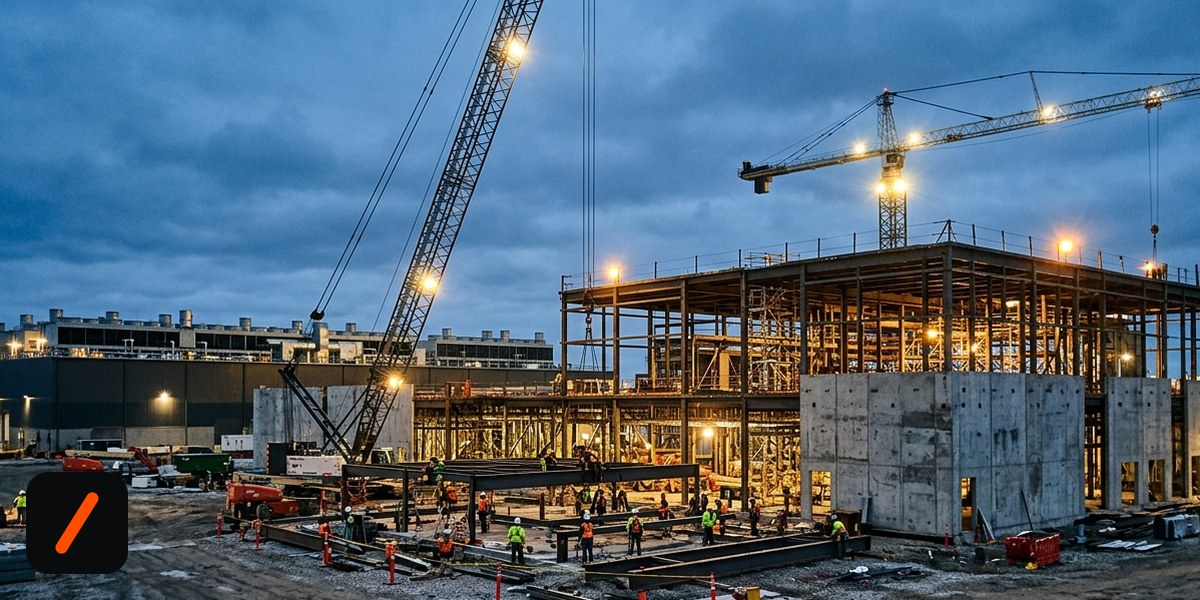
Five companies have committed roughly $1.09 trillion in future lease payments for data centers that have not opened. Microsoft, Meta, Oracle, Amazon and Alphabet disclosed the figures in their Q2 2026 filings, where they sit under a heading most readers skip: leases that have not yet commenced. Against that, the same companies carry about $285 billion of lease liabilities recognized on their balance sheets. The gap is roughly four to one, and it is not an accounting error. It is how lease accounting works.
This is not hidden money. Every number here comes from a public filing. But there is a real difference between an obligation that is disclosed in a footnote and one that appears as a liability on the balance sheet, and right now the overwhelming majority of Big Tech's AI infrastructure commitment lives in the footnote.
RelatedAI Datacenter Debt Isn't Subprime. It's Something Quieter.
How much AI data center lease debt is off the balance sheet?
About $1.09 trillion. That is the combined future lease payments Microsoft, Meta, Oracle, Amazon and Alphabet disclosed in Q2 2026 filings for data centers that have not commenced. Only about $285 billion of lease liabilities sit on their balance sheets, so roughly four dollars of committed rent exist for every one dollar recognized.
Why does a signed lease not count as debt?
Under current lease accounting standards, a lessee recognizes a right-of-use asset and a matching lease liability when the lease commences, meaning when the lessor makes the asset available for use. Sign a fifteen-year lease today on a data center that will be ready in 2028, and until that handover happens you record nothing on the balance sheet. You disclose it, in a footnote, as an uncommenced lease.
That rule is defensible for a company signing an office lease. It behaves very differently when applied to a wave of purpose-built AI data centers with construction timelines of two to four years, signed simultaneously across an entire industry. The commitments are contractual and largely non-cancellable. The accounting simply has not caught up to them yet.
One more distinction worth holding onto: uncommenced lease disclosures are typically undiscounted totals, the raw sum of payments across the term, while recognized lease liabilities are present values. So the four-to-one gap overstates the economic difference somewhat. It does not come close to explaining it away.
Oracle is the outlier, and the tell
Oracle disclosed roughly $260 billion of uncommenced lease commitments against about $37.89 billion of recognized lease liabilities. That is close to a seven-to-one ratio, against an industry average nearer four to one. For a company with Oracle's balance sheet, the asymmetry is the most aggressive posture in the group by a wide margin.
Oracle's cloud business is also the one most dependent on a small number of very large AI customers. That combination, enormous forward lease obligations plus concentrated customer revenue, is the specific structure that turns a demand slowdown into a balance-sheet event rather than a revenue miss. Microsoft's $329.1 billion is a larger absolute number, but it sits against a far larger and more diversified business.
Purchase commitments are the second, larger pile
Leases are only half the picture. Separately from leases, hyperscalers disclose purchase, construction and other commitments, which cover GPUs, servers, power and construction contracts. Alphabet's disclosed purchase commitments reached roughly $811 billion at the end of Q2 2026, including about $200.7 billion in short-term commitments, up from roughly $332.4 billion a quarter earlier. Meta's rose to about $349.3 billion from roughly $238 billion over the same period.
Combine both categories across the group and the total disclosed obligation lands near $1.67 trillion, split roughly between leases and purchase commitments. Alphabet's purchase commitments more than doubling in a single quarter is the number that should get the most attention, because it is the closest thing available to a real-time reading of how fast the buildout is still accelerating.
RelatedOpenAI Is Roughly 70% of Microsoft AI Revenue, Filings Show
| Recognized lease liability | Uncommenced leases | Ratio | |
|---|---|---|---|
| Microsoft | on balance sheet | $329.1B | largest absolute pipeline |
| Meta | on balance sheet | $279.0B (+$68B in July) | fastest additions |
| Oracle | $37.89B | $260.0B | ~7x |
| Amazon | on balance sheet | $137.2B | most diversified revenue base |
| Alphabet | on balance sheet | $85.2B | lease-light, purchase-heavy |
| Group total | ~$285B | ~$1.09T | ~4x |
What does this mean for investors?
The signal is about timing, not solvency. These are the most cash-generative companies in the world and none of them is at risk from a lease schedule. What changes is the shape of their financials over the next three years, and the change is mechanical rather than speculative.
The commitments are expected to commence largely between fiscal 2027 and fiscal 2029, with terms generally running fifteen to nineteen years. As each facility hands over, its lease moves out of the footnote and onto the balance sheet as a right-of-use asset and a liability, and the associated depreciation and interest start hitting the income statement. Free cash flow, already under pressure from capex, absorbs the cash rent on top. The concrete thing to watch is the ratio itself: track uncommenced leases against recognized liabilities each quarter, because that ratio is the closest available proxy for how much cost is still queued up outside the reported numbers.
The scenario that actually matters is a demand shortfall arriving mid-commencement. Data-center leases at this term length are not easily exited, and the obligation lands regardless of whether the AI revenue that justified it materialized. Oracle's concentration makes it the most exposed on that specific risk; Amazon and Alphabet, with the smallest lease pipelines relative to their revenue bases, the least. This is analysis of disclosed exposure, not investment advice.
- The ratio, quarter by quarter. Uncommenced leases divided by recognized lease liabilities is the single most useful number here. Rising means the buildout is still accelerating; falling means commitments are converting to reported cost.
- Alphabet's purchase commitments. Roughly $332B to $811B in one quarter is the steepest move in the group and the clearest live read on buildout pace.
- Oracle's concentration. A ~7x ratio plus a small number of very large AI customers is the group's most fragile structure if demand softens.
- Free cash flow as leases commence. The first quarters where a large tranche hands over will show what the cash rent actually does to reported FCF.
Our take
Calling this hidden debt, as some coverage has, oversells it. Nothing here is concealed. Every figure is in a public filing, and the accounting treatment is standard and correct under the rules as written.
What is genuinely notable is that the standard was designed for a world where lease commencement followed signing by months, not years, and where an industry did not sign a trillion dollars of purpose-built capacity simultaneously. The result is that the single largest capital commitment in the history of the technology industry is currently visible mainly to people who read footnotes. That is a disclosure-quality problem more than an integrity problem, and it resolves itself between 2027 and 2029 as the leases commence. The interesting question is not whether these companies can pay. It is what the reported financials look like when roughly a trillion dollars of obligation finishes migrating from the footnotes to the balance sheet, and whether the AI revenue arrives on the same schedule the leases do.
- FilingSEC EDGAR · 10-Q full-text search the lease and purchase-commitment footnotes these figures come from
- ReferenceFASB ASC 842 · Leases why an uncommenced lease is disclosed rather than recognized
- ReportingBloomberg · data-center lease commitments the per-company uncommenced-lease breakdown
- ReportingDCD · additional data-center lease commitments quarter-over-quarter lease additions
- FundingGENZ TECH Funding Tracker the private-capital side of the same buildout
Original analysis by GenZTech. Figures from Q2 2026 filings, current as of August 2026. Source: SEC EDGAR.