
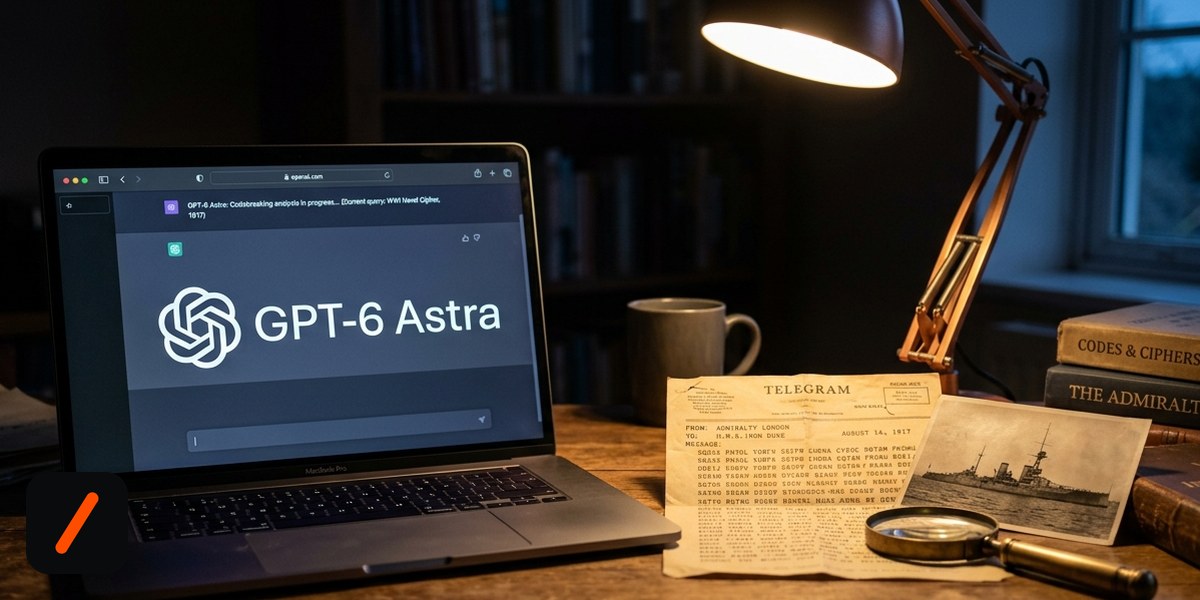
GPT-6 Astra spent part of this week reading a 1935 cryptography book, applying a key it found on pages 214 and 215 to a 170-symbol German radio message from November 27, 1918, and then checking its own answer against Royal Navy ship logs. The result decoded cleanly. Headlines called it "GPT-6 Astra cracks WWI cipher." What actually happened is narrower and, honestly, more interesting: the model didn't recover a hidden key from raw ciphertext the way a wartime codebreaker would. It found a key someone had already published, applied it correctly, and then went looking for corroborating evidence on its own. That's a real skill. It's just a different skill than the headlines describe.
- The cipher is ADFGVX, the transposition-and-substitution system German forces used for WWI radio traffic.
- The key, "TRUPPENVERSCHIEBUNG," was already sitting in J. Rives Childs' 1935 book on German military ciphers, not derived by Astra from the ciphertext alone.
- The recovered plaintext describes the cruiser HMS Canterbury reaching Sevastopol on November 24, 1918, with an Allied squadron following on the 26th.
- Royal Navy records and a British memorandum held at the Australian War Memorial line up with those dates, but no independent cryptographer has reviewed the work yet.
What did GPT-6 Astra actually do?
The person behind the experiment writes under the name "prinz" on a Substack called Prinz AI, and the write-up is refreshingly specific about the mechanics. Astra was pointed at scanned pages from J. Rives Childs' "The History and Principles of German Military Ciphers, 1914-1918," a reference book that has been sitting in libraries since before World War II. Page 217 held one of roughly twenty ADFGVX-enciphered messages from late 1918 that Childs never fully solved. Pages 214 and 215, elsewhere in the same volume, held a 19-letter keyword: TRUPPENVERSCHIEBUNG, German for "troop movement."
RelatedOpenAI's Astra for Law Brings GPT-6 to Am Law 200 Firms
Astra's job was to connect those two things. It reconstructed the columnar transposition using the keyword's alphabetical column order, re-sorted the 170 ciphertext symbols into their original sequence, then ran the recovered ADFGVX coordinate pairs through the standard 6x6 substitution square to produce German plaintext. That plaintext, once translated, describes the English cruiser HMS Canterbury arriving at Sevastopol on November 24 and an Allied squadron following two days later. None of those individual steps require inventing cryptography. What they require is holding a long archival document in context, keeping the bookkeeping straight across a multi-stage decode, and not losing the thread over what amounts to a fairly tedious research task. That's exactly the kind of long-horizon, detail-heavy work GPT-6 Astra's 1.05-million-token context window and cybersecurity-oriented training were built for.
Why does "solved" oversell it?
Because the hard part of classical cryptanalysis is recovering the key when you don't have it. Real ADFGVX-breaking, the kind French cryptanalyst Georges Painvin did against German traffic in 1918, starts from ciphertext alone and works backward through frequency analysis and pattern-matching to guess at a key with no external hints. Astra started with the key already in hand, sitting in a book that's been in print for ninety years. That's a meaningfully easier problem: closer to solving a puzzle when someone hands you the answer key from the back of a different book than to solving it cold. Runtime Wire's write-up on the story puts it plainly: this was "a key-application and validation task rather than independent cipher recovery." The Hacker News thread that picked up the story split roughly the same way, with one commenter asking whether Astra might have simply fabricated a plausible-looking key that happened to match public ship logs, and others pointing out that ADFGVX's structural constraints make that kind of coincidence extremely unlikely once you check the columnar math against the exact ciphertext.
How was the plaintext actually checked?
This is the part that's genuinely solid. Once Astra produced a candidate plaintext naming HMS Canterbury and specific dates, it didn't stop there. It cross-referenced those claims against outside sources: Royal Navy movement records for HMS Canterbury and a British memorandum held at the Australian War Memorial, dated November 24, 1918, that independently documents the same squadron timing. The dates matched. That's real corroborating evidence, and it's a genuinely useful pattern for historical research: an AI system that can decode a document and then go hunt down primary sources to check its own output against, without being told to. What it isn't is a substitute for a cryptographer publishing a reproducible transcript, the intermediate transposition grid, and the substitution table, so someone else can run the same 170 symbols through the same steps and get the same nineteen-letter answer. That hasn't happened yet, which is why outlets covering this story keep pairing the naval-log corroboration with a caveat about independent review.
Does this move the needle for OpenAI?
GPT-6 Astra launched to approved users on September 3 and to general availability the next day, priced at $10 per million input tokens and $50 per million output on the API, with OpenAI calling it a "generational leap" for cybersecurity, science, and software engineering. A viral archival-research demo two weeks later is a low-cost, high-visibility way to keep that framing alive without OpenAI spending anything on it directly. It's the kind of story that gets cited in future model comparisons even though it was produced by an independent blogger, not an OpenAI research team. Anthropic and Google DeepMind have both leaned on similar third-party "look what the model can do" moments to shape perception between major releases, and expect more of them here: OpenAI has no reason to discourage coverage that reinforces "generational leap" language it's already using in its own marketing, and it costs the company nothing to let an outside enthusiast generate that coverage for free.
RelatedOpenAI's GeneBench-Pro Exposes AI's Genomics Judgment Gap
| Claim | How it got framed | What actually happened |
|---|---|---|
| "Cipher solved" | Multiple headlines used "cracked" or "solved" without qualification | Astra applied a transposition key already published in a 1935 reference book |
| "First to solve it" | Framed by some coverage as a historic first | Unverified: no reproducible transcript or third-party cryptography review exists yet |
| "Proven by history" | Treated as a closed, fully confirmed case | Plaintext matches known naval-log dates, which is real corroboration, but a matching narrative isn't the same as an audited proof |
Who is actually behind this, and what's next?
There's no institutional affiliation attached to the experiment. It's one person, publishing under a pseudonym, running a chatbot against scanned book pages and a naval archive. That's worth sitting with, because it means the bar for producing a viral "AI does something historians haven't done" story has dropped to a single afternoon and a ChatGPT Plus, Pro, Business, or Enterprise subscription. The real test of whether GPT-6 Astra (or any model) can meaningfully assist cryptanalysis isn't this message. It's one of the roughly nineteen other ADFGVX-enciphered messages from late 1918 that scienceblogs.de's list of unsolved WWI ciphers still marks as open, where nobody has already published the key in a library book. Point a model at one of those with nothing but the raw ciphertext, and either it produces a plaintext that checks out against independent history, or it doesn't. That experiment hasn't been run publicly yet.
- Nov 27, 1918German radio operators transmit the 170-symbol ADFGVX message.Ship-movement report, Black Sea theater.
- 1935J. Rives Childs publishes the TRUPPENVERSCHIEBUNG key in his cipher history.The message itself stays unsolved in his book.
- Sep 3, 2026OpenAI launches GPT-6 Astra.1.05M-token context, cybersecurity-focused training.
- Mid-Sep 2026"prinz" runs the archive-to-plaintext experiment on Substack.Includes naval-log cross-check.
- Sep 19, 2026Story spreads via Hacker News and X, with skepticism attached.Independent review still pending.
- Reproducible transcripts. Whether "prinz" publishes the full transposition grid and code so cryptographers can rerun the exact 170 symbols independently.
- A cold case. Whether anyone points Astra, or a rival model, at one of the ~19 other unsolved 1918 ADFGVX messages where no key is sitting in a published book.
- OpenAI's response. Whether OpenAI amplifies this as evidence for Astra's "generational leap" claims, given it cost the company nothing to produce.
- Copycat demos. Whether Anthropic or Google DeepMind respond with their own archival or historical-research showcase before the next major model release.
Our take
This is a legitimately cool use of a long-context model, and dismissing it as "just autocomplete with a keyword" undersells the part that's actually new: an AI system that decodes a document and then independently goes and checks its own work against outside primary sources is a workflow worth paying attention to, especially for historians and archivists sitting on piles of undigitized material. But the framing running around social media, that GPT-6 Astra "cracked" or "solved" a WWI cipher, borrows credibility from a much harder problem than the one that was actually attempted. The honest version of this story is narrower and still interesting: a chatbot did competent archival research and showed its work. Judge the next one by whether it can do that without the answer key already sitting in the room.
- OriginalPrinz AI: "GPT-6 Astra Solves a WWI German Radio Cipher" the original write-up and methodology
- DiscussionHacker News thread community verification attempts and skepticism
- AnalysisRuntime Wire: "GPT-6 Astra might have cracked a World War I radio cipher" the key-application vs. independent-recovery distinction
- LaunchCNBC: OpenAI announces rollout of GPT-6 Astra model official launch date, pricing, and positioning
- ReferenceADFGVX cipher background on the cipher system itself
Original analysis by GenZTech Team, based on the sources cited above.