
$1.37 billion, at a $7.87 billion post-money valuation, for a company that machines metal parts. Hadrian announced its Series D on August 6, and the size of it is the story: this is late-stage software money going into a business whose output is aluminum and titanium components for rockets and munitions.
The round was co-led by WCM Investment Management, Washington Harbour Partners, Valor Equity Partners, 137 Ventures and Baillie Gifford, with JPMorganChase's Strategic Investment Group anchoring through its Security and Resiliency Initiative. The participant list runs through most of the names you would expect on a hot AI round: Andreessen Horowitz, Founders Fund, Lux Capital, CapitalG, Altimeter, Construct Capital, 1789 Capital, Apollo funds, T. Rowe Price accounts and Morgan Stanley Wealth Management.
RelatedLovable raises $400M at $13.3B, doubling in eight months
What Hadrian actually sells
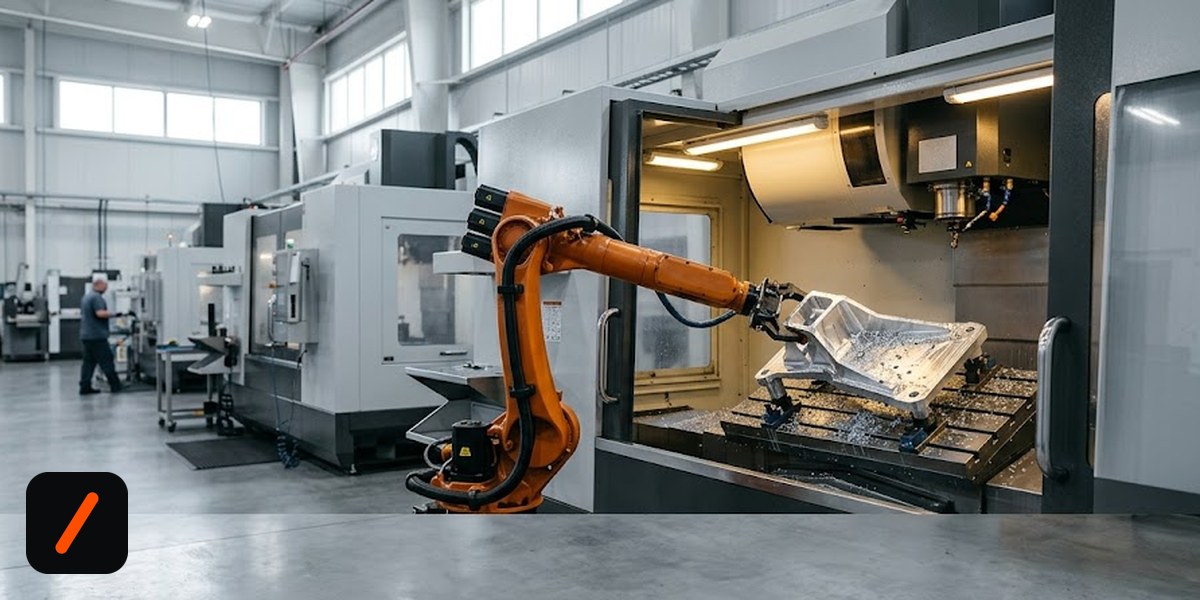
Founder and CEO Chris Power's pitch is Factories-as-a-Service. Aerospace and defense primes have a chronic problem: the machine shops that make their precision parts are small, aging, individually owned, and cannot scale on demand. Hadrian's answer is to build highly automated factories that customers can call on for capacity, rather than qualifying and babysitting dozens of suppliers.
The automation layer is what justifies the multiple. Hadrian pairs robotics with AI-driven tooling and real-time manufacturing intelligence, aiming at the part of precision machining that normally requires a scarce, highly experienced machinist per station. If that works, the constraint on defense production stops being how many skilled people you can hire and becomes how fast you can pour concrete.
The footprint today is four sites and just under three million square feet: two in Torrance, California, plus newer plants in Mesa, Arizona and Muscle Shoals, Alabama, both opened within the past year.
Why now?
Because the Pentagon spent the last two years discovering that its munitions and autonomous systems supply chains cannot surge. That is not a secret, it is the explicit rationale in Hadrian's own framing. Power's line in the announcement is blunt: "Production is now the frontline of deterrence. America's ability to lead will depend on whether we can build, train, and scale faster."
The proceeds go to new factories, expanded R&D, dedicated munitions and autonomous systems production lines, and workforce hiring and training. The training piece is not a footnote. A company betting that automation solves the machinist shortage is also, simultaneously, funding programs to produce machinists, which is a reasonable hedge and a quiet admission that the automation is not total.
Who is exposed to this?
There is no ticker to trade here, but there are readable signals. JPMorganChase anchoring through a Security and Resiliency Initiative rather than a growth fund tells you large financial institutions are now treating industrial capacity as a strategic category with its own mandate, not as one more industrials allocation. When Baillie Gifford and T. Rowe Price accounts show up at a $7.87 billion private valuation, they are marking a path to public markets.
The pressure lands on the traditional primes. Lockheed, RTX, Northrop and General Dynamics do not lose contracts to Hadrian, they buy from companies like it, or they explain to a customer why their own supply base is slower. The competitive read is closer to Anduril's: a venture-funded entrant that reframes a procurement problem the incumbents have described as structural.
RelatedFireworks AI Raises $1.5B Series D at $17.5B Valuation
The other exposure is the one nobody prices. Four billion-dollar-plus rounds closed in a single week, and every one above $500 million funded physical capacity: chips, power, nuclear, optics, factories. Capital that spent a decade preferring assets with no marginal cost has rotated hard into assets with enormous ones. We track where those rounds land in our funding tracker, and the contrast with the software-era comparison set in our biggest AI rounds ranking is getting sharp.
| Site | Status | Role |
|---|---|---|
| Torrance, CA | Two sites, established | Original operations and R&D base |
| Mesa, AZ | Opened within past year | Capacity expansion |
| Muscle Shoals, AL | Opened within past year | Capacity expansion |
| Total | ~3M sq ft across 4 sites | Target of this round: more of the same |
Our take
The thing to be skeptical about is not the demand. Defense demand for precision parts is as close to guaranteed as any market gets right now. It is the automation claim, because that is what separates a $7.87 billion valuation from a well-run contract manufacturer worth a fraction of it.
Precision machining has resisted automation for decades for unromantic reasons: fixturing, tool wear, thermal drift, and the fact that a skilled machinist makes hundreds of small judgment calls that are hard to specify. Plenty of companies have promised to systematize that. Hadrian has now raised enough to actually find out, across three million square feet, which is a real test rather than a demo.
What would make us more confident is throughput data. Parts per month per square foot, first-pass yield, and how many humans are on the floor. None of that is public, and at this valuation it is the only number that matters. Until it is, the round is a bet on a thesis that has been correct in aggregate, that America under-built manufacturing capacity, and unproven in the specific, that this company's software makes the machining part fundamentally cheaper.
- A named prime contract. Hadrian talks in terms of capacity and customers, not programs. A disclosed contract with a prime or a program office would convert the thesis into revenue you can size.
- Site five. The round is explicitly for new factories. Where the next one lands, and how fast it reaches production, is the cleanest read on whether the playbook is repeatable.
- Headcount per square foot. If the workforce grows in proportion to floor space, the automation is assistive rather than transformative, and the multiple is hard to defend.
- Whether the rotation holds. Four billion-dollar hard-tech rounds in one week is either a new baseline or a top. Check back in a quarter.
- FundingHadrian Raises $1.37B Series D , company announcement via PR Newswire, 2026-08-06
- OfficialHadrian , Factories-as-a-Service and site footprint
- ReferenceWilson Sonsini advises Hadrian on $1.37 billion Series D , deal counsel confirmation of terms
- FundingThe Week's 10 Biggest Funding Rounds , Crunchbase News, comparison set for Aug 1-7
- TrackerGenZTech Funding Tracker , our running record of confirmed rounds
Original analysis by GenZTech. Round details from Hadrian's announcement.