
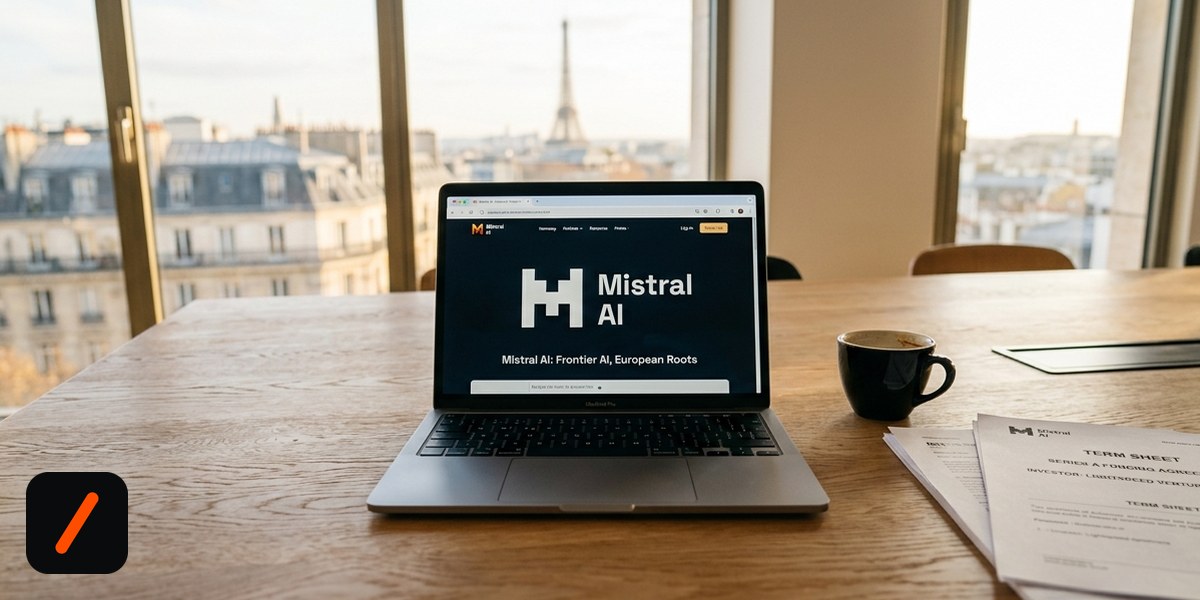
Mistral AI announced a €3 billion Series D on the morning of September 8, 2026, pushing its valuation past €21 billion in what the Paris startup calls the largest all-equity round any European technology company has ever closed. Samsung Electronics led the round, and the money is earmarked for the data centers and compute Mistral needs to keep selling what it calls "sovereign AI": models, infrastructure and hardware that a government or company can run without handing control to a foreign hyperscaler.
- Mistral raised €3 billion (roughly $3.5 billion) in a Series D that values the company at more than €21 billion, nearly double the €11.7 billion price tag it carried a year earlier.
- Samsung Electronics led the round, co-leading with Scaleup Europe Fund (managed by EQT) and existing investor PSG Equity; Advent, funds managed by BlackRock, and the Grand Duchy of Luxembourg joined as new backers.
- It's Mistral's fifth raise in three years and, by the company's own account, the largest equity round any European tech company has closed, full stop, not just among AI startups.
- CEO Arthur Mensch says the funding builds out Mistral's own data centers, part of a push toward 200 megawatts of European compute capacity the company wants live by the end of 2027.
What did Mistral actually announce?
Mistral confirmed a €3 billion Series D on its own blog the morning of September 8, at a post-money valuation of more than €21 billion. Samsung Electronics led the round, joined as co-lead by Scaleup Europe Fund, a vehicle managed by EQT, and by existing investor PSG Equity. Advent, funds and accounts managed by BlackRock, and the Grand Duchy of Luxembourg came in as new investors, alongside more than twenty returning backers including a16z, ASML, DST Global, General Catalyst, Index Ventures, Nvidia and Salesforce Ventures. Mistral says the round is the largest all-equity fundraise any European technology company has closed, not just the largest for an AI startup, three years after it launched.
RelatedPixxel Raises $100M in India's Largest Spacetech Round
How does this round compare to Mistral's past raises?
Mistral has closed five rounds since mid-2023, and the valuation curve tells its own story: a $260 million seed, a roughly $2 billion Series A the same year, a €600 million Series B in June 2024 at a $6 billion valuation, then €1.7 billion at €11.7 billion in September 2025. It nearly doubled that in twelve months, a faster climb than most enterprise-software startups manage over their entire lifecycle.
- Mid-2023Seed round $113M led by Lightspeed, $260M valuation
- Late 2023Series A $415M led by a16z, ~$2B valuation
- Jun 2024Series B €600M led by General Catalyst, $6B valuation
- Sep 2025Series C €1.7B led by ASML, €11.7B valuation
- Sep 8, 2026Series D €3B led by Samsung, €21B+ valuation
Why is a South Korean chipmaker leading a French AI startup's round?
Samsung Venture Investment Corporation has actually been in Mistral's cap table since the Series B, but leading the round outright is a bigger commitment. Samsung sells the memory chips every AI data center burns through, and putting money into a lab about to spend heavily on its own European compute buildout is as much a customer relationship as an investment. ASML, which led last year's Series C, sells the lithography gear behind advanced chip production; Nvidia has been in every round since the Series B. Read together, Mistral's cap table looks less like a typical venture syndicate and more like a list of the companies that build the hardware AI runs on, betting that a credible non-American, non-Chinese lab is worth owning a piece of.
What is "sovereign AI," and why does Mistral bet the whole company on it?
Mistral's own framing, repeated in its funding announcement, is that organizations used to ask how to adopt AI at all; now they ask how to use it without surrendering control of their infrastructure to somebody else. Its answer is to build the full stack itself: open-weight models a customer can inspect and fine-tune, infrastructure that can sit on-premise or inside an EU cloud, and dedicated compute rather than a shared queue on someone else's GPUs. That claim is the whole reason a chipmaker and an EU-backed growth fund would rather own equity than just buy API credits, and why Mistral keeps releasing open weights instead of locking everything behind an API the way OpenAI and Anthropic mostly do. A government client that can't audit the weights it's running isn't actually sovereign over anything.
What it means for the AI funding market
Set against the two labs actually running the AI race, the number looks small. Anthropic priced its most recent round near $965 billion in valuation in May, and OpenAI sat around $852 billion after a $122 billion raise in March. Mistral's €21 billion is roughly 2 to 3 percent of either figure. The signal isn't that Mistral is catching up on scale; it's that a distinct, non-US, non-China AI champion is valuable enough on its own terms that a chipmaker, a European growth fund and Luxembourg's government all wanted into this specific round. That's a data point worth adding next to the other megarounds piling up this year: Prometheus at $12 billion, DeepSeek at $7 billion, Anthropic and Safe Superintelligence tied at $5 billion apiece. Our Funding Tracker and ranked Biggest AI Funding Rounds page both add this round now that it's confirmed.
RelatedWonderful's $550M Series C Doubles Valuation to $5B
| Company | Round | Valuation | Sector |
|---|---|---|---|
| Mistral AI | €3B Series D | €21B+ | Sovereign AI / open-weight models |
| Prometheus | Growth | Undisclosed | AI infrastructure |
| DeepSeek | Growth | Undisclosed | Frontier research |
| Anthropic | Corporate/strategic | ~$5B round size | Frontier AI (Claude) |
| Safe Superintelligence | Growth | ~$5B round size | Frontier research, no product |
What happens next for Mistral?
Mensch says the new capital funds Mistral's own data centers, on top of the 200 megawatts of European compute capacity it wants live by the end of 2027 and the $830 million debt facility it lined up in March from a seven-bank consortium for a Paris cluster. There's no IPO on the table; Mensch has talked about 2027 in terms of growth, not a listing. Expect the near-term story to be government and enterprise deals that trade on the sovereignty pitch specifically: defense ministries, banks and public administrations in Europe and the Gulf that can't or won't run their AI on a US hyperscaler's terms.
- The 200MW buildout. Mistral's sovereignty pitch only holds if the compute actually lands on schedule; slippage here undercuts the whole thesis.
- Government contract wins. Watch for defense, banking, or public-sector deals in Europe and the Gulf that name Mistral specifically over a US alternative.
- Samsung's role beyond capital. Whether the relationship turns into a memory or compute supply deal, not just a board seat, is the tell that this was a strategic bet, not a financial one.
- Whether rivals answer with their own "sovereign" framing. If Cohere, Aleph Alpha, or a Gulf-backed lab starts using the same language, it becomes a category, not just Mistral's pitch.
Our take
The interesting thing here isn't the size of the check, it's who signed it. A memory chipmaker, a European infrastructure fund, and a national government all chose to buy equity in an AI lab rather than just buy its output, which only makes sense if you believe the compute and sovereignty story is the actual product, not the model weights. Mistral is betting that "we'll build your AI so a foreign company never gets to turn it off" is a pitch big institutions will pay a premium for, and this round is the first hard evidence that a meaningful slice of European industrial capital agrees. Whether that's worth €21 billion depends entirely on the 200 megawatts actually getting built on schedule; announcements are cheap, data centers are not.
- OfficialMistral AI Series D announcement round size, investors, valuation, strategic framing
- ReferenceBloomberg: Mistral AI raises at €21 billion valuation independent confirmation, CEO comments
- FundingGenZTech Funding Tracker running record of confirmed AI funding rounds we've covered
Original analysis by GenZTech, based on Mistral's official announcement and independent reporting. Source