
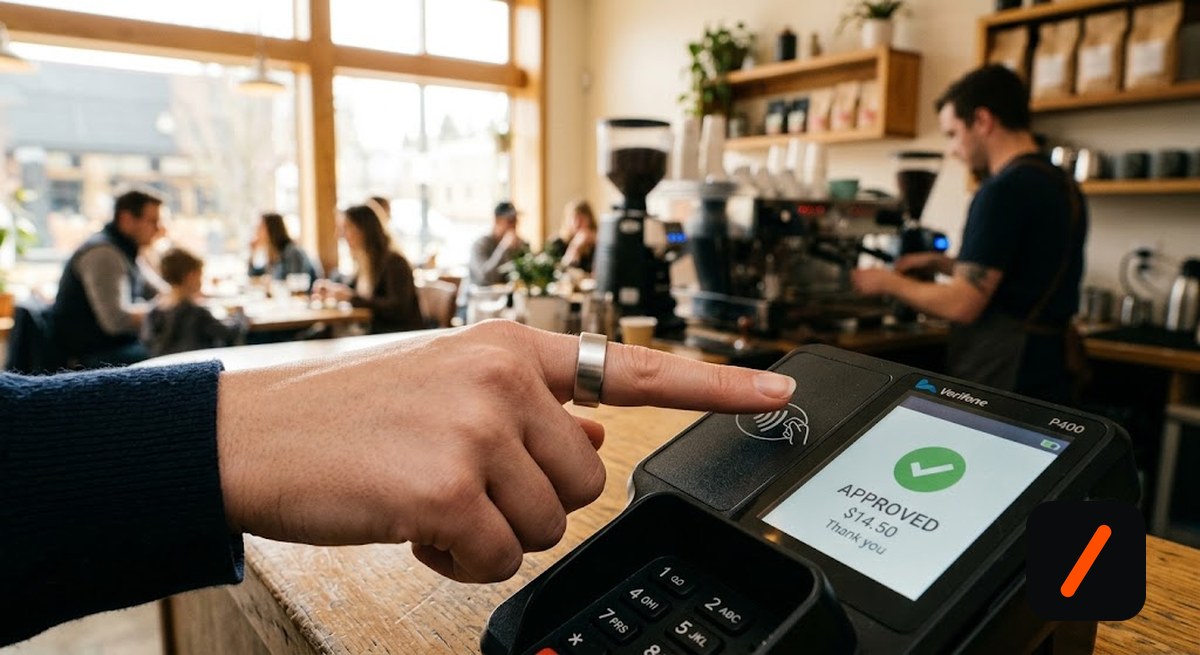
Inter announced the US launch of the Inter Ring and Inter Wristband on July 13, contactless payment accessories that carry no screen, no battery and no requirement to have a phone in your pocket. The company, a fintech serving more than 44 million customers worldwide and listed on the Nasdaq as INTR, is initially shipping to a limited group of select customers with a broader rollout later in 2026. The interesting engineering decision here is not the hardware. It is that the ring is not an account.
- Two devices: the Inter Ring (gold, silver, rose, black, gray) and the Inter Wristband, both contactless payment accessories with no screen and no battery.
- They extend an existing Inter credit card rather than being separate products: same credit limit, same due date, one statement across card, ring and wristband.
- Transactions use tokenization and encryption consistent with contactless payment standards, and certain purchases still require a PIN.
- Availability is limited at launch to select Inter customers, broader rollout later in 2026.
What did Inter actually ship?
Two accessories. The Inter Ring comes in gold, silver, rose, black and gray. The Inter Wristband is the same idea in a different form factor. Both bring contactless payment capability through what the company describes as industry-standard security technology, to accessories customers already wear, without requiring a screen, a battery, or a phone in hand.
RelatedNothing Launches the Phone (4b) and Ear (3a) Together
Availability is deliberately narrow at launch: a limited group of select Inter customers, with broader rollout later in 2026. Inter (Inter&Co Inc., Nasdaq: INTR) is a global fintech providing banking, credit, investments, payments and lifestyle services to more than 44 million customers, so this is a large institution testing a small product rather than a hardware startup betting the company.
Why does no battery matter?
Because it removes the failure mode that kills wearable payments. A smart ring with a battery is a device you charge, a device that dies, and a device whose battery degrades until the ring is e-waste you cannot open. A payment ring with no battery is a passive NFC target: the terminal's own field induces enough current in the ring's antenna to wake the chip, run the transaction and go back to sleep. Nothing to charge, nothing to degrade, nothing to fail in a checkout line.
That is the same physics behind a contactless card, which is exactly the point. Inter is not building a computer for your finger. It is repackaging the card's secure element into jewelry. The tradeoff is real and worth stating: no battery means no screen, no notifications, no transaction history on the device, no way to see a balance. The ring cannot tell you anything. It can only prove who you are.
What is the actual design insight?
The account structure, and it is easy to skim past. Payments made through the Inter Ring or Wristband are an extension of the customer's existing Inter credit card. Same limit. Same due date. Purchases from all three surfaces appear on a single statement.
That sounds like a detail and it is the whole product. The failure pattern for payment wearables has been treating the wearable as its own thing: a separate balance to top up, a separate app, a separate line item to reconcile. Every one of those is a reason to leave the ring in a drawer. By making the ring a surface on an account the customer already has, Inter reduces the cognitive cost of adopting it to approximately zero. There is nothing to manage. It is your card, in a different shape.
The security model follows the same logic. Transactions use tokenization and encryption consistent with contactless payment standards, meaning the ring transmits a token rather than the card number, and certain purchases still require a PIN. That is the existing card rails, not a new trust model, which is the correct call for a bank shipping jewelry.
RelatedApple Will Lease You an iPhone and Klarna Is Funding It
| Inter Ring | Smart ring (Oura-class) | Smartwatch payments | Contactless card | |
|---|---|---|---|---|
| Battery | None | Yes, days | Yes, daily-ish | None |
| Screen | None | None | Yes | None |
| Phone required | No | For data | For setup | No |
| Separate account | No, extends your card | n/a | Varies by wallet | It is the account |
| Can show balance | No | No | Yes | No |
| Fails when | Physically damaged | Battery dies or degrades | Battery dies | Physically damaged |
| Replacement cost | New ring | New ring | New watch | Free reissue |
Who is this for, and what breaks?
The honest use case is narrow and real: situations where you do not want to carry a phone or a wallet. Running, the gym, the beach, a festival, a commute where you are already tapping a gate. That is a genuine gap, and the phone-free framing is the whole pitch.
The problems are equally concrete. Sizing is the obvious one: a ring is a physical object that has to fit, and fingers change size with temperature, exercise and time of year, which is a fitting and returns problem no software update solves. Loss is the second: a lost ring is a live payment credential, and while it needs your hand near a terminal to do anything, the recovery path is a new ring rather than a free card reissue. And the ring cannot tell you it worked. There is no screen, so the only confirmation is the terminal's beep and whatever your phone tells you later, which is a small trust cost repeated at every transaction.
- Whether the broader rollout actually lands. Limited-release fintech hardware has a long history of quietly never expanding. The 2026 rollout is the real test.
- Sizing and returns. This is the operational problem that decides whether a bank wants to keep selling jewelry.
- Whether rivals copy the account structure. The one-account, three-surfaces model is the reusable idea here, not the ring.
- Attachment rate. If existing Inter cardholders adopt at any meaningful rate, expect the larger US issuers to move within a year.
Our take
The tech press will read this as a smart ring story and it is not one. There is no sensor, no app, no health data, no battery and no screen. It is a contactless card in a shape you already wear, and that restraint is why it might work where more ambitious wearables did not. The category graveyard is full of payment wearables that tried to be a second device with a second balance and a second app, and every one of those decisions added a reason not to bother.
What Inter got right is the boring part: same limit, same due date, one statement. Nothing to manage means nothing to abandon. What remains unproven is whether anyone actually wants this enough to deal with ring sizing, and whether a limited launch to select customers ever becomes a real product. Banks pilot hardware constantly and ship it rarely. The idea is sound. The follow-through is the open question, and the 2026 rollout is where we find out.
- OfficialInter: Launches Wearables in the U.S., Taking Banking Beyond the Phone the company announcement, device list and account structure
- ReferenceEMVCo the tokenization and contactless standards this rides on
Original analysis by GenZTech. Product detail from Inter's July 13 announcement. Availability is limited at launch and subject to change.