
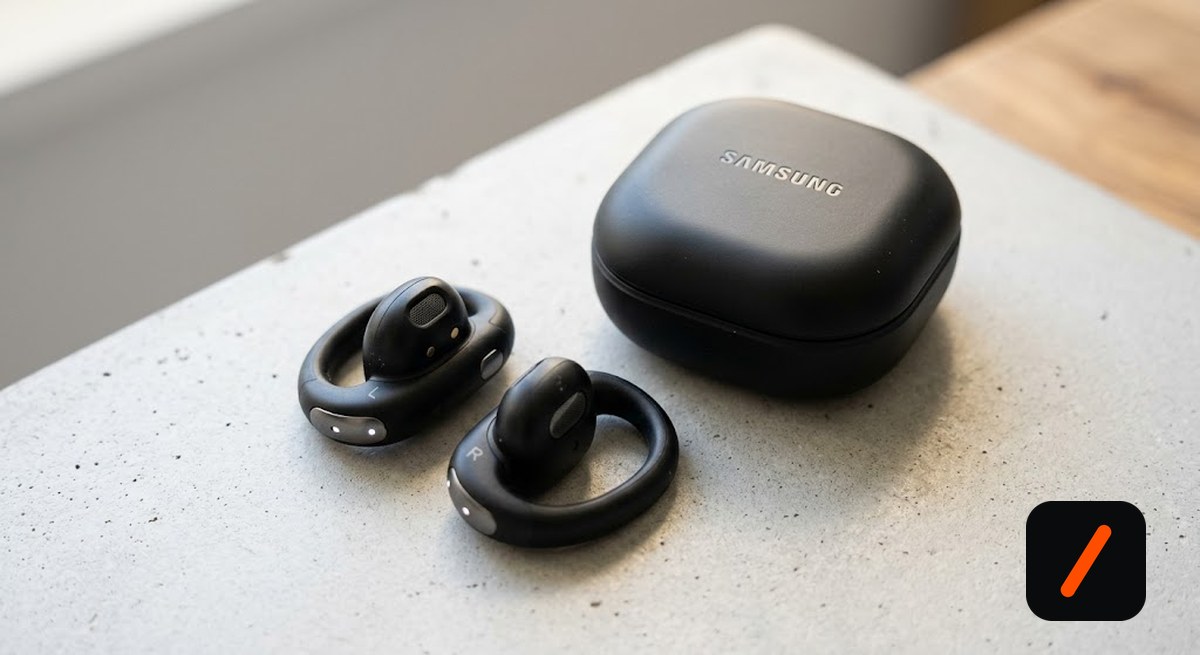
Samsung is preparing its first clip-on wireless earbuds, revealed as the Galaxy Able in its own Galaxy Wearable app, and they reportedly use bone conduction to deliver sound while leaving the ear canal fully open. It is Samsung's clearest move yet into the fast-growing open-ear category, though reports suggest the launch has been delayed more than once and may not make the July 22 Galaxy Unpacked stage after all.
- A new form factor for Samsung. Galaxy Able is a clip-on, open-ear design, a departure from the in-canal Galaxy Buds line.
- Bone conduction is the twist. Reports say it reproduces sound through bone conduction rather than sealing the ear, prioritizing awareness and comfort.
- The name is confirmed in software. Earlier rumors said "Galaxy Buds Able," but the Wearable app lists the final name as simply Galaxy Able.
- Timing is uncertain. A July 22 Unpacked reveal looks unlikely per reports of repeated delays, even as the Fold, Flip, and Watch lineup is set.
What is the Galaxy Able?
It is Samsung's first clip-on wireless earbud, a form factor that hooks onto the outer ear rather than plugging into the canal. Samsung effectively confirmed the product by listing its name, Galaxy Able, in the Galaxy Wearable app, correcting the earlier rumored "Galaxy Buds Able." The most notable reported detail is the audio method: rather than firing sound into a sealed canal like traditional earbuds, Galaxy Able is said to use bone conduction, transmitting vibrations through bone to the inner ear while leaving the ear itself open to the world.
RelatedGalaxy Z Flip 8 Grows Its Cover Screen and Adds Qi2 Charging
Why go open-ear and bone conduction?
Because comfort and awareness are the fastest-growing wants in personal audio. Open-ear designs let you hear your surroundings, traffic, colleagues, announcements, while still getting audio, which suits running, cycling, and long workdays where sealing your ears is either unsafe or exhausting. Bone conduction takes that further by not covering the ear canal at all. The trade-off is real: open-ear and bone-conduction audio typically deliver weaker bass and no meaningful noise cancellation. Samsung is betting a sizable group of users will happily accept that in exchange for all-day comfort and situational awareness.
How does it fit Samsung's lineup?
It broadens the Galaxy audio family beyond the in-canal Buds line, giving Samsung an entry in the open-ear category where rivals have been active. Positioned alongside the Galaxy Unpacked hardware, foldables like the Z Fold 8 and Flip 8 and the Galaxy Watch 9 and Watch Ultra 2, Galaxy Able would round out the wearables story with a distinct third audio option. The catch is timing: reporting suggests the earbuds have slipped multiple times, and a July 22 Unpacked debut now looks unlikely, so the reveal may come later in the year.
Who is it for?
Runners, cyclists, and commuters who want to stay aware of their surroundings; office workers who dislike the plugged-up feeling of sealed buds over long stretches; and anyone who finds in-canal tips uncomfortable. It is explicitly not for bass-heads or frequent flyers who prize noise cancellation. If Samsung nails fit, battery life, and call quality, Galaxy Able could become the default "aware" earbud for the Galaxy ecosystem, much as clip-on and open-ear rivals have found a loyal niche.
RelatedSamsung's Galaxy Z Fold 8 Goes Passport-Shaped July 22
How does it stack up against open-ear rivals?
The open-ear category is no longer empty. Clip-on and bone-conduction earbuds from specialist brands and larger rivals have established what buyers expect: secure all-day fit, enough volume and clarity for calls and podcasts, and battery life that survives a workday. Samsung's advantages are ecosystem and scale, seamless pairing with Galaxy phones and watches, Find integration, and mass retail reach, which can turn a niche form factor into a default for existing Galaxy owners. Its challenge is proving the audio holds up: bone conduction and open designs have historically traded away bass and isolation, and reviewers will judge Galaxy Able against rivals that have iterated on exactly those weaknesses for years. If Samsung matches them on comfort and call quality while leaning on its ecosystem, it can win the segment among its own users even without leading on pure sound.
Our take
Open-ear is one of the few genuinely growing segments in a saturated earbud market, so Samsung entering it makes sense, and bone conduction gives Galaxy Able a differentiator rather than a me-too clip-on. The risk is expectation management: buyers conditioned by Galaxy Buds will notice the thinner bass and missing ANC, so Samsung needs to market this as a different tool, not a downgrade. The repeated delays are the bigger worry, hinting the product is not fully baked. If it ships polished, it is a smart lineup expansion; if it ships rushed, the open-ear promise could sour on first listen.
- OfficialSamsung Newsroom
- ReportingSamMobile — Galaxy Able reporting
- ReferenceSamsung — Galaxy Unpacked
Original analysis by GenZTech. Details current as of July 2026, based on Galaxy Wearable app listings and reporting via SamMobile. Specs and timing are not final.