
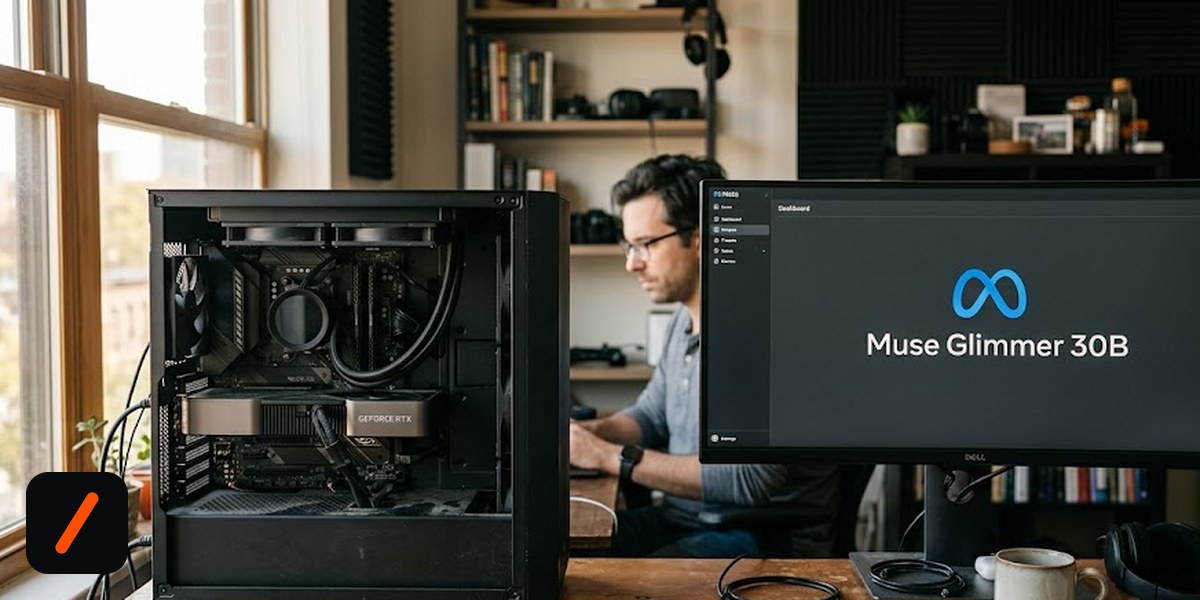
Meta published downloadable weights for Muse Glimmer this morning, a 30-billion-parameter agentic model built to run locally on one consumer GPU, released under a plain Apache 2.0 license. The license is the part worth pausing on. Meta's previous open releases shipped under bespoke source-available terms with user-count thresholds attached, and the entire Muse line has been API-only until today.
Buried one line deeper in the announcement is the bigger story. Both Mark Zuckerberg and Meta Superintelligence Labs lead Alexandr Wang confirmed that an open-weight version of Muse Spark 1.2, the company's flagship coding model, lands in the coming weeks. That is a different order of release, and our own leaderboard data says something about it that most of today's coverage is missing.
RelatedCohere Ships North Mini Code, a 30B Coder for One H100
- Muse Glimmer is a 30B dense model under Apache 2.0, on Hugging Face now, quantized so the weights sit under 20 GB and the whole runtime fits a 24 GB card.
- Meta published no SWE-bench Verified score for Glimmer. It benchmarked against Gemma4-31B and Qwen3.6-27B instead, so Glimmer enters our leaderboard unranked.
- Muse Spark 1.2 measures 86.6% on SWE-bench Verified independently. Opened, it would be the third-strongest downloadable coder we track, not the first.
- Every open-weight model ranked above it on our board comes from a Chinese lab: Kimi K3 at 93.4% and DeepSeek V4 Flash at 88.8%.
What exactly did Meta ship?
Glimmer is a dense 30B model trained by logit distillation from Muse Spark as the teacher, across pre-training, mid-training and post-training stages. It is multimodal by way of a dedicated perception encoder, handles more than 100 languages, and is aimed squarely at agent work rather than chat: end-to-end task completion, tool calling, multi-step reasoning, recovery after a failed step, and controllable effort levels. Meta says it is compatible with the OpenClaw scaffold, which matters because a local model that cannot slot into an existing agent harness is a demo, not a tool.
Distribution is unusually broad for a launch-day release. The weights are on Hugging Face, with day-one support across Ollama, LM Studio and Unsloth, edge runtimes llama.cpp, ExecuTorch and MLX, serving stacks vLLM and SGLang, and hosted endpoints at Together AI, Fireworks AI and OpenRouter. Meta clearly wanted this running everywhere by lunchtime.
Why is 24 GB the number that matters?
At full bf16 precision Glimmer wants north of 55 GB, which puts it out of reach of every consumer card on the market. Meta's shipped quantization compresses the weights to roughly 4-bit precision, dropping the language model under 20 GB. The remaining headroom inside a 24 GB or 32 GB envelope is not spare change, it is spoken for: the KV cache, the perception encoder that handles image input, and the drafter model used for speculative decoding all have to be resident at the same time.
That budget is the whole design. An always-on local agent has a harsher constraint than a chatbot you open occasionally, because it has to hold residency while you are also using the machine for the work it is helping with. Meta pairs the quantization with a speculative decoding scheme it calls DFlash, reporting 3.1x faster generation on an RTX 5090, 1.8x on an M5 Max and 1.5x on an M4 Max. Those are the machines this is for.
Where does this land against the open-weight field?
Here is where our own data disagrees with the framing you will read elsewhere today. Meta returning to open weights is genuinely significant, but it is not Meta reclaiming a lead. On the GenZTech AI coding leaderboard, which ranks on independently measured SWE-bench Verified scores rather than vendor claims, the downloadable models at the top are all from Chinese labs.
Kimi K3 sits at 93.4% and DeepSeek V4 Flash at 88.8%. If Meta ships Spark 1.2 weights at its measured 86.6%, it arrives third in that group. Useful, competitive, and not the top. Glimmer itself cannot be placed at all yet, because Meta published no SWE-bench figure for it and benchmarked against size-class peers instead.
| Muse Glimmer | Gemma4-31B | Qwen3.6-27B | |
|---|---|---|---|
| Maker | Meta | Alibaba | |
| Parameters | 30B dense | 31B | 27B |
| License | Apache 2.0 | Gemma terms | Apache 2.0 |
| Built for | Always-on local agents | General assistant | General assistant |
| SWE-bench Verified | Not published | Not published | Not published |
What happens when Muse Spark 1.2 opens?
Spark 1.2 is already a known quantity on our board at rank 9, measured at 86.6% by vals.ai on August 6, an exact tie with Grok 4.5. Its weakness is long work: 64% on the one-to-four-hour task tier against 90% for Claude Opus 5, while short bounded tasks reach 92%. A downloadable model with that profile is genuinely useful for teams who want a capable coder inside their own network without paying per token or shipping code to an API.
One thing Meta has not said is what license Spark 1.2 weights carry. Apache 2.0 on Glimmer is a real commitment, but it is also the easier one to make on a smaller model. Recent history says read the terms before celebrating: Kimi K3 shipped under a bespoke Moonshot license with revenue and user thresholds attached rather than Apache, and it shipped 4-bit only with no base checkpoint, which makes it open for inference rather than open for training. Until the Spark 1.2 files actually land, the promise is a roadmap item.
RelatedGemini 3.7 Flash Ships at Half Price, 3.5 Pro Still Missing
- Jul 8, 2026Meta launches Muse image model API only
- Jul 9, 2026Muse Spark 1.1 coding model ships 82.0% measured
- Aug 6, 2026Muse Spark 1.2 plus Muse Code CLI 86.6%, closed weights
- Aug 10, 2026Muse Glimmer 30B weights open Apache 2.0
- Coming weeksMuse Spark 1.2 open weights License unstated
Who should actually care today?
If you run a 24 GB or 32 GB machine and have wanted a local agent that does more than autocomplete, Glimmer is worth an evening. It is on Ollama and LM Studio already, so trying it costs a download rather than a migration. The absence of a SWE-bench number is a reason to test it on your own repository instead of trusting a launch post, which is what you should be doing regardless.
If you are running a team on API models, today changes nothing yet. The release that matters to you is Spark 1.2, and it has not shipped. Watch the license terms and whether Meta publishes a base checkpoint or inference-only quantized weights, because that difference decides whether anyone can fine-tune on it.
- The Spark 1.2 license. Apache 2.0 would be the real headline. Anything with revenue or user-count thresholds is a weaker claim than today's announcement implies.
- An independent Glimmer score. vals.ai has not evaluated it. Until it does, every performance claim in circulation is Meta's own.
- Base checkpoint or not. Quantized inference-only weights, as with Kimi K3, would mean nobody can meaningfully fine-tune Spark 1.2.
- Whether the field responds. Moonshot and DeepSeek currently hold the top of the downloadable board, and neither has a reason to concede it quietly.
Our take
The Apache 2.0 license on Glimmer is the most interesting thing Meta did today, more than the model itself. A permissive license on a 30B model that runs on hardware people already own removes most of the friction that made previous Meta releases awkward to build on commercially.
What we would push back on is the framing that Meta is leading an open-weights revival. Our leaderboard says the strongest downloadable coders right now come from Moonshot and DeepSeek, and even an opened Spark 1.2 slots in behind both of them. Meta is rejoining a race that moved on while the Muse line stayed closed. Rejoining it with a permissive license and a model that fits a gaming GPU is a good way to do it, but the scoreboard is the scoreboard.
- OfficialMeta AI Research: Introducing Muse Glimmer , launch post, Aug 10, 2026
- OfficialAI at Meta: Apache 2.0 release thread , license and hardware targets
- OfficialAlexandr Wang on the Muse Spark 1.2 open-weight plan , MSL lead confirming what follows
- Benchmarkvals.ai SWE-bench Verified , the independent harness behind Fig 2
- ReferenceGenZTech AI coding leaderboard , our ranked board, open and closed
Original analysis by GenZTech. Primary reporting from Meta AI Research.