
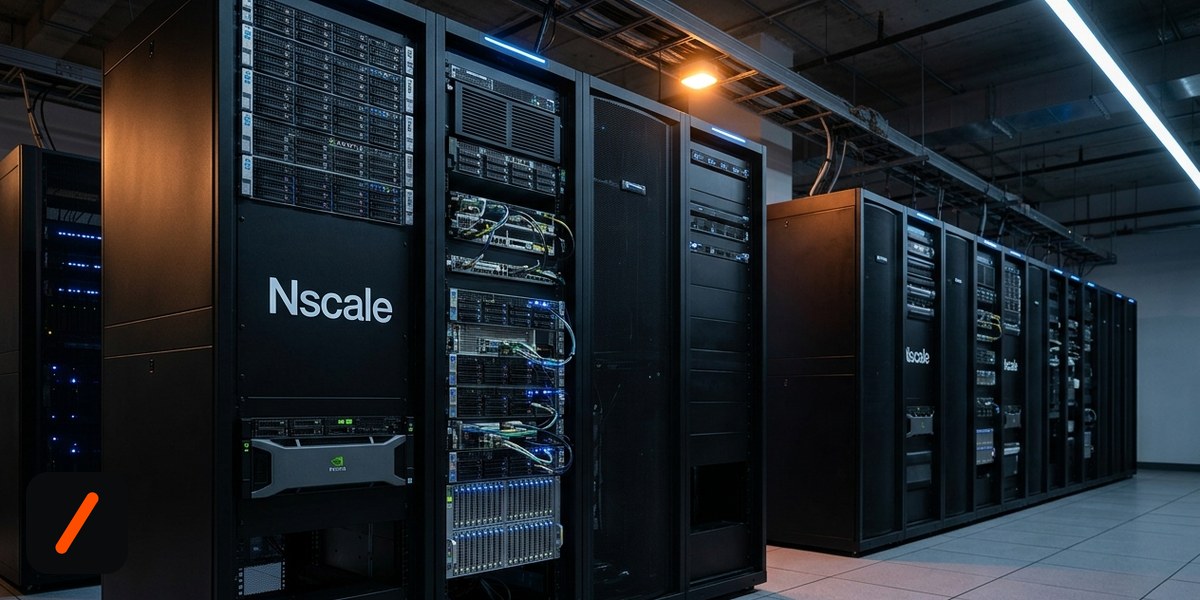
Nscale, the London-based AI cloud company, filed a Form S-1 with the SEC on September 18, 2026, to list on the New York Stock Exchange under the ticker NSCL. The gap in the numbers is the whole story: $140.6 million in revenue for the first half of 2026, next to $103.4 billion in active and contracted total contract value. Not a typo. It is the defining tension of the neocloud IPO wave, and Nscale's paperwork is the most detailed look yet at how these companies justify it.
What exactly did Nscale file?
The S-1 was filed by Nscale plc, incorporated in England and Wales, sitting above the existing operating businesses, Arkon Energy and Nscale Global Holdings, once the pre-IPO reorganization completes. Nscale is registering as an emerging growth company, trimming some disclosure burden. Goldman Sachs, J.P. Morgan and Morgan Stanley are lead bookrunners. Share count and price range are not set yet, but Reuters has reported a target near $30 billion, roughly double the $14.6 billion private valuation Nscale carried in March 2026.
RelatedWonderful's $550M Series C Doubles Valuation to $5B
Founder and CEO Josh Payne launched Nscale in May 2024. Headcount has grown from about 40 at launch to more than 1,000, with offices in London, Houston, Singapore and New York, plus a planned Bellevue expansion, Amazon and Microsoft's backyard.
How can $140.6 million in revenue support a $103.4 billion backlog?
This is the number everyone will misread, so it is worth being precise. TCV is not revenue and it is not cash in the bank. It is the sum of what customers have committed to pay over the life of their contracts, whether or not the data center capacity exists yet. As of August 31, 2026, Nscale reported about $2.6 billion of active TCV, capacity that is built and billing, against $103.4 billion of active and contracted TCV combined, capacity either live or locked into a signed agreement. Weighted average contract life across that backlog is about 5.7 years.
Picture it as a funnel. A customer signs a multi-year commitment, which lands in contracted TCV. Nscale then builds or leases the data center, installs and powers the GPUs, and energizes the site. Only once capacity is live does it become active TCV, and only the portion consumed and billed becomes revenue. Nscale has about 25,000 active GPUs against roughly 461,000 active and contracted GPUs, call it 5 percent live versus 95 percent still on paper. That ratio explains why revenue looks tiny next to the backlog, and why $103.4 billion is a five-plus-year promise, not a certainty.
Why did Nscale lose $1.02 billion in six months?
Net loss for H1 2026 hit $1,020.1 million, up from $368.9 million in H1 2025. Full-year 2025 net loss was $761.8 million on just $33.0 million of revenue. Adjusted EBITDA for H1 2026 was negative $199.2 million, a negative 142 percent margin. Building data centers ahead of the contracts that pay for them is expensive: land, power interconnects, cooling, and GPUs financed before a dollar of TCV starts billing. Nscale has raised more than $3.3 billion in equity and layered on debt, including a roughly $1.4 billion GPU financing facility and a $900 million revolving credit line. Revenue is up 1,252 percent year over year, but the cost of standing up 1.37 gigawatts of capacity is growing faster right now.
Who is actually plugged into Nscale's build-out?
The S-1 names the customers carrying that backlog. Anthropic's agreement is worth up to $44.6 billion in aggregate payments, tied in part to a West Virginia data center buildout. Microsoft has more than 66,000 GPUs deployed or planned across European sites. Figure AI has an option to deploy up to 100,000 GPUs and made a strategic investment in Nscale. Nvidia is putting in a minimum $3.1 billion subscription of convertible instruments, closing around November 2026, part of a wider $3.1 billion convertible bond sale where Nvidia's share is roughly $1 billion.
RelatedUnitree's $9B IPO Makes Humanoid Robots a Public Stock
The risk underneath: Nscale discloses that a substantial portion of revenue comes from a limited number of customers, with the single largest customer accounting for 52 percent of revenue. Not unusual for a young infrastructure company still ramping, but the case leans on a handful of counterparties drawing down capacity on schedule.
What does this mean for the market?
Nscale's filing lands right after CoreWeave (NASDAQ: CRWV) and Nebius (NASDAQ: NBIS) proved public markets will pay up for GPU cloud exposure despite thin trailing revenue. Nebius has pushed through price increases, and CoreWeave keeps signing contracts at higher rates, both signs GPU capacity is still scarce enough to command pricing power. A successful Nscale listing adds a third pure-play way to bet on AI infrastructure demand, and validates Nvidia's habit of taking equity or convertible stakes in the cloud providers buying its chips. For Nvidia (NASDAQ: NVDA), a strong debut reinforces the flywheel where chip sales fund balance sheets that buy more chips. The signal for investors: the market treats contracted backlog, not trailing revenue, as the primary valuation input here, raising the stakes on execution. If energization slips, the multiple compresses fast.
How does Nscale stack up against CoreWeave and Nebius?
| Nscale | CoreWeave | Nebius | |
|---|---|---|---|
| Status | S-1 filed, NYSE ticker NSCL | Public (NASDAQ: CRWV) | Public (NASDAQ: NBIS) |
| H1 2026 revenue | $140.6M | n/a | n/a |
| H1 2026 net loss | $1,020.1M | n/a | n/a |
| Active + contracted TCV | $103.4B | n/a | n/a |
| Key GPU backer | Nvidia ($3.1B convertible) | Nvidia (investor and customer) | n/a |
| Recent pricing signal | n/a | New contracts at higher prices | Announced price increases |
| Headquarters | London | Livingston, NJ | Amsterdam |
Our take
The revenue-to-TCV gap is not a red flag by itself, it is how this industry works now: sign the contract first, then spend years pouring concrete and running power lines to earn it. What should make investors pause is the 25,000-versus-461,000 GPU ratio, the real execution risk behind the headline backlog, a construction and power-procurement problem as much as a technology one. Nscale has to keep hitting energization deadlines across twelve contracted sites while carrying billion-dollar losses, and 52 percent customer concentration means any slip by its largest counterparty hits the model directly. We would not call $103.4 billion a guarantee. It is a well-documented queue, and the IPO is a bet on how fast Nscale can shorten it.
- Energization pace. The gap between 25,000 active and 461,000 contracted GPUs closing matters more than any single revenue print.
- Pricing range. Whether the IPO lands near the reported $30 billion target, roughly double the March 2026 private mark.
- Nvidia convertible close. The $3.1 billion subscription is set to close around November 2026.
- Customer concentration. Whether the 52 percent single-customer share shifts in future filings.
- 2026-05Nscale launches Josh Payne founds the company, about 40 employees.
- 2025-12-31Active + contracted TCV hits $38.0B End-2025 backlog, per the S-1.
- 2026-03Private valuation reaches $14.6B Last private mark before IPO process.
- 2026-08-31Active + contracted TCV hits $103.4B Backlog nearly triples in eight months.
- 2026-09-18Form S-1 filed with the SEC Targets NYSE listing as NSCL.
- ~2026-11Nvidia convertible subscription closes Part of a $3.1B convertible bond sale.
- TBDIPO pricing and NYSE debut Share count and price range not set.
- FilingNscale plc Form S-1, SEC EDGAR filed September 18, 2026.
- ReportReuters via Investing.com revenue, concentration and bond details.
- ReportBloomberg Nvidia-backed IPO filing coverage.
- ReferenceGenZTech Funding Tracker running log of AI funding and IPO activity.
- ReferenceGenZTech Biggest AI Funding Rounds how this raise compares.
Original analysis by GenZTech. Source: SEC Form S-1.