
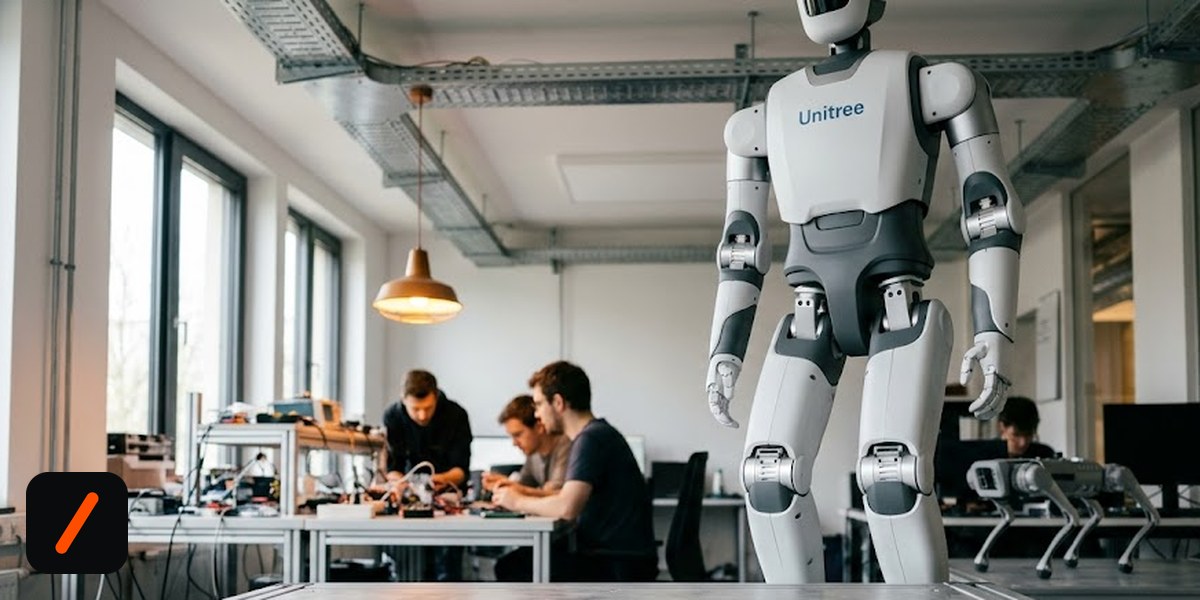
$9.04 billion, on 1.7 billion yuan of revenue, at roughly 60 percent gross margins. Those three numbers are the first honest price tag the humanoid robotics sector has ever had, because Unitree just became the first humanoid robot maker anyone can actually buy shares in.
The Hangzhou company priced its Shanghai STAR Market listing at 150.8 yuan per share on August 6, selling 40.45 million new shares to raise about $904 million. Retail subscription opened August 10. Until now every valuation in this field was a private mark set by investors with an interest in the mark going up. This one gets tested daily by people who can sell.
RelatedDeepSeek Nears $74B Valuation Ahead of 2027 IPO
What the numbers actually say
Unitree shipped roughly 5,500 humanoid robots in 2025, more than any other manufacturer worldwide, and its cumulative quadruped sales have passed 33,000 units. Revenue quadrupled to 1.7 billion yuan. Gross margin sits near 60 percent, which is a hardware margin most hardware companies would trade a limb for and suggests these are being sold as research and industrial platforms rather than dumped to buy market share.
Work the multiple out and it gets interesting. Using the exchange rate implied by the offering itself, where roughly 6.1 billion yuan raised equals about $904 million, 1.7 billion yuan of revenue is close to $250 million. A $9.04 billion valuation on that is roughly 36 times trailing revenue. Rich by any normal industrial standard. Almost conservative next to what this sector has been marking itself at in private.
Why did the regulator move this fast?
The Shanghai Stock Exchange accepted Unitree's application on March 20, 2026. The China Securities Regulatory Commission granted final registration approval on July 2. That is 104 days for a full-cycle review, the fastest since the STAR Market introduced its preliminary review system.
Nothing about a robotics company's paperwork is inherently simpler than anyone else's. A 104-day review is a policy decision, and the policy is that embodied AI is a strategic priority worth clearing a path for. Deep Robotics, AgiBot and EngineAI are all preparing listings across Shanghai, Shenzhen and Hong Kong. Unitree is the first through a door that was deliberately propped open.
| Humanoid robotics | Unitree | Figure AI |
|---|---|---|
| Valuation | $9.04B at IPO price | ~$39B private mark |
| 2025 revenue | 1.7B yuan, quadrupled | Not disclosed |
| Humanoids shipped 2025 | ~5,500, most of any maker | Not disclosed |
| Gross margin | ~60% | Not disclosed |
| Ownership | Public, Shanghai STAR Market | Private |
What it means for the sector's valuations
A public comparable is a discipline device. Private humanoid valuations have been set by narrative, because there was no traded instrument to argue with. Now there is, and every subsequent round in the sector gets negotiated in its shadow. An investor asked to pay a multiple far above 36 times revenue for a company shipping far fewer units will have a specific, liquid, daily-updating number to point at.
RelatedLovable raises $400M at $13.3B, doubling in eight months
The direction of the pressure is not obvious, though, and anyone certain about it is guessing. If Unitree trades up hard on listing, the read flips: the public market endorses the sector and private marks look defensible rather than stretched. If it trades flat or drifts down while still shipping more robots than anyone else, that is a much harder conversation for every private company in the field. Either way, the argument now has evidence in it. For readers tracking where private capital is going in this sector, our funding tracker follows the rounds that will get repriced against this listing.
- Mar 20, 2026Shanghai Stock Exchange accepts the application clock starts
- Jul 2, 2026CSRC grants final registration approval 104 days, a STAR Market record
- Aug 6, 2026IPO priced at 150.8 yuan per share $9.04B valuation, ~$904M raised
- Aug 10, 2026Retail subscription opens China's first humanoid robot stock
- NextDeep Robotics, AgiBot, EngineAI listings Shanghai, Shenzhen and Hong Kong
Our take
The genuinely notable thing here is not the valuation. It is that a humanoid robotics company has real revenue, real unit volume and real margins at all. Most of this sector's capital has gone to companies whose product is a demo video and a roadmap. Unitree sells machines to customers who pay for them, mostly research labs, universities and industrial buyers, and it does so at 60 percent gross margin.
The obvious caution is that 5,500 units at those margins is a research-tools business, not the general-purpose labor market every humanoid pitch deck promises. Those are different companies with different economics, and buying the first at a multiple that prices in the second is the specific mistake available here. What Unitree has proven is that you can build a real business selling robots to people who study robots. Whether that becomes a business selling robots to people who need work done is the question the share price will spend the next few years arguing about.
- The first post-listing quarter. Revenue quadrupled in 2025 off a small base. The growth rate as the base gets larger is the whole thesis.
- Customer mix disclosure. Research and university buyers versus industrial deployment is the difference between a good instrument company and a category-defining one.
- How the peers price. Deep Robotics, AgiBot and EngineAI now have a comparable. Their listings will show whether it holds.
- Margin durability. 60 percent gross margin invites competition. Watch whether it survives contact with a second serious volume manufacturer.
- ReferenceUnitree clears key hurdle to Shanghai IPO review timeline and regulatory context
- ReferenceChina's Unitree launches IPO process amid humanoid robotics boom offering mechanics and subscription dates
- FundingGenZTech Funding Tracker private rounds that now have a public comparable
Original analysis by GenZTech. Offering details via South China Morning Post and Xinhua. This is factual analysis, not investment advice.