
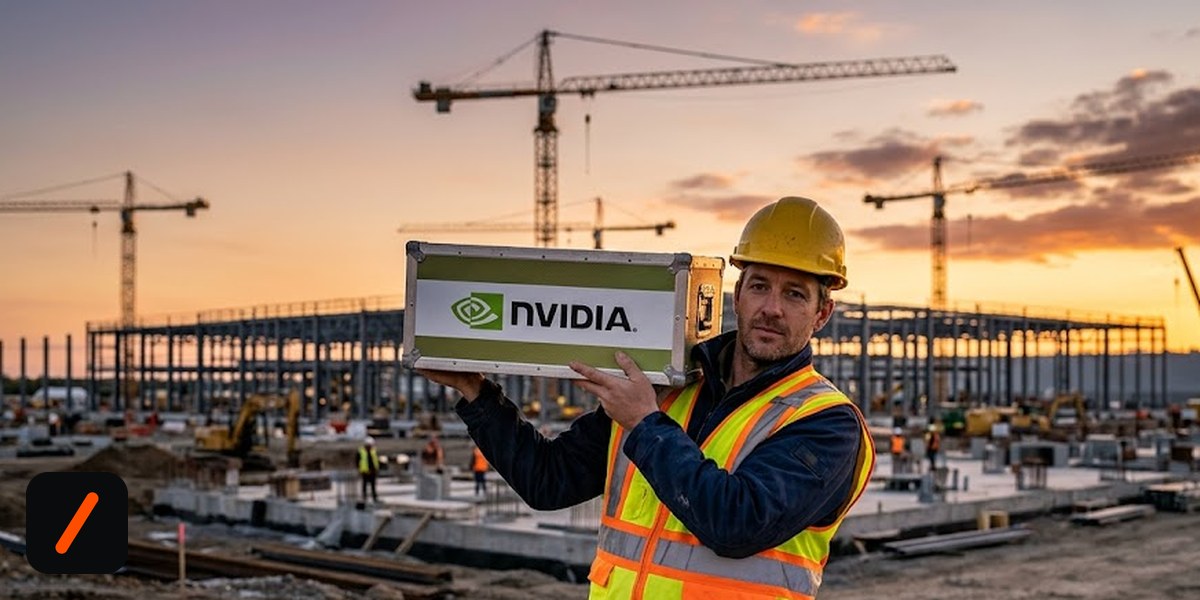
On July 24 and 25, NVIDIA and SK Group put a number on what "sovereign AI" actually costs: more than $500 billion, the largest figure yet attached to a single country's AI buildout. SK Telecom is committing to a 2 gigawatt AI factory running on NVIDIA's Vera Rubin platform, paired with SK hynix's HBM4 memory, with the first site targeted for 2027, as GENZ TECH reported this week. It builds directly on NAVER's earlier sovereign AI push on NVIDIA's DSX reference architecture, which GENZ TECH covered when it started at 55 megawatts with a stated goal of reaching gigawatt scale. Put the two announcements together and South Korea is arguably the clearest test case anywhere for what sovereign AI means once governments actually write the checks.
"Sovereign AI" has floated around policy conferences for a few years without much behind it beyond the phrase itself. It no longer looks like a talking point. It looks like a line item.
RelatedNvidia's $750B AI Deals Just Spooked Its Own Bondholders
The urgency behind that spending has a specific, recent source. In late May 2026, it emerged that Microsoft had shared emails, meeting minutes, and internal records naming individual Dutch civil servants, officials at the ACM (the Authority for Consumers and Markets) and the AP (the Dutch data protection authority), with the US House Judiciary Committee, without redacting their names. The disclosure came as part of a Republican-led congressional inquiry that characterized European Digital Services Act enforcement as "foreign interference" with American platforms, and the officials named work specifically on implementing that law. Two Dutch state secretaries called the episode "extremely concerning," the Dutch cabinet raised it directly with the US ambassador, and officials have warned the named civil servants could plausibly face personal sanctions or travel restrictions.
Microsoft was complying with a US congressional committee's document request, not handing over the data on its own initiative. But the substance doesn't need much dressing up: a US company gave a US government body identifying information about European regulators, without those regulators' consent, while they were doing their jobs enforcing European law. That's the kind of episode that turns "digital sovereignty" from a policy abstraction into a felt risk for anyone doing regulatory work in Europe.
Kevin Dominik Korte, a member of the board of advisors at Targa AI who describes himself as an evangelist for digital sovereignty and open source, sees a straight line from episodes like that to the money Korea is now spending. "As an evangelist for Digital Sovereignty and Open Source, I see the push for sovereign AI as a logical conclusion," he told GENZ TECH. "Over the past month, the current US administration has restricted the export of some of the most advanced AI models and allegedly forced Microsoft to disclose private information from the Dutch civil service."
Why Are Governments Building Instead of Renting?
Take the export-control half of Korte's claim first, because the real picture is more contested than a simple tightening story. In January 2026, the Commerce Department actually loosened chip export rules, allowing case-by-case sales of advanced AI chips, Nvidia's H200 and AMD's MI325X among them, to China under new licensing terms. A separate regime does exist on paper requiring a license, presumptively denied outside a short list of allied countries, to export the weights of advanced closed AI models. But enforcement of that rule was quietly shelved: a May 2025 rescission, announced only through a press release and never formally entered into the Federal Register, told enforcement staff to stand down. The only official confirmation of that non-enforcement posture shows up in a July 2026 rule about the United Arab Emirates. Eased chip sales to China alongside an unevenly enforced weights regime elsewhere is the actual state of play, messier and more contested than either side of the sovereignty debate tends to admit.
The Microsoft episode isn't in dispute the same way, and it's doing real work in Korte's argument even under the more careful framing. "Given the amount of data AI processes, it should not be surprising that countries want to control the AI running within their borders," he said. "Not only does it protect them from arbitrary and often random actions by the US or Chinese governments, but it also allows them to capture the value AI provides locally. Further, it provides an incentive to stem the brain drain of AI talent to the US, which has boosted the American tech sector for decades." As he put it, "Thus, the benefits of sovereign AI go far beyond virtue signaling and encompass privacy and civil rights as well as economic and educational policy."
Each piece of that holds up reasonably well against the available evidence. The privacy and civil rights point isn't hypothetical, it's the Dutch case: officials doing DSA enforcement work who now have to think about travel restrictions because a US platform handed a congressional committee their names. The local value capture point tracks with how Korea is actually spending its money: NAVER and SK Group aren't just hosting American compute, they're building factories that keep jobs, tax revenue, and data processing on Korean soil. The brain drain point is harder to prove with a single data point, but it matches years of complaints from European and Asian tech ministries about their strongest AI researchers ending up at labs in the Bay Area.
Does Owning the Hardware Mean You Own the AI?
Edward Tian, founder of GPTZero, doesn't dispute that sovereign AI is a real strategic category. "In part, Sovereign AI refers to both a technology strategy and a national security strategy," he told GENZ TECH. "Countries are beginning to realize that nations' prowess regarding access to those technologies made such a huge economic impact in the past with those technologies as energy and telecommunication."
Where his argument breaks from Korte's is on what actually constitutes sovereignty once the spending happens. "There is a danger of thinking that by just owning the machinery, we can gain in AI," Tian said. "The actual power of the system lies in the whole package, being high skill engineers, good quality data or research facilities capable of making real use of the infrastructure set. Hence, a country can invest billions of dollars in data centers. However, without capable people and real applications for them, those investments will fall flat."
- $500 billion plus. The combined figure NVIDIA and SK Group attached to Korea's AI buildout on July 24-25, 2026, the largest number yet tied to a single country's AI infrastructure push.
- 2 gigawatts. The scale of the AI factory SK Telecom has committed to on NVIDIA's Vera Rubin platform, running on SK hynix HBM4 memory.
- 2027. The target date for the first site to come online, and the point at which Tian's warning about people and applications either holds up or it doesn't.
Korea is a reasonable test of that warning, arguably a better one than most countries could offer. This isn't a government buying racks of GPUs and hoping something useful happens. NAVER has run production AI services domestically for years, SK hynix supplies a meaningful share of the world's high-bandwidth memory, and Samsung and SK both already employ large semiconductor engineering workforces. If any country could pair Tian's "whole package" of skilled engineers, real data, and applications people actually use with hundreds of billions in new infrastructure, Korea has a more credible claim to it than most. That's exactly why 2027 matters as a date rather than just a construction milestone. It's close enough that any gap between infrastructure and capability should start showing up in something other than a press release.
RelatedBig Tech's $1T AI lease bill isn't on the books
What About Countries That Can't Spend $500 Billion?
Almost no country can run Korea's playbook, and that's Tian's next point, the one that matters most for the roughly 190 countries that are not Korea, the US, or China. "For the less powerful countries, making progress just by constructing everything on their soil is not always realistic," he said. "Hence, a better solution is to develop expertise in some particular areas, go for international cooperation, and getting access to solid AI infrastructure without relying exclusively on some provider."
That's a narrower, more achievable version of sovereignty than building a gigawatt data center from scratch, and it maps onto what smaller, well-resourced states have actually been doing: picking a specific niche, medical imaging, a local-language model, an agricultural application, rather than trying to replicate a hyperscaler, and pairing that with regional infrastructure-sharing agreements or multi-vendor contracts instead of a single point of dependency. It's a hedge against the same vulnerability Korte points to, arbitrary action by a foreign government, without needing hundreds of billions of dollars to pull off.
It also implies something Tian didn't say outright but that follows from his own logic: full self-sufficiency and sovereignty aren't actually the same goal, even though they get bundled into the same word in most of these conversations. A country can cut its dependence on any single foreign provider through diversification and targeted expertise without ever owning a domestic gigawatt-scale data center. Korea is pursuing both at once. Most countries will only ever pursue the second.
Are Korte and Tian Even Disagreeing?
Not really, once the two questions get separated. Korte is answering why: why would a government want to control the AI systems running inside its own borders instead of leasing capacity from a foreign cloud. His case, privacy exposure, local value capture, stemming a talent drain, holds up well against what actually happened in the Netherlands, and it doesn't need the shakier export-control framing to work. Tian is answering a different question: whether spending money on infrastructure is enough, on its own, to produce the outcome sovereignty advocates actually want. His answer is no. That's not a rebuttal of Korte's motives. It's a warning about execution.
Our own view is that both are correct about the piece they're each looking at. Sovereignty is a legitimate political and economic motive. The Dutch case alone justifies why a country would want its regulators' data to stay under its own control, and a genuinely mixed export picture, eased chip sales to China alongside a model-weights licensing regime Washington itself has stopped enforcing, complicates the "US is locking down AI" narrative more than it undercuts the underlying motive for sovereignty. But motive isn't execution. Tian's warning that infrastructure without skilled people and real applications falls flat is the operational reality check Korea's own buildout is now positioned to test, in public, over the next 18 months.
GENZ TECH's own reporting on the buildout flagged 2027 as the target date for the first site. That date is more than a construction milestone. It's the date that actually tests all of this, whether Korea ends up with AI capability that matches its AI infrastructure, or just a very large amount of very expensive hardware. The money is already committed. What happens after the ribbon-cutting isn't, and that's the only question that will actually settle the argument between these two.
- BackgroundNVIDIA and SK Group Unveil $500B Korea AI Buildout — GENZ TECH's report on the July 2026 announcement, including the Vera Rubin platform and HBM4 memory specs.
- BackgroundNAVER, NVIDIA Build Gigawatt Sovereign AI in Korea — GENZ TECH's earlier reporting on NAVER's DSX buildout, the foundation the SK Group deal builds on.
- ReferenceNL Times: Microsoft accused of leaking Dutch civil servants' names to US government — local reporting on the disclosure and the Dutch cabinet's response.
- ReferenceCybernews: Microsoft and the Dutch data disclosure — additional detail on what records were shared and with whom.
Quotes gathered directly by GENZ TECH from sources who volunteered to comment on this story, with full attribution as agreed with each. Figures on Korea's buildout current as of July 25, 2026.