
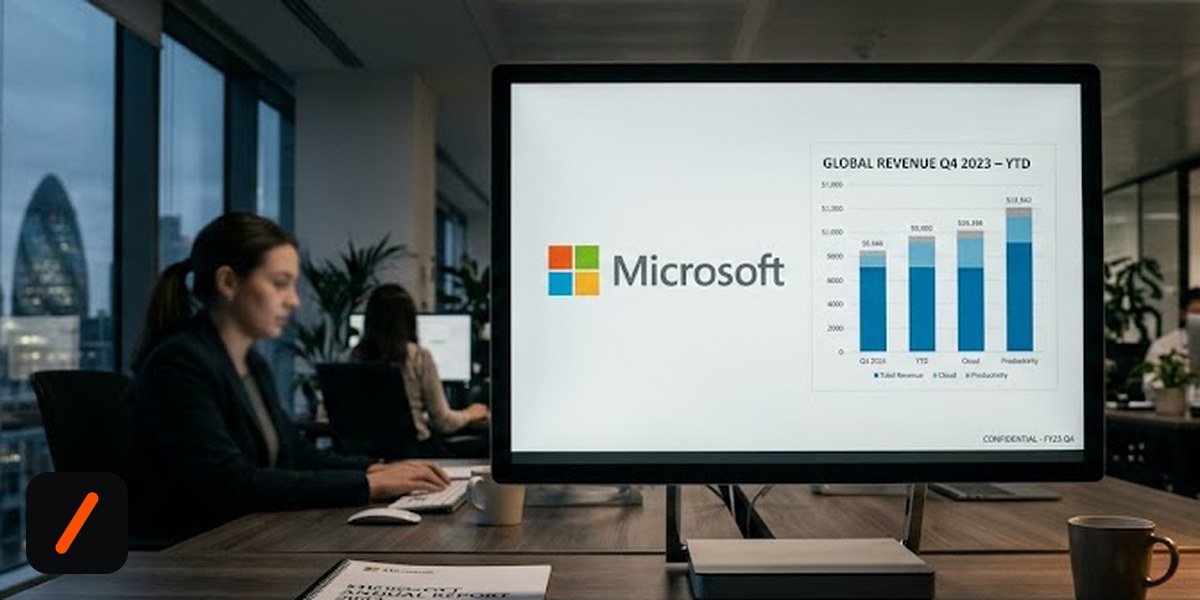
Microsoft's fiscal 2026 annual report put a number on the OpenAI relationship for the first time: $24.1 billion of revenue from commercial arrangements with OpenAI in the year ended June 30, 2026. The filing landed yesterday. The reading that spread across tech media tonight is the uncomfortable part, and it comes from arithmetic Microsoft did not print: measured against the company's own stated AI growth rate, something close to 70% of Microsoft's AI revenue traces back to one customer.
Microsoft has spent three years talking about its AI business in run rates and growth percentages while carefully never saying where the money came from. The 10-K answers that question sideways, and the answer is a single name.
RelatedBig Tech's $1T AI lease bill isn't on the books
How is the 70% figure actually calculated?
It is an inference stacked on two disclosures, and it is worth being precise about which half is fact and which half is estimate, because plenty of the coverage tonight is blurring them.
The fact: Microsoft's FY26 filing states $24.1 billion in revenue from commercial arrangements with OpenAI, plus $6.0 billion in accounts receivable owed by OpenAI as of June 30, 2026. It also confirms Microsoft has committed $13 billion to OpenAI, of which $11.9 billion had been funded by the same date. Those figures come straight from the document.
The estimate: Microsoft told investors in March that its AI business was growing about 123% year over year. Carry that rate through the remainder of the fiscal year and the full-year AI number lands somewhere around $34 billion. Divide $24.1 billion by $34 billion and you get roughly 70%. Bloomberg ran that math first and other outlets picked it up within hours.
So the concentration ratio is a well-reasoned approximation, not a line item. What the filing does and does not settle:
- Confirmed: OpenAI generated $24.1 billion of revenue for Microsoft in FY26, equal to about 7.3% of the company's $331.8 billion total revenue.
- Confirmed: OpenAI owed Microsoft $6.0 billion at the fiscal year end, roughly a quarter of the year's billings still outstanding.
- Inferred: The ~70% share of AI revenue, which depends on Microsoft's own growth-rate guidance holding for the back half of the year.
- Still opaque: The split inside that $24.1 billion between Azure compute, revenue-share payments and other commercial terms. Microsoft gives no breakdown.
Why does one company's spending show up as Microsoft AI revenue?
Because a large share of it is OpenAI paying its own compute bill. OpenAI trains and serves models on Azure, and that spend is booked as Microsoft revenue like any other cloud contract. Layer on the revenue-share payments OpenAI sends Microsoft on its products, and you have a number that says less about Microsoft selling AI to the world than about Microsoft hosting the most expensive workload in the industry.
There is also a loop worth naming plainly. Microsoft has funded $11.9 billion into OpenAI. OpenAI spends heavily on Azure. Some portion of the money Microsoft invested comes back as Microsoft revenue, which then supports the growth story that justifies further investment. That structure is not unique to these two companies, and it is not fraud, but it does mean the $24.1 billion is not the same quality of revenue as $24.1 billion from twenty thousand unrelated enterprise customers.
The $6 billion receivable is the detail that deserves more attention than it is getting. Roughly a quarter of the year's OpenAI billings were still unpaid at the close of the fiscal year. For a normal cloud customer that would be an unusual balance. For the customer carrying most of your AI line, it is a real credit exposure sitting on the balance sheet.
What does this mean for the stock?
At the top line, not much. Seven percent of revenue is meaningful but not existential, and Microsoft's Office, Windows and enterprise-cloud businesses are unaffected by any of this. The exposure is to the narrative rather than the earnings.
Microsoft trades at a multiple built substantially on the belief that it converted an early OpenAI bet into a broad, durable AI franchise. A disclosure suggesting that most of the AI franchise is one counterparty's compute spend does not break that belief, but it does invite a harder question at the next earnings call: how large is AI revenue excluding OpenAI, and how fast is that piece growing? Microsoft has never answered it, and now analysts have a filed number to anchor the question to.
RelatedNvidia's $750B AI Deals Just Spooked Its Own Bondholders
The signal for investors is in three things to watch rather than any move to make today: whether Microsoft starts disclosing AI revenue net of OpenAI, how the $6 billion receivable trends over the next two quarters, and how fast OpenAI draws down the $250 billion Azure commitment it signed in the October 2025 restructuring. Nvidia, CoreWeave and the rest of the AI infrastructure chain carry versions of the same concentration question, so the read-through is not confined to one ticker.
- 2019Microsoft invests $1 billion in OpenAI Azure becomes the exclusive compute partner
- Jan 2023Multiyear, multibillion extension Widely reported at around $10 billion
- Oct 2025OpenAI recapitalizes as OpenAI Group PBC Microsoft takes a 27% stake, OpenAI commits to $250B of Azure, Microsoft loses cloud right of first refusal
- Apr 2026Revenue-share payments capped The partnership is reworked again, loosening the flow back to Microsoft
- Aug 5 2026FY26 filing discloses $24.1B First time the OpenAI revenue figure appears in a Microsoft filing
- Oct 2026Q1 FY27 earnings The first chance to ask for AI revenue excluding OpenAI
Is this actually a risk, or just an awkward number?
Both, depending on the time horizon. In the near term, OpenAI is not going anywhere and its compute needs are growing, so the revenue is real and probably increasing. The risk is structural and slower: OpenAI has already won the right to buy compute elsewhere, has been building its own capacity plans, and capped what it sends Microsoft in revenue share. Every one of those developments points the same direction, which is a counterparty gradually acquiring the ability to spend less with Microsoft.
The optimistic reading is that this is what a well-placed infrastructure provider looks like early in a platform cycle, when one customer is simply further ahead than everyone else, and that Copilot and Azure AI services broaden the base over time. That reading is defensible. It just has not shown up in a disclosed number yet.
- An ex-OpenAI AI number. If Microsoft volunteers one, it is confident. If it keeps declining, the concentration read stands.
- The receivable. $6 billion outstanding is the single most concrete risk item in the filing. Watch whether it grows.
- Azure commitment burn. The $250 billion contract is the floor under this revenue. Its pace matters more than any quarterly headline.
- OpenAI's other clouds. Compute deals signed away from Azure are the leading indicator of the 70% coming down for the wrong reason.
Our take
The number itself is not a scandal. Companies land big customers, and hosting the most compute-hungry lab on earth is a good problem. What bothers us is that Microsoft spent three years reporting AI as a growth rate rather than a revenue line, and the composition only became visible because a securities filing required it. A business that was 70% one customer was described to the market the entire time as an AI franchise.
Read the filing as good news about demand and a caution about disclosure. The demand is genuine. The framing was doing a lot of work.
- OfficialMicrosoft Investor Relations, SEC filings FY26 Form 10-K, the source of the $24.1B, $6.0B receivable and $11.9B funded figures
- ReferenceSEC EDGAR, Microsoft Corporation 10-K filings The filing index, if you want to read the disclosure yourself
- OfficialThe next chapter of the Microsoft and OpenAI partnership Microsoft's own account of the October 2025 restructuring, the 27% stake and the $250B Azure commitment
- AnalysisMicrosoft disclosures suggest OpenAI is around 70% of FY26 AI revenue Working through the same arithmetic in detail
Original analysis by GenZTech. Reporting on the filing via Windows Central.