
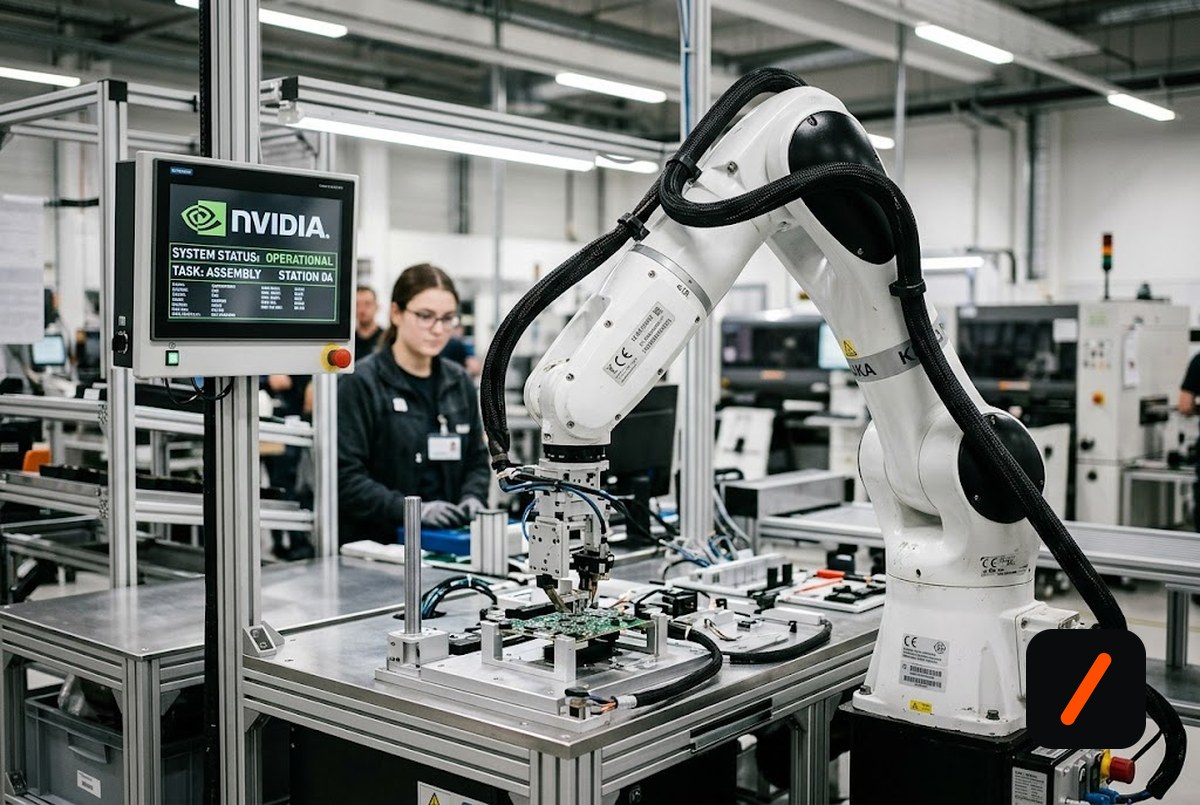
NVIDIA has introduced Halos, which it calls the industry's first full-stack, comprehensive safety system for robotics and physical AI, announced alongside its Vera Rubin supercomputing push. The pitch is simple and overdue: as robots move from caged factory arms to machines that share space with people, the AI that drives them needs the same kind of certified safety layer that cars and aircraft already require. Halos is NVIDIA trying to own that layer, unifying AI compute and functional safety into one system rather than leaving each robot maker to bolt safety on afterward.
- Halos is a safety system for physical AI, spanning the chip, the software, and the process a robot maker uses to prove the machine is safe.
- It targets the gap between fast AI inference and functional safety, the discipline that keeps a machine from harming people when a sensor or model fails.
- It arrives with NVIDIA's robotics platform push, positioning safety as a built-in stack, not an afterthought each vendor solves alone.
- The bet: humanoid and mobile robots do not scale into shared spaces until safety is standardized and certifiable.
What is functional safety, and why is AI bad at it?
Functional safety is the engineering discipline that answers one question: when something fails, does the machine fail safely? Cars, elevators, and industrial robots live under standards like ISO 26262 and IEC 61508 that demand provable, deterministic behavior. Modern AI is the opposite of deterministic. A neural network that identifies a person 99.9% of the time still has a tail of cases where it does not, and you cannot easily write a proof about a billion-parameter model. That mismatch is the single biggest thing keeping capable robots out of hospitals, sidewalks, and homes. Halos is NVIDIA's attempt to bridge it by pairing probabilistic AI with a deterministic safety envelope that can catch and override the model.
RelatedQualcomm's AI200 and AI250 Chase Nvidia in Inference
What does Halos actually include?
NVIDIA describes it as full-stack, which means it spans three layers most vendors treat separately. At the silicon level, it uses safety-capable compute that can run monitoring alongside the main AI workload. At the software level, it provides a safety framework and guardrails that watch the robot's decisions. At the process level, it offers the documentation, tooling, and reference designs a manufacturer needs to actually certify a machine, which is often the slowest and most expensive part of shipping a robot. Bundling all three is the point: today a startup building a humanoid has to assemble safety from scratch, and that work does not differentiate the product, it just delays it.
| Approach | NVIDIA Halos | Roll your own | Bolt-on safety PLC |
|---|---|---|---|
| Compute + safety unified | Yes | Manual integration | Separate hardware |
| Certification support | Reference designs, tooling | Vendor does it all | Partial |
| Handles AI uncertainty | Designed for it | Depends on team | Not AI-aware |
| Time to certify | Shorter (claimed) | Long | Medium |
Who needs this now?
The humanoid and mobile-robot wave. A crop of companies is racing to put walking robots in warehouses and, eventually, homes, and every one of them hits the same wall: a machine that can fall on someone or swing an arm into them cannot ship without a safety story regulators and insurers accept. By owning the safety stack, NVIDIA does two things at once. It removes a real blocker for its robotics customers, and it deepens the lock-in of its platform, because a robot certified around Halos is a robot built around NVIDIA compute. That is the same playbook that made CUDA unavoidable in AI, applied to the physical world.
What is the risk?
Standardizing safety around one vendor is a double-edged move. It accelerates the industry, but it also concentrates enormous influence over how physical AI is regulated in the hands of the company that also sells the compute. Certification bodies, not NVIDIA, ultimately decide what is safe, and Halos will only matter if regulators and insurers treat it as credible. There is also execution risk: a full-stack safety claim is easy to announce and hard to prove across the messy diversity of real robots.
RelatedSK hynix and Samsung Race to Ship 12-Layer HBM4E
- First certified robots. The proof is a shipping humanoid or mobile robot certified with Halos in the loop, not a keynote slide.
- Standards alignment. Whether Halos maps cleanly to ISO and IEC functional-safety standards decides if certifiers accept it.
- Third-party adoption. Watch which robot makers build on it versus keep safety in-house to avoid deeper NVIDIA lock-in.
- Insurer buy-in. Insurance underwriters, quietly, are the gatekeepers for robots in public space. Their acceptance matters as much as any regulator's.
Our take
Halos is the least flashy and most strategically shrewd robotics move NVIDIA has made. Everyone is fixated on how capable humanoid robots are getting, but capability was never the thing blocking deployment into shared human space. Safety certification is, and it is a grinding, expensive, unglamorous problem that no single robot startup wants to solve alone. By turning that shared pain into a platform, NVIDIA both unblocks its customers and quietly makes its compute the default substrate for the entire physical-AI industry, exactly as it did for training. The open question is governance: it is genuinely good for the field to standardize safety, and genuinely uncomfortable to hand that standard to the company selling the chips. Watch the certifiers, not the keynote.
- OfficialNVIDIA Newsroom Halos and Vera Rubin announcements
- ReferenceNVIDIA Robotics platform overview for physical AI
- ReferenceFunctional safety the standards Halos must satisfy
Original analysis by GenZTech. Figures current as of July 2026. Source: NVIDIA Newsroom.