
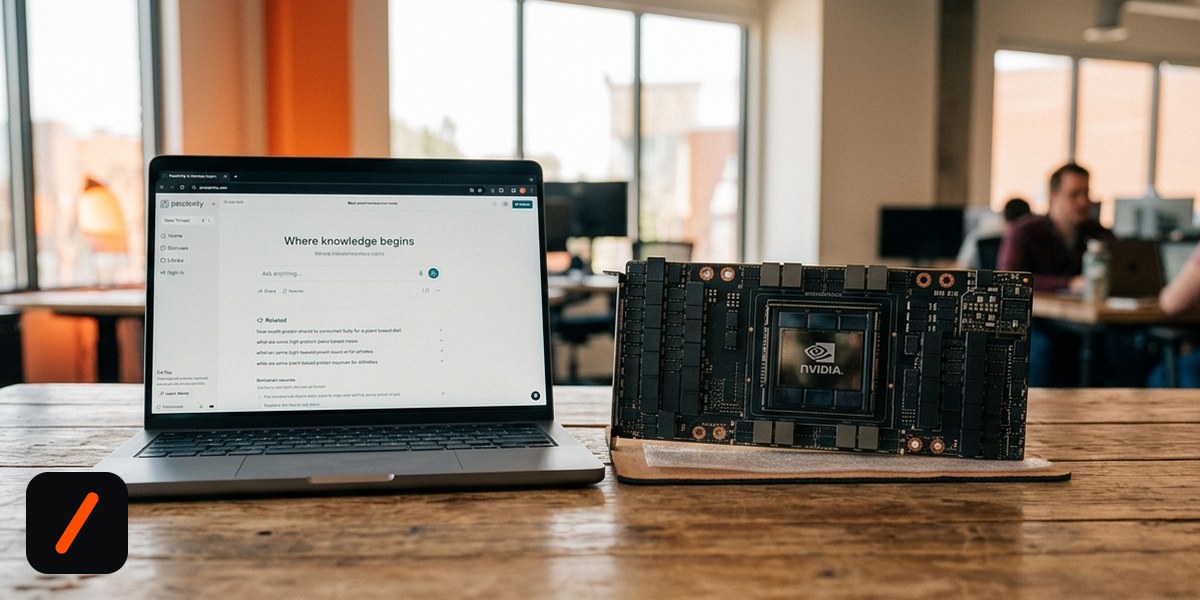
Nvidia wants a piece of Perplexity, and the price tag being floated is steep. The Information reported on August 23 that Nvidia is discussing an equity investment in Perplexity's next funding round, one that would value the AI answer engine north of $30 billion. That is more than 50% above the roughly $20 billion mark Perplexity carried into its last round, struck about a year ago in September 2025. Nothing is signed. Both companies declined to comment when reporters asked, so treat this as a deal in motion, not a done one.
- Nvidia is reportedly in talks to join Perplexity's next funding round at a valuation above $30 billion, up from roughly $20 billion a year earlier.
- Perplexity's annualized revenue climbed from under $250 million in January 2026 to more than $750 million now, helped by its Perplexity Computer agent product.
- Perplexity separately signed a $750 million cloud agreement with Microsoft Azure earlier this year and counts Jeff Bezos and SoftBank Group among its backers.
- CEO Aravind Srinivas has said Perplexity will go public in 2028 regardless of how markets receive Anthropic's and OpenAI's own listings.
What Nvidia is actually proposing
Before landing on a straightforward equity stake, Nvidia reportedly floated something stranger: paying Perplexity billions to license its technology and hire away specific staff, an acquihire dressed up as a licensing deal. That structure got shelved in favor of a normal investment. It is worth pausing on why that detail matters. Nvidia ran the exact same playbook with Poolside in August 2026, a roughly $6 billion license-and-model-factory arrangement that pulled in 109 of Poolside's staff without technically being an acquisition. With Perplexity, the company apparently considered that route first, then backed off it. Either the target resisted, or Nvidia decided a cap-table seat was worth more than the IP.
RelatedOpenAI Shops a $1.5 Trillion Valuation Ahead of a 2027 IPO
Why is Nvidia doing this?
Nvidia doesn't need Perplexity's search index. It needs Perplexity to keep buying and renting GPUs, and it needs the broader market to believe every layer of the AI stack is still expanding. A $30 billion check into an answer engine does both. Perplexity Computer, the company's cloud-based agent product for task automation, runs on compute. More usage means more inference, and more inference eventually means more chips, whether Perplexity buys them directly or rents them through Azure and other clouds. Nvidia sits at the top of nearly every part of that chain now: GPU buyer, model shop, cloud provider, and, with this deal, an application company that puts its silicon in front of end users. That is a lot of leverage bought with a balance sheet.
What does it mean for Perplexity?
Money and a stamp of approval. Perplexity's revenue trajectory is the real story underneath the valuation headline: annualized revenue was under $250 million at the start of 2026 and has since crossed $750 million, a tripling in under eight months. That growth is what makes a $30 billion price defensible rather than absurd. Nvidia's name on the cap table also does something the revenue numbers alone cannot: it signals to the rest of the market, and to future IPO investors, that the company everyone associates with picking AI winners thinks Perplexity is one of them. Combined with the $750 million Azure cloud deal signed earlier this year, Perplexity is stacking up the kind of infrastructure and capital relationships a company builds when it is genuinely planning to go public, not just talking about it.
- Dec 2025Nvidia invests in Groq a direct equity stake in an AI chip rival, not a licensing deal.
- Aug 2026Nvidia signs $6B Poolside license a model-factory arrangement that also pulled in 109 Poolside staff.
- Aug 2026In talks with Perplexity reportedly considered a licensing structure first, now discussing equity at $30B+.
Is this the same circular investment problem again?
Yes, and it is worth naming plainly. Nvidia sells GPUs to cloud providers and AI labs, some of that revenue funds new model training runs, and now Nvidia is also putting cash directly into the companies at the very top of the stack, the ones building consumer-facing products on top of everything below them. When the chipmaker is simultaneously a supplier, a landlord, and now an investor in the tenant, the usual arm's-length signals about demand get harder to read. That doesn't make the Perplexity talks improper. It does mean a $30 billion valuation partly reflects Nvidia's willingness to write the check, not just independent market appetite for Perplexity's product.
What it means for the market
For anyone tracking Nvidia (NVDA) as an infrastructure bellwether, this is another data point that the company is using its balance sheet, not just its product roadmap, to lock in influence across AI. Three moves in nine months, Groq, Poolside, Perplexity, span chips, models, and applications. Watch two things from here. First, whether the Perplexity round actually closes at $30 billion or gets renegotiated once term sheets are final; reported talks and signed deals are different animals. Second, whether more of these circular arrangements show up elsewhere in the stack, since a pattern that repeats a third and fourth time starts to look less like opportunistic dealmaking and more like a deliberate strategy to keep every layer of AI spending flowing back toward Nvidia silicon. None of this is a signal to buy or sell anything. It's a signal about where power in AI infrastructure is concentrating.
RelatedDeepSeek Pauses $1.5B Raise After Leaked Compute Remarks
What's next for Perplexity's 2028 IPO plans?
Srinivas has been unambiguous that Perplexity intends to list in 2028, and he has said it will do so regardless of how the market receives Anthropic's and OpenAI's own public debuts, both of which are expected to land before Perplexity's. That's a notable stance. It means Perplexity isn't waiting to see whether the market has appetite for AI IPOs generally; it's committing to a timeline. A $30 billion private round, if it closes, buys two more years of runway and a valuation anchor that public-market investors will measure the eventual IPO price against. If Perplexity can keep growing revenue at anything close to its current pace, that anchor works in its favor. If growth slows, a $30 billion private mark becomes a number the company has to defend rather than beat.
- Deal confirmation. Neither company has confirmed the talks. A signed term sheet, not another leak, is what turns this from rumor into fact.
- Revenue durability. The tripling from $250M to $750M annualized needs to hold up over a few more quarters before a $30B mark looks earned rather than momentum-priced.
- More Nvidia moves at the application layer. If Nvidia writes a similar check into another consumer-facing AI product within the next two quarters, the pattern becomes the story.
- Pre-IPO positioning. Watch for further large infrastructure deals, similar to the Azure agreement, as Perplexity builds the balance sheet a 2028 listing will need.
Our take
Nvidia pivoting away from an acquihire-style license and toward a straight equity check is the more interesting fact here, more interesting than the $30 billion number itself. It suggests Nvidia wants a durable seat at the table across the AI stack rather than a one-time technology grab, and Perplexity was apparently in a strong enough position to hold out for that. The circularity critique is real and worth tracking, but it doesn't make Perplexity's underlying growth fake. A company that tripled annualized revenue in eight months earned real leverage in this negotiation, Nvidia or no Nvidia. The more useful question isn't whether this deal is good for Perplexity. It's how many more times Nvidia can run this playbook before regulators, competitors, or its own shareholders start asking who is actually setting the price when the buyer keeps also being the investor.
- Reporting Nvidia discusses Perplexity investment at $30 billion : Reuters via Yahoo Finance, Aug 24, 2026
- Reporting Nvidia in talks to invest in Perplexity as revenue tops $750 million : TechStartups, Aug 24, 2026
- Reporting Nvidia, Perplexity, $30 billion valuation, $750 million revenue, Bezos : Benzinga, Aug 24, 2026
- Context Nvidia's $6B Poolside license and model-factory deal : GenZTech, Aug 23, 2026
Original analysis by GenZTech. Source: Reuters via Yahoo Finance.