
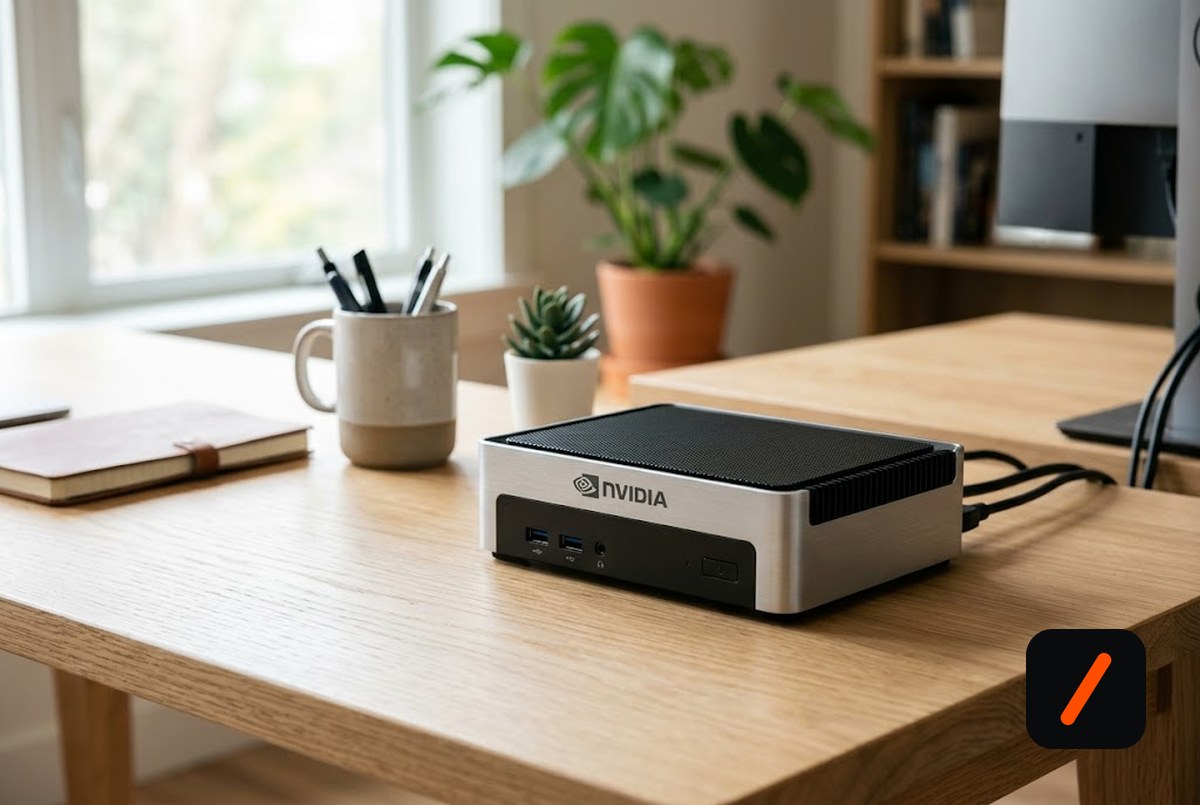
Nvidia's RTX Spark is a bet that the next personal computer runs AI agents locally, not in the cloud. It is a single superchip that fuses a 20-core Arm CPU with a Blackwell GPU carrying 6,144 CUDA cores, wired together over Nvidia's NVLink-C2C interconnect and backed by 128GB of unified LPDDR5X memory at up to 300 GB/s. Nvidia rates it at up to one petaflop of AI compute, and RTX Spark laptops and compact desktops arrive this fall from Asus, Dell, HP, Lenovo, MSI, and Microsoft Surface, with Acer and Gigabyte to follow.
- One chip, not a discrete CPU plus GPU: a 20-core Grace-class Arm CPU and a Blackwell GPU joined by NVLink-C2C, co-designed with MediaTek for power efficiency.
- 128GB of unified memory at up to 300 GB/s means the CPU and GPU share one pool, so large models load without a copy across a PCIe bus.
- Up to 1 petaflop of AI compute, positioned for on-device agents rather than only gaming.
- Shipping this fall from six major PC makers, with Nvidia and Microsoft framing it as turning Windows into an agentic AI operating system.
What is RTX Spark, exactly?
It is a superchip, Nvidia's term for a package that treats the CPU and GPU as one tightly coupled unit rather than two cards talking over a slow bus. The CPU is a 20-core Arm design in the Grace family, co-engineered with MediaTek for efficiency and connectivity. The GPU is Blackwell with 6,144 CUDA cores. The two are joined by NVLink-C2C, a chip-to-chip link far faster than PCIe, and they share a single 128GB LPDDR5X memory pool running up to 300 GB/s. That unified memory is the whole point: on a normal PC a large model must be shuttled between system RAM and GPU VRAM, and both the copy and the VRAM ceiling are bottlenecks. RTX Spark removes the copy and hands the GPU far more addressable memory than any consumer graphics card ships with.
RelatedNvidia's RTX PRO 5500 Pairs 5090 Cores With 84GB of VRAM
Why build this instead of a bigger GPU?
Because the workload changed. Gaming rewards raw shader throughput and fast but modest VRAM. Local AI agents reward memory capacity and bandwidth, because the limiting factor is how big a model you can hold and how fast you can feed it. A 128GB unified pool lets RTX Spark keep large language models resident on-device, which a 16GB or 24GB gaming card simply cannot. Nvidia is not abandoning gaming, but with RTX Spark it is explicitly chasing the personal-AI use case: assistants that run on your machine, keep your data local, and respond without a round trip to a datacenter. That is a different customer than the one buying a graphics card for frame rates.
| Trait | RTX Spark | Typical gaming GPU |
|---|---|---|
| Design | CPU + GPU superchip | Discrete GPU card |
| Memory | 128GB unified LPDDR5X | 16-32GB dedicated VRAM |
| Interconnect | NVLink-C2C | PCIe to host |
| Tuned for | On-device AI agents | Rendering / frame rate |
| Form factor | Laptop + mini desktop | Desktop tower |
Who ships it, and when?
RTX Spark laptops and small desktops land this fall from Asus, Dell, HP, Lenovo, MSI, and Microsoft Surface, with Acer and Gigabyte following. The Surface inclusion matters: Nvidia and Microsoft jointly pitched RTX Spark as the hardware that turns Windows into an agentic operating system, where the OS runs local models to act on your behalf. Broad OEM support on day one signals Nvidia wants this to be a category, not a niche developer box. The open question is price. A one-petaflop, 128GB machine is not a budget device, and where it lands will decide whether it stays a prosumer and developer tool or reaches mainstream buyers.
- Price and battery. Unified memory and a petaflop of compute are expensive and power-hungry. Real laptop battery life and starting price will make or break adoption.
- Software that needs it. The hardware is ahead of the apps. Watch whether Windows ships agent features that genuinely require on-device compute this size.
- The x86 response. Intel and AMD will not cede the AI PC. Expect competing unified-memory designs to answer within a year.
Our take
RTX Spark is the most honest hardware statement yet about where Nvidia thinks personal computing is heading. The unified-memory design is not marketing; it directly attacks the two real limits on running AI locally, capacity and the copy across the bus, and 128GB on a personal machine is a genuine capability jump. The risk is not the silicon, it is the surrounding case. Local agents that actually need a petaflop and 128GB are still thin on the ground, and the price will likely put the first wave in developer and prosumer hands rather than on every desk. But the direction is right, the OEM lineup is serious, and the Microsoft partnership gives it a software home. If the apps arrive to match the hardware, RTX Spark looks less like a gadget and more like the template for what a PC becomes.
- OfficialNvidia Newsroom · RTX Spark platform announcement with Microsoft
- ProductNvidia at COMPUTEX 2026 RTX Spark specs and OEM lineup
- ReferenceTom's Hardware · RTX Spark independent breakdown
Original analysis by GenZTech. Figures current as of July 2026. Source: Nvidia Newsroom.