
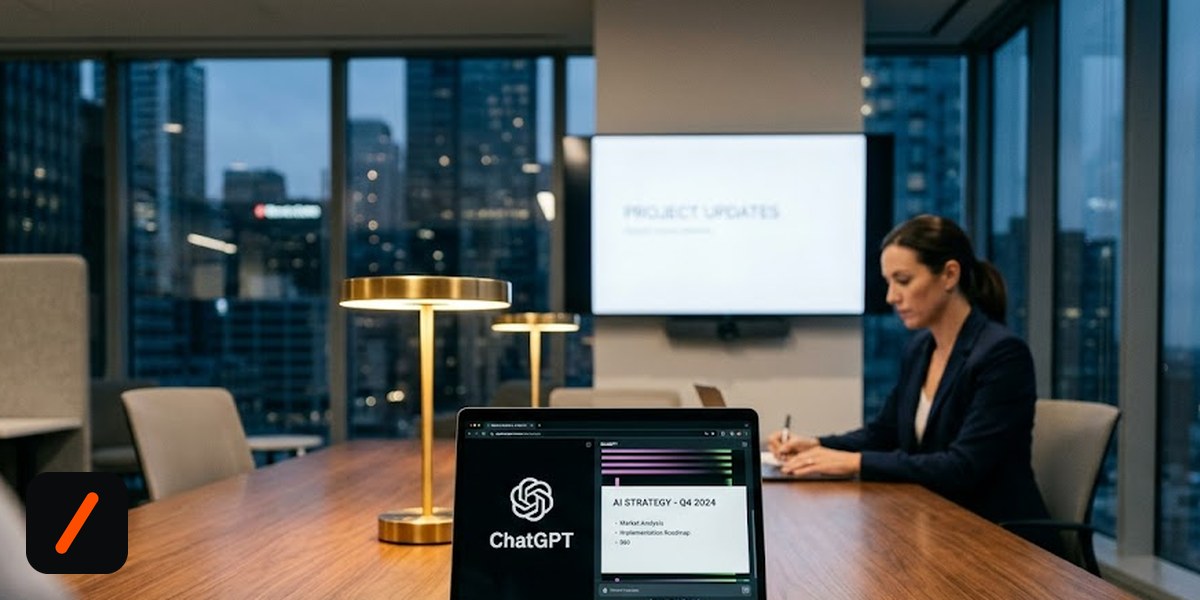
OpenAI has acquired NextSlide, a startup whose software turns rough notes and documents into finished presentation decks, and the entire team has already moved onto ChatGPT. The news went public in the last hour through NextSlide's own site and founder Ahmed Beshry, though the deal itself closed quietly earlier in 2026 and is only being announced now.
Terms were not disclosed, which is how OpenAI handles most of its smaller pickups. The price is not the interesting part. What OpenAI keeps choosing to buy is.
RelatedIn 2026, Venture Money Is Buying Shovels, Not Gold
- Who was bought: NextSlide, founded in mid-2025 by Ahmed Beshry, who previously co-founded Caper AI and sold it to Instacart in 2021.
- What it did: took prompts, notes, documents or research and produced a polished, editable deck instead of a wall of bullet points.
- Where the team landed: directly on ChatGPT. Beshry's note frames this as continuing the same mission inside OpenAI, which reads as an acqui-hire rather than a product purchase.
- What is still unknown: the price, the valuation, whether NextSlide's standalone app survives, and when any of this shows up in ChatGPT.
What did OpenAI actually buy here?
On the available evidence, a team and the engineering behind a hard layout problem, not a product with users OpenAI wants to keep. Nothing in the announcement commits to the standalone NextSlide app continuing. The language is about the people going to work on ChatGPT.
Beshry is a second-time founder with a completed exit. Caper AI built smart shopping carts that identified items as shoppers dropped them in, and Instacart bought the company in 2021. That is a background in shipping something physical and consumer-facing under real-world messiness, which is a different skill set from training models. OpenAI has been hiring for exactly that gap all year.
Why does a chatbot company need a slide startup?
Because ChatGPT can already generate a presentation and the results are mediocre, and the reason they are mediocre has almost nothing to do with the model.
Writing the words on a slide is the easy half. A language model does that well. The hard half is everything after: text that has to fit inside a fixed box without overflowing or shrinking to six points, a visual hierarchy that survives when one bullet runs long, charts that arrive as editable objects rather than flat images, and a file that opens in both PowerPoint and Google Slides without the layout collapsing. That is a rendering and templating engine with a lot of unglamorous edge cases in it, and it is built, not prompted.
This is the gap the whole AI presentation category has been fighting over: the distance between a deck a model can produce and a deck someone would actually send to a client without rebuilding it first. Buying a team that spent a year on that specific problem is cheaper than assigning it to a research org.
How does this land on Gamma, Canva and Microsoft?
Awkwardly, and in different ways for each.
| ChatGPT + NextSlide | Gamma | Canva | Microsoft 365 Copilot | |
|---|---|---|---|---|
| Core strength | Reasoning over your source material | Full deck from one prompt | Design control and brand libraries | Living inside PowerPoint |
| Whole-deck AI editing | Not yet shipped | Yes | Partial | Partial |
| Where the work starts | A chat you were already having | A blank prompt box | A template | An existing file |
| Distribution | Hundreds of millions of weekly users | Standalone product | Standalone product | Enterprise seats |
| Main risk | Feature never ships well | Absorbed as a feature | AI commoditises layout | Partner becomes rival |
Gamma is the most directly exposed. It won the category by closing the quality gap first, and its moat is a product advantage rather than a distribution one. A competitor arriving with the same capability attached to ChatGPT's user base is the specific scenario that kills standalone AI tools.
Canva is more insulated. Presentations are one surface among many there, and its pull is brand kits, template libraries and design control, which is a different job than generating a first draft.
Microsoft is the strange one. PowerPoint is the format everyone exports to, Copilot already sits inside it, and Microsoft remains OpenAI's largest partner. A better deck generator inside ChatGPT competes with a Microsoft product built on OpenAI models. That tension is not new, but it gets more concrete every time OpenAI buys another piece of the office suite.
RelatedSpaceX Closes $60B Cursor Deal, Folds It Into SpaceXAI
- 2021Instacart acquires Caper AI Beshry's first exit
- Mid 2025NextSlide founded notes and documents to editable decks
- Early 2026OpenAI closes the acquisition terms undisclosed, kept quiet
- Aug 2026Deal announced publicly team confirmed working on ChatGPT
- NextSlide generation surfaces in ChatGPT no date given
What it means for the market
An undisclosed acqui-hire does not reprice anything by itself, so treat this as a signal rather than an event. The name to watch is Microsoft, since the overlap between ChatGPT's expanding output formats and the Microsoft 365 Copilot pitch keeps widening while the two companies remain financially entangled. Every OpenAI deal that lands on knowledge-work output rather than model capability narrows the space where Microsoft's own AI features are the obvious default.
On the private side, the read for anyone holding or chasing AI presentation startups is harsher. This category now has an incumbent with the largest consumer AI distribution in the world and a stated interest in owning the output. Standalone tools in that position historically have two exits: get very good at the enterprise and brand-control problems ChatGPT will not touch, or get acquired. Building a thin layer over a model is no longer one of the options.
Our take
The pattern is what matters, and it is fairly blunt once you line the deals up. OpenAI is not buying model capability. It is buying finished output formats and the unglamorous engineering that makes them usable: developer tooling from Astral, evaluation from Promptfoo, product analytics from Statsig, hardware from io, and now decks. 2026 has already brought OpenAI close to its entire deal count for the previous year.
Read together, that is a company deciding that the next round of competition is not won by a better model. It is won by whether the thing the model produces is something you can actually use without redoing it. A deck is a good test of that, because a bad one is obvious in about two seconds.
The honest caveat: no shipping date, no confirmed feature, no product commitment. Teams get absorbed into large organisations and their work disappears all the time. Until slide generation shows up in ChatGPT and is good, this is a hiring event with a press release.
- A ChatGPT slides surface. Whether deck generation appears as a first-class feature rather than a file export, and whether the output is editable in PowerPoint.
- The NextSlide app. Whether the standalone product is wound down, which would confirm this was purely a team purchase.
- Gamma's response. Enterprise and brand-control features would signal it is moving to where ChatGPT will not follow.
- Microsoft's positioning. Any daylight between Copilot's roadmap and OpenAI's app ambitions is the story worth tracking.
- OfficialNextSlide is joining OpenAI the company's own announcement
- ReportingTechCrunch on the acquisition founder background and deal timing
- DataCrunchbase News: OpenAI's 2026 M&A pace the acquisition run this fits into
- OfficialOpenAI to acquire Astral the developer-tooling deal from March
Original analysis by GenZTech. Reporting source: TechCrunch.