
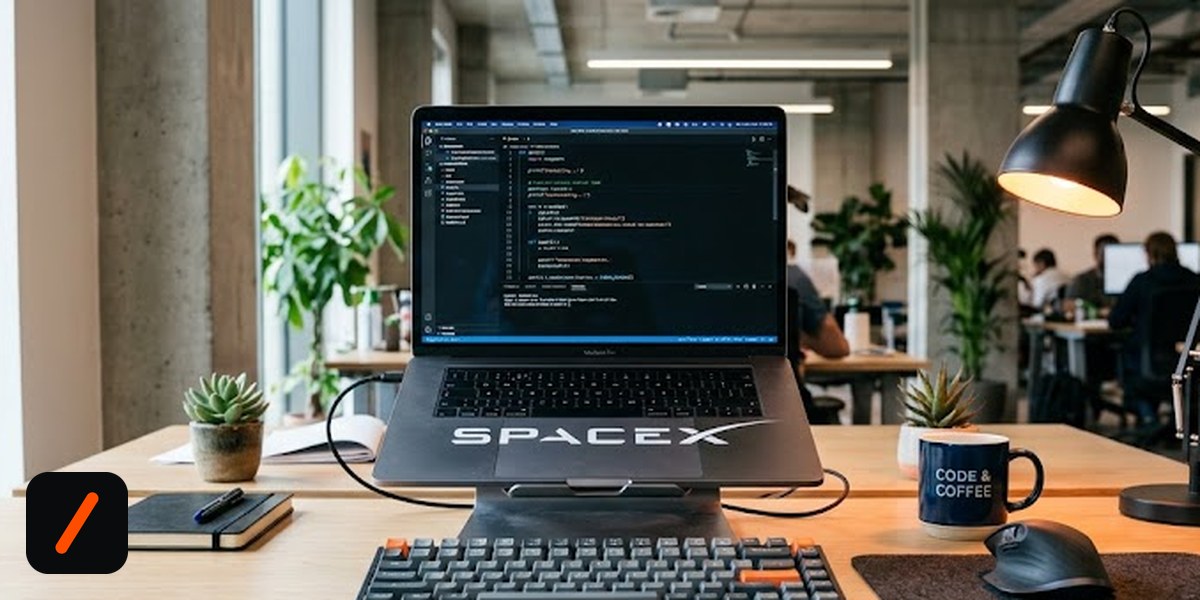
SpaceX owns Cursor now. A securities filing dated August 14 confirms that the $60 billion all-stock acquisition of Anysphere has closed, ending a deal that was signed back in June and spent the summer working through regulatory review. The AI coding tool that a few million developers open every morning is a wholly owned subsidiary of a rocket company.
The filing is more interesting than the announcement was. SpaceX formed a shell subsidiary called X67 Inc. and merged it into Cursor. Cursor survived that merger, which is the standard way to acquire a company without dissolving it, and Anysphere remains the parent entity on paper. Nobody got paid in cash. Cursor shareholders received an aggregate of 389,289,254 shares of SpaceX Class A common stock, priced off the volume-weighted average closing price of SpaceX shares across the seven trading days before the close.
RelatedOpenAI buys NextSlide to aim ChatGPT at PowerPoint
What does the share math actually imply?
Divide the stock by the price tag and you get a number nobody put in a press release. Sixty billion dollars spread across 389,289,254 shares works out to roughly $154 per SpaceX share. That is the level the consideration was struck at, and it is the denomination every Cursor employee's payout landed in. Anyone holding SpaceX stock before August 14 should sit with the other half of that arithmetic: this deal created 389 million new Class A shares out of nothing. Existing holders paid for Cursor through dilution, not from the treasury.
That is the honest read on an all-stock deal, and it cuts both ways. SpaceX spent no cash and preserved its balance sheet for the capital-intensive business of launching things into orbit. Cursor's shareholders took on SpaceX's volatility in exchange for liquidity they could not otherwise get at that size. Whether it was a good trade depends entirely on what SpaceX stock does from here, which is a question this filing cannot answer.
Why was Cursor still buying companies the day before?
Here is the detail that says the most about how this was negotiated. On August 13, one day before the merger became effective, Cursor announced that Firetiger had joined the company. A business being absorbed for $60 billion was still making its own acquisitions on the eve of completion, which does not happen unless the acquirer has agreed to keep its hands off operations. Cursor had already bought Graphite in December 2025 and kept doing so straight through the close.
Cursor also kept its name, its blog, and its own framing of what just happened. The company's line is that SpaceX builds computing capacity while Cursor remains one place where that capacity becomes useful. Alongside the Firetiger news, Cursor claimed it would now have the largest fleet of GPUs in the world and that this would let it build stronger models that are cheaper to run. Treat the second half of that claim carefully. Owning more GPUs lowers your marginal cost of training only if you were previously renting them at a markup, and it does nothing for inference economics if your models get correspondingly larger.
- Dec 2025Cursor acquires Graphite code review tooling
- Jun 2026Binding agreement signed with SpaceX $60B, all stock
- Aug 13Cursor announces Firetiger has joined one day before close
- Aug 14Merger effective, filing published X67 Inc. merges into Cursor
- Aug 15Close confirmed publicly team moves into SpaceXAI
What changes for developers using Cursor?
Nothing this week. Product, pricing, and the editor itself are unchanged, and the deal terms explicitly preserve the brand. The change that matters is organizational: the Cursor team now sits inside the SpaceXAI division, alongside Grok Build and Grok Bot, and integration between those products is stated intent rather than speculation.
That is the thing to actually watch. A coding tool that was previously model-agnostic now reports into an organization with its own frontier model line. Cursor's appeal for a lot of teams was that it would route you to whichever model was best for the task, and it has been willing to say publicly when that was not its own. Independent evaluation makes the tension concrete: on our AI coding leaderboard, Cursor's own Composer 2.5 sits at 79.6% on SWE-bench Verified, well behind the frontier models Cursor currently lets you select. If the SpaceXAI relationship starts shaping default routing, that gap is where it will show up first.
RelatedHadrian raises $1.37B to automate defense manufacturing
What it means for the market
For anyone holding SpaceX stock, the concrete number is the 389 million new Class A shares, not the $60 billion headline. Dilution of that size is the real cost of the deal to existing holders, and it is already done rather than pending. The forward question is whether an AI coding subscription business, which sells seats to developers at tens of dollars a month, meaningfully changes the earnings profile of a company whose economics are launch cadence and satellite bandwidth. Those are very different businesses with very different margins, and the burden of proof sits with the acquirer.
The signal for investors is in the integration disclosures over the next two quarters. Watch whether SpaceX starts reporting SpaceXAI as its own segment, whether Cursor's revenue is broken out at all, and whether developer seat growth survives the ownership change. None of that is investment advice, and it is worth saying plainly that a $60 billion price for a subscription tool is a bet on where AI coding goes next rather than on what it earns today.
- Model routing defaults. If Cursor quietly starts preferring SpaceXAI models over higher-scoring third-party ones, that is the first real cost of the acquisition to users.
- Whether the autonomy holds. Cursor kept acquiring right up to the close. If that stops abruptly, the operational independence was a closing condition, not a philosophy.
- Segment reporting. SpaceX has never had to explain a software subscription business to shareholders before.
- Talent retention. All-stock deals lock people in through vesting. The interesting departures happen at the twelve-month mark, not now.
Our take
The number everyone will repeat is $60 billion. The number that tells you more is 389,289,254, because it says SpaceX paid for the most valuable AI coding company on earth without spending a dollar, and existing shareholders absorbed the cost through dilution they did not vote on line by line. That is not a criticism, it is just what an all-stock acquisition is, and it deserves to be stated in plain terms rather than buried in a filing.
The strategic logic is coherent if you accept the premise that compute and the tools that consume it belong under one roof. We are not sure that premise holds. Cursor's advantage was never infrastructure, it was taste in developer experience and a willingness to route users to the best available model regardless of who made it. Those are cultural assets, and cultural assets are exactly what large acquisitions are worst at preserving. The Firetiger timing suggests SpaceX understands this. The next twelve months will show whether understanding it is enough.
- FilingSpace Exploration Technologies Corp. 8-K, material event share count, merger-sub structure and VWAP pricing mechanism
- ReferenceSpaceX has closed its $60bn Cursor deal Firetiger timing and the GPU-fleet claim
- RegulatorySpaceX finalizes regulatory procedures to close acquisition pre-close regulatory sequence
- BenchmarkGENZ TECH AI coding leaderboard independent SWE-bench Verified scores, including Composer 2.5
Original analysis by GenZTech. Share-price implication derived from the filing's own figures.