
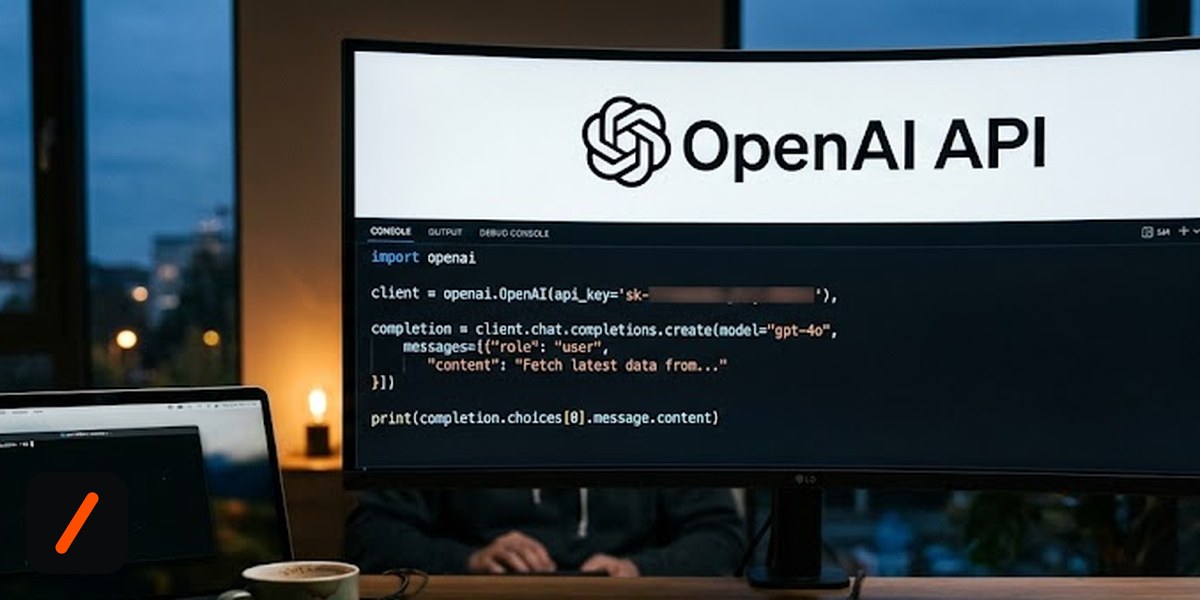
OpenAI is previewing Ultrafast mode, an API tier that serves GPT-5.6 Sol at up to 14 times standard speed. The company posted the announcement this evening, said it launches first to a select group of customers, and added that access widens to more businesses as capacity grows. That last clause is the part worth reading twice.
Until tonight the OpenAI API had two speeds. Standard is the default. Fast mode, renamed from Priority processing on July 30, runs GPT-5.6 Sol at up to 2.5x standard for twice the standard price, with no change in intelligence. Ultrafast is a third rung, and it is not a modest step up: 14x is 5.6 times the ceiling of the tier OpenAI shipped six weeks ago.
RelatedOpenAI Ships GPT-5.6 but the Government Locks the Door
What exactly did OpenAI say?
Very little, which is normal for a preview. The announcement names the tier, names the model, gives the multiplier, and describes the rollout: API first, a select group of customers, expanding as capacity allows. Almost everything a developer would want next is missing. There is no price. There is no service_tier string to pass. There is no general availability date, no tokens per second figure, and no word on whether the tier handles long context prompts.
OpenAI's developer documentation still describes exactly two tiers tonight, default and fast, with priority accepted as a legacy alias for the latter. Docs trailing a preview post by hours is routine, so the gap is not a contradiction. It does mean nobody outside the allowlist can call this thing yet.
- Ultrafast mode runs GPT-5.6 Sol at up to 14x standard API speed, per OpenAI's own announcement.
- It goes to a select group of API customers first, and wider access is tied explicitly to capacity rather than to a date.
- Fast mode, the existing premium tier, tops out at 2.5x standard for 2x the price. Ultrafast pricing has not been disclosed.
- Speed tiers do not change model quality. Sol's benchmark scores are identical whichever tier serves the tokens.
Why does "as capacity grows" matter more than the 14x?
Because of what it rules out. A software side speedup, better batching, speculative decoding, a cheaper draft model, does not need an allowlist. You ship it, the scheduler picks it up, and everyone on the tier benefits at once. Rationing by capacity is what you do when the speed is coming from hardware you have a finite amount of.
We covered the most likely source of that hardware on July 11, when OpenAI began serving GPT-5.6 Sol on Cerebras wafer-scale engines for a limited customer set at up to 750 tokens per second, roughly 15x what clustered GPU serving typically manages for a frontier model. OpenAI did not mention Cerebras tonight, so treat the link as inference and not confirmation. The shapes match closely, though: 14x tonight against roughly 15x in July, and the same select-customers-first pattern in both.
If that reading holds, Ultrafast mode is mostly a product name for a serving arrangement that already existed. The announcement is less about a new capability than about turning a private arrangement into something with a tier label, which is how it eventually reaches everyone else.
How does Ultrafast compare with Fast mode?
| Standard | Fast mode | Ultrafast (preview) | |
|---|---|---|---|
| Speed vs Standard | 1x | up to 2.5x | up to 14x |
| Price vs Standard | 1x | 2x | not disclosed |
| service_tier value | default | fast (priority accepted) | not published |
| Who can use it | every API customer | self-serve | select customers, expanding with capacity |
| Long context prompts | yes | yes, above 272K tokens | unstated |
| Effect on output quality | baseline | none, per OpenAI | none stated |
The gap between the two rightmost columns is the whole story. Fast mode is a scheduling decision: pay double, get moved up the queue on the same underlying fleet. Ultrafast, gated on capacity rather than on willingness to pay, reads like a supply decision instead.
Who actually needs 14x?
Sol is OpenAI's heaviest model, pitched at biology, chemistry and cybersecurity work, and it sits second on our AI Coding Leaderboard at 96.2% on SWE-bench Verified as independently measured by vals.ai. A speed tier does not move that number, and OpenAI has been careful to say exactly that about Fast mode: same intelligence, faster delivery.
Where speed changes the product is anything that calls the model in a loop. One response arriving in eight seconds instead of two is a mild irritation. A thirty step agent chain paying that cost at every step is a coffee break. Latency compounds in agentic work, and agentic work is precisely what OpenAI, Anthropic and Google have spent the past year pushing developers toward. Interactive coding assistants, long tool chains, voice, and anything with a person waiting on the other end are where a 14x tier stops being a spec sheet number.
RelatedOpenAI Previews GPT-5.6 With Sol, Terra, and Luna, and the Real Story Is the Tiering
The catch is the access model. If you cannot get on the list, the tier is unavailable at any price, which is a different constraint from one that is merely expensive. It also favours large incumbent customers over the developer shipping something new this week.
What does it mean for the market?
If OpenAI's fastest tier depends on capacity it has to build rather than software it can ship, the exposure sits on the silicon side. Nvidia (NVDA) still supplies the overwhelming majority of the compute behind standard and Fast mode serving, and nothing announced tonight changes that for the volume tiers. What a capacity gated premium tier does signal is where non-Nvidia inference silicon gets its opening: a small share of total tokens, but the share buyers will pay the most for. Cerebras is private, so there is no clean way to express that thesis in public markets.
The read for investors is narrower than "Nvidia loses inference". Watch whether the tier stays gated, and for how long. A tier that opens to self-serve within weeks means the supply was never especially scarce. One still sitting behind an allowlist at year end means OpenAI has found a serving path it cannot buy enough of, which is a more interesting fact than any benchmark this quarter.
- Jul 8, 2026GPT-5.6 goes public Sol, Terra and Luna ship as the new lineup.
- Jul 11, 2026Sol lands on Cerebras wafer-scale silicon Select customers, up to 750 tokens per second.
- Jul 30, 2026Priority processing becomes Fast mode Sol raised to 2.5x standard speed at 2x the price.
- Aug 2026Fast mode extended to long context Prompts above 272K tokens keep the 2.5x tier.
- Aug 13, 2026Ultrafast mode preview announced Up to 14x, API first, select customers.
- NextPricing, a service_tier string, wider access None of the three has a date attached yet.
- The price. Fast mode charges 2x for 2.5x. Ultrafast's multiplier is 5.6 times higher and its supply is constrained, so whatever number OpenAI lands on will say more about the serving economics than tonight's post did.
- The service_tier string. When a third value shows up in the API reference next to default and fast, the tier is real for everyone rather than for an allowlist.
- Long context. Fast mode needed a separate rollout before it handled prompts past 272K tokens. Do not assume Ultrafast arrives with that already working.
- Sustained versus peak. "Up to 14x" is doing real work in that sentence. The number that matters is what a long generation averages, not what the first tokens hit.
Our take
The 14x is the least interesting number in the announcement. What stands out is the cadence: the Priority to Fast rename on July 30, long context support added to Fast mode shortly after, and now a third tier on August 13. Six weeks, three shipped changes, every one of them about latency rather than capability. OpenAI has decided that speed is a product line, priced and rationed separately from intelligence.
For anyone building agents that reframing matters more than another point of SWE-bench, because the wall clock cost of a loop becomes a purchasing decision. Teams that can buy their way down the latency curve will ship agent products the rest cannot match on responsiveness. Whether that is healthy for the ecosystem depends almost entirely on how long "select group of customers" turns out to last.
- OfficialOpenAI on X the Ultrafast mode preview announcement
- ReferenceOpenAI API: Fast mode the two tiers documented today, and the July 30 rename
- BenchmarkGenZTech AI Coding Leaderboard where GPT-5.6 Sol ranks on independently verified evals
- ContextOpenAI puts GPT-5.6 Sol on Cerebras wafer-scale silicon our July 11 report on the 750 tokens per second serving deal
Original analysis by GenZTech. Source: OpenAI on X.