
OpenSEO is an open source, self-hostable alternative to Semrush and Ahrefs that pulls real keyword, rank, and backlink data using your own pay-as-you-go DataForSEO key instead of a monthly SaaS subscription, and it is one of the hottest repositories on GitHub trending today, adding more than 600 stars in a single day on top of nearly 16,000 total. The pitch is aimed squarely at developers: fork it, run it in Docker, and wire it straight into Claude Code so an AI agent can run the SEO grunt work for you.
- OpenSEO ships MIT licensed with a built-in MCP server and prebuilt Agent Skills, so Claude Code, OpenClaw, or Hermes can run keyword research, rank tracking, and site audits directly from a chat.
- There is no OpenSEO subscription: you bring a DataForSEO API key and pay DataForSEO directly for the data you pull. New DataForSEO accounts include $1 of free credit to test with.
- Self-hosting with Docker takes two commands once Docker itself is installed:
cp .env.example .envanddocker compose up -d. - Docker mode runs with authentication disabled by design (
AUTH_MODE=local_noauth), so it is meant for your own machine, not the open internet, unless you put it behind your own auth-protected proxy.
The exact steps, start to finish
- Step 1. Check your prerequisites. OpenSEO's Docker path needs Git and Docker with Compose. Confirm all three are installed first:
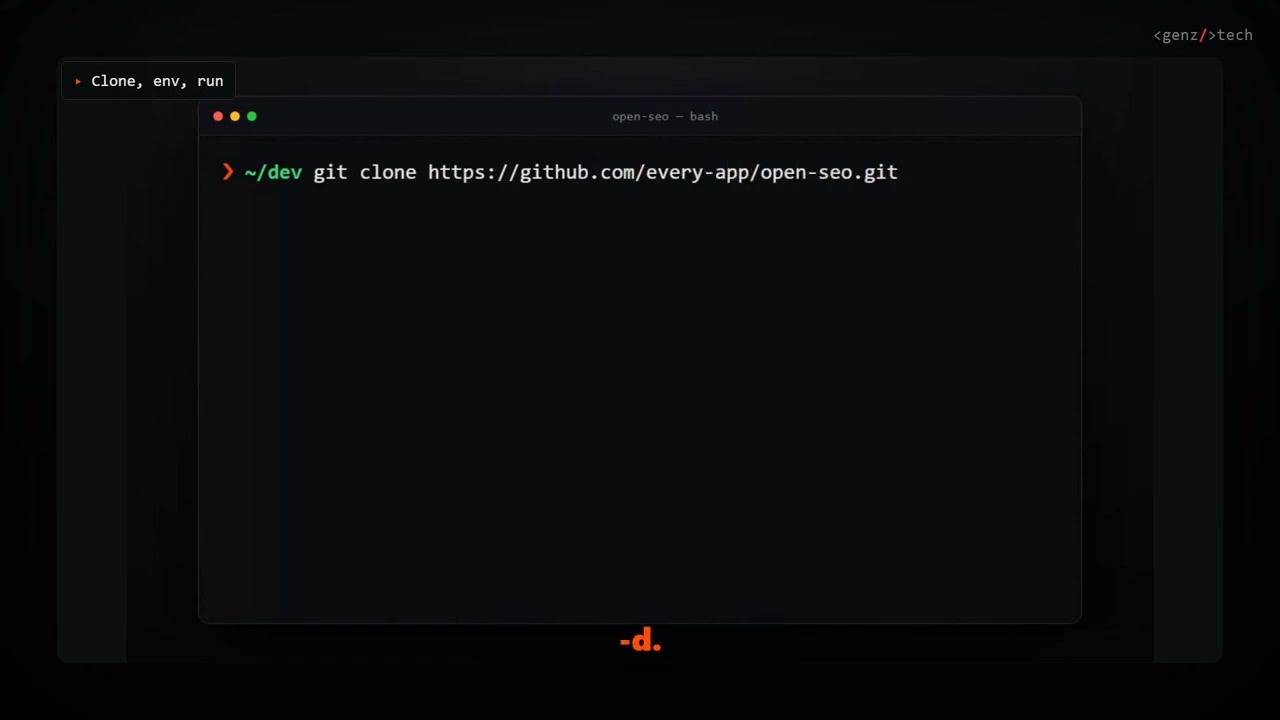
# confirm Git and Docker are ready git --version docker --version docker compose version - Step 2. Clone the repository.
git clone https://github.com/every-app/open-seo.git cd open-seo - Step 3. Create your environment file.
cp .env.example .env - Step 4. Get a free DataForSEO API key. OpenSEO has no data of its own; it fetches everything live from DataForSEO, a separate pay-as-you-go provider. Go to app.dataforseo.com/api-access and create an account (new accounts get $1 of free credit). Click "Send by email," then copy the longer credential labelled "Base64," which is your email and API password already encoded as
email:password. Open.envin a text editor and set:DATAFORSEO_API_KEY=your_base64_credential_here - Step 5. Start OpenSEO.
The first start builds the app and can take 1-2 minutes. Watch progress withdocker compose up -ddocker compose logs -fif you want to see it happen. - Step 6. Open the dashboard and run your first real query. Visit
http://localhost:3001in a browser. Docker mode logs you in automatically as the local admin, no password needed. Pick any workflow, Keyword Research is the simplest, type in a real keyword or a competitor's domain, and confirm the results populate from your DataForSEO key. That live pull is the whole point: a working SEO tool you control end to end.
What is OpenSEO and why is it trending?
OpenSEO is a TypeScript project from developer Ben Senescu, built to run on Cloudflare's stack (the repo ships Wrangler config and Cloudflare Workers deploy scripts alongside the Docker path) and released under the MIT license. Its six core workflows, keyword research, rank tracking, competitor insights, backlinks, site audits, and AI visibility, cover the same ground as Semrush or Ahrefs, but the delivery model is inverted. Instead of a closed platform that bundles software and data behind a flat monthly fee, OpenSEO is just the software: free, forkable, and yours to run, while the data itself comes from DataForSEO, a third-party broker you pay directly and only for what you use. The latest tagged release, v0.1.6, shipped on August 19, 2026 and added shared project context for its AI features, Google Analytics integration, and beta OpenSEO skills built into its "SAM" assistant. The trending spike lines up with a real shift in how developers think about SEO tooling: instead of a human clicking through a dashboard, the pitch is an agent that runs the workflows unsupervised, which is exactly what the MCP server and Agent Skills are built for.
RelatedEver Gauzy Setup: Self-Host an Open Source ERP and CRM
How does OpenSEO connect to Claude Code and other AI agents?
OpenSEO exposes an MCP server so any MCP-capable client, Claude Code, OpenClaw, or Hermes among them, can call its SEO workflows as tools instead of a person navigating a UI. On top of that, OpenSEO ships Agent Skills: reusable, documented workflows that walk an agent through a specific SEO task using the MCP connection underneath. The project's own docs cover exact setup for both at openseo.so/docs/mcp and openseo.so/docs/skills/setup. The README also demonstrates the general pattern for pulling in one of its skills through the community skills CLI:
# install one of OpenSEO's published skills into your agent
npx skills add every-app/open-seo --skill simple-issue-description
Because the dashboard and the MCP server are the same self-hosted instance, an agent working through MCP sees the identical data a human would see in the browser, which is what makes "ask Claude Code to audit this competitor's backlinks" an actual working request instead of a demo.
What does self-hosting actually cost?
OpenSEO itself is free. The bill you actually pay is DataForSEO's, and it is worth sizing up front: new accounts get $1 of free credit, but the minimum top-up after that is $50. That is fine for a solo developer running occasional audits, and expensive if you were expecting a truly zero-cost tool. If you want OpenSEO's AI assistant features, such as SAM, you also need a separate OPENROUTER_API_KEY from OpenRouter, on top of the DataForSEO key. If self-hosting still feels like too much infrastructure, the maintainers run a hosted version at openseo.so for $10 a month, which the docs note carries a 28% markup on DataForSEO calls, the price of not running your own server.
How does OpenSEO compare with Semrush and Ahrefs?
| Trait | OpenSEO | Semrush | Ahrefs |
|---|---|---|---|
| Hosting | Self-hosted (Docker or Cloudflare) | Vendor cloud only | Vendor cloud only |
| Pricing | Pay-as-you-go via DataForSEO, no subscription | From $139.95/mo | From $129/mo |
| Source | Open source, MIT | Proprietary | Proprietary |
| AI agent access | Native MCP server + Agent Skills | Limited/none | Limited/none |
| Data ownership | You hold the API key and the instance | Vendor-controlled | Vendor-controlled |
The trade-off is depth versus control. Semrush and Ahrefs have spent years building proprietary crawl indexes and polish that a young self-hosted project cannot match overnight. OpenSEO's answer is not to out-crawl them, it is to remove the subscription tax and hand the whole stack, UI included, to whoever wants to fork it.
RelatedMacro Setup: Self-Host the Open Source Slack and Linear Rival
What are the gotchas before you rely on it?
Four things worth knowing before this becomes part of your workflow. First, Docker self-hosting ships with authentication disabled by default, fine for a laptop, dangerous on a public IP without your own reverse proxy or tunnel in front of it. Second, DataForSEO's $50 minimum top-up means the free tier is really just a trial, budget for the real cost once you move past testing. Third, the project is genuinely young, 121 open issues at the time of writing and a changelog that is still actively reshuffling features like Google Analytics integration and AI skills, so expect rough edges. Fourth, OpenSEO collects anonymized telemetry by default, install counts and feature usage tied to a random install ID, not URLs or keywords, but if that matters to you, set OPENSEO_TELEMETRY_DISABLED=1 in your .env before you forget.
- AI Skills maturing. SAM and the built-in Agent Skills are marked beta; whether they reach parity with the MCP path is the real product bet.
- Cloudflare self-hosting getting simpler. The maintainers admit the Cloudflare path is currently the harder of the two; watch for that gap closing.
- DataForSEO cost at scale. Pay-as-you-go is cheap for occasional use and can add up fast for a team running continuous rank tracking, worth modeling before committing a whole workflow to it.
Our take
OpenSEO's real bet is not out-crawling Semrush or Ahrefs on raw data depth, DataForSEO is a shared data broker plenty of tools already sit on top of. The bet is that SEO grunt work, rank checks, competitor audits, keyword sweeps, is repetitive enough that it should run through an agent unsupervised, and that developers would rather own that pipeline than rent it. Cutting the subscription entirely and replacing it with a pay-only-for-what-you-pull model is a smart, honest trade for anyone already comfortable with Docker and an API key. It is not a tool for someone who just wants a polished dashboard with zero setup, and the authentication-disabled default means you have to take self-hosting seriously rather than treating it as a toy. For a developer who already lives in Claude Code, though, a fifteen-minute setup that ends with an agent that can genuinely run your SEO audits is a fair trade for the extra control.
- Officialevery-app/open-seo repository, README, and self-hosting docs
- OfficialDocker self-hosting guide exact setup commands and environment variables
- Officialopenseo.so hosted version, pricing, and MCP/Skills docs
- ReferenceDataForSEO the pay-as-you-go data provider OpenSEO runs on
Original analysis by GenZTech. Tool documentation: every-app/open-seo on GitHub.