
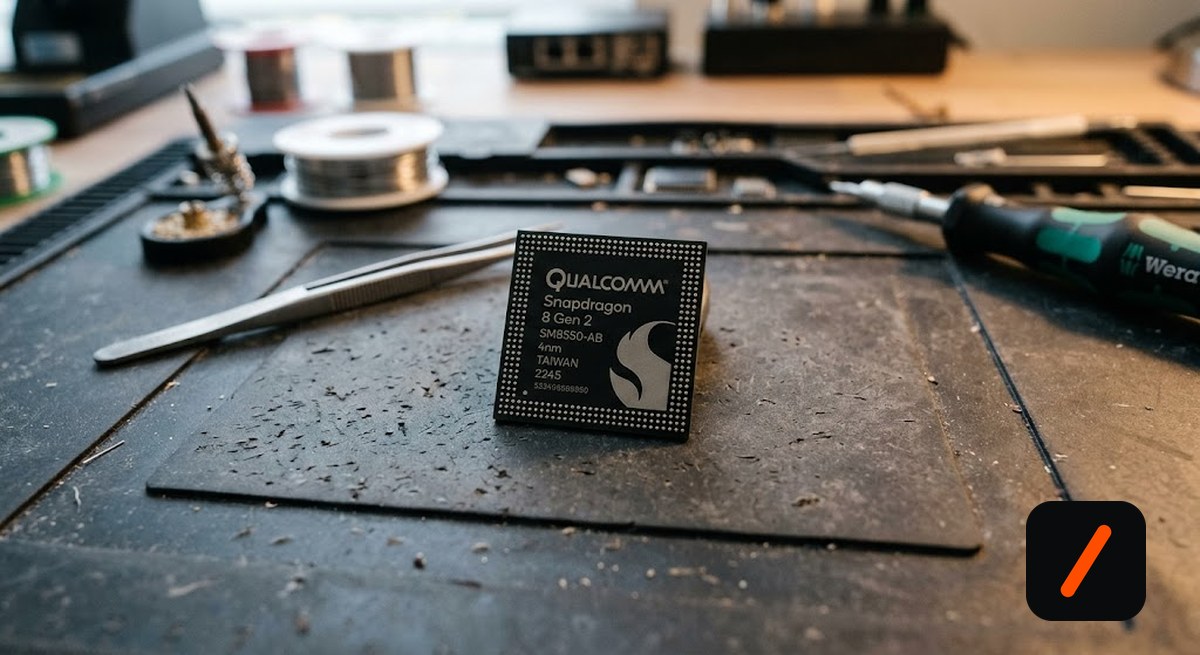
Qualcomm entered talks to acquire Modular Inc. for roughly $4 billion, and the target tells you the strategy: this is a software buy, not a silicon one. Modular builds MAX and the Mojo language, an AI infrastructure layer meant to run models fast across many chips. Qualcomm makes excellent hardware but has never had the software moat that lets Nvidia charge a premium. Buying Modular is an attempt to close exactly that gap as Qualcomm pushes into data-center AI.
- Qualcomm is reportedly in talks to acquire Modular Inc. for about $4 billion, folding in the MAX serving stack and the Mojo programming language.
- The deal complements Qualcomm's new Dragonfly data-center roadmap for the agentic-AI era, unveiled alongside an expanded Hugging Face partnership.
- The prize is a CUDA-style software moat: portable, high-performance inference that is not locked to one vendor's GPUs.
- It signals Qualcomm widening beyond phones into the compute layer of AI, where margins and lock-in actually live.
Why buy a software company for AI hardware?
Because the money in AI compute increasingly sits in the software that makes chips usable. Nvidia's durable advantage is not just fast GPUs; it is CUDA, a mature stack that developers already know and that keeps them from leaving. Everyone selling an alternative accelerator hits the same wall: the hardware may be competitive, but the software to program it, optimize it, and serve models on it is immature. Modular was founded to attack that wall with MAX, a serving engine, and Mojo, a language designed to hit hardware-level performance while staying portable across chips. For Qualcomm, buying that is faster than building it.
RelatedNvidia Bets $3.5 Billion on MediaTek to Ride the Custom-Chip Wave
What does Modular actually bring?
Modular's pitch is portable performance: run inference at high speed without hand-rewriting kernels for every new chip. MAX handles model serving and optimization, while Mojo aims to give Python-like ergonomics with C-like speed for AI workloads. Paired with Qualcomm's Dragonfly data-center roadmap and its recent Hugging Face tie-up, the combination could let Qualcomm tell customers a full story: here is the silicon, here is the software to serve your models on it, and neither locks you to a single GPU vendor. That vendor-neutral angle is the wedge against Nvidia.
| Layer | Nvidia | Qualcomm + Modular |
|---|---|---|
| Silicon | Data-center GPUs | Dragonfly accelerators |
| Software moat | CUDA (deep, sticky) | MAX + Mojo (portable) |
| Lock-in | High | Pitched as vendor-neutral |
| Maturity | 15+ years | Early, acquiring the gap |
Who is affected if this closes?
Nvidia most directly, because a credible portable software layer chips at the reason customers tolerate GPU lock-in. AMD and Intel are affected too, since a strong neutral stack could run on their chips as easily as Qualcomm's, reshaping how buyers evaluate accelerators. And Modular's developer community faces the usual acquisition question: does an independent, cross-vendor project stay neutral under a hardware owner, or does it quietly tilt toward the parent's silicon over time? The answer will decide whether the moat Qualcomm is buying actually holds.
What it means for the market
For investors, the read on Qualcomm (NASDAQ: QCOM) is a deliberate push up the value chain, away from smartphone-modem dependence and into the higher-margin AI compute layer where software creates pricing power. A $4 billion price is modest against the data-center opportunity if the software actually differentiates the silicon. The risk for Nvidia (NASDAQ: NVDA) is not immediate, its CUDA lead is measured in years, but a well-funded portable alternative is exactly the kind of long-term threat that erodes lock-in slowly. Watch whether other chipmakers respond by backing neutral software stacks of their own.
RelatedNvidia's LPU Bets Inference Needs Its Own Silicon
- Deal confirmation. These are talks; price and structure can still move or fall apart.
- Mojo neutrality. Whether Modular stays cross-vendor or tilts to Qualcomm silicon decides the moat's value.
- Dragonfly design wins. Real cloud customers, not benchmarks, prove the combined pitch.
- Nvidia's response. CUDA licensing or pricing shifts would signal it takes the threat seriously.
What could derail the deal?
Regulators are the obvious wildcard. A major chipmaker absorbing a cross-vendor AI software project invites antitrust scrutiny, especially if watchdogs worry that Modular's neutrality is the very asset being bought and then bent inward. Beyond approval, there is integration risk: infrastructure software is only as good as the community and talent around it, and acquisitions routinely trigger departures that hollow out the thing that made the target valuable. Qualcomm will need to keep Modular's engineers, keep Mojo credible on rival silicon, and resist the temptation to quietly favor its own chips. Any of those going wrong turns a $4 billion moat into $4 billion of goodwill.
Our take
This is the most interesting thing Qualcomm has done in years precisely because it admits the real problem. Chipmakers keep learning that competitive silicon is not enough when the software ecosystem belongs to someone else. Buying Modular is Qualcomm skipping the decade of ecosystem-building that Nvidia already banked, and betting that portable performance is a feature enough customers want to pay for. The catch is cultural and strategic: acquired infrastructure projects only keep their momentum if they stay genuinely useful across the whole market, and a hardware parent always faces the temptation to optimize for its own chips. If Qualcomm resists that temptation, it may have just bought the one thing money usually cannot: a credible reason to leave CUDA.
- OfficialQualcomm Newsroom Dragonfly data-center roadmap
- ReferenceModular MAX and Mojo documentation
- ReportingCNBC reported $4B acquisition talks
Original analysis by GenZTech. Figures current as of July 2026.