
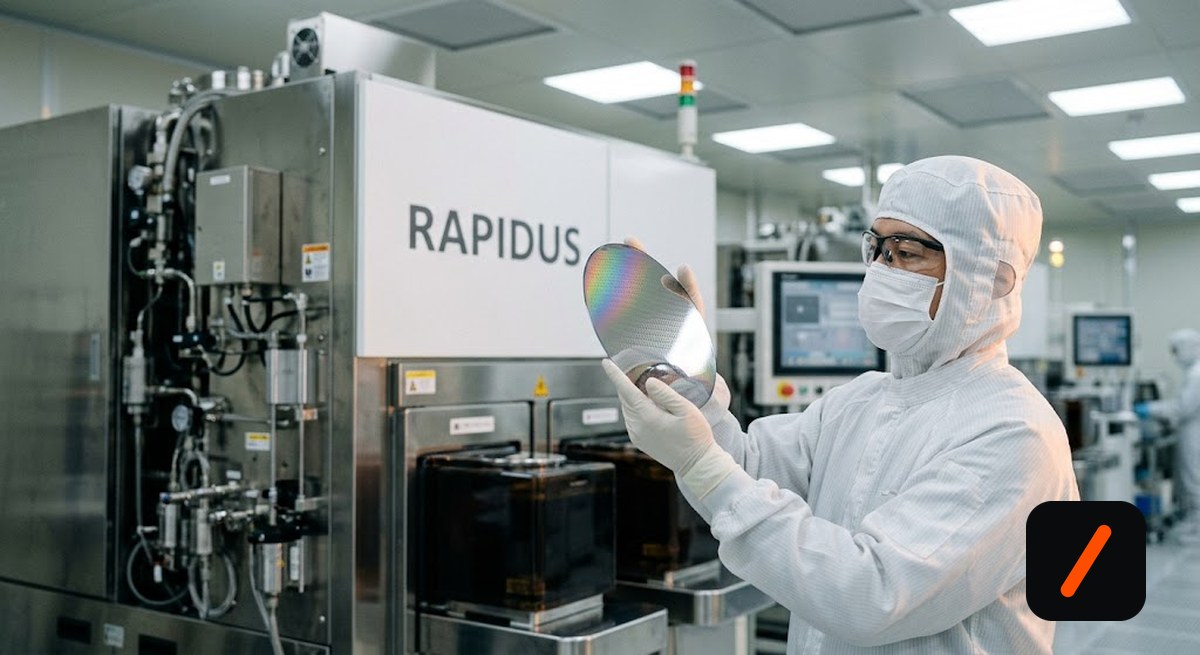
Japan’s state-backed foundry Rapidus plans to price 2nm-class silicon at roughly $20,000 per wafer when it opens for business in 2027, undercutting TSMC’s leading-edge rates. It is a direct attack on the pricing power of the world’s most important chipmaker, and the first credible one in years.
- Rapidus is targeting ~$20,000 per 2nm wafer in 2027, positioned below TSMC’s comparable leading-edge pricing.
- The company is Japan’s national bet on returning to the frontier, backed by government money and partners including IBM for the 2nm process.
- TSMC’s 2nm (N2) volume production is sold out, and the foundry has been raising wafer prices into that demand.
- A lower-cost second source at the frontier would matter most to the AI and HPC customers currently paying TSMC’s premium.
What actually happened?
Rapidus, the Japanese foundry consortium formed to put the country back on the semiconductor frontier, signaled it will price its 2nm-class wafers around $20,000 when the process reaches customers in 2027. That undercuts TSMC, whose 2nm (N2) node has sold out its initial volume production and whose wafer pricing has been climbing on the back of relentless AI demand. Rapidus has developed its 2nm process in partnership with IBM and is building capacity with heavy government backing, framing low pricing as the wedge to win its first customers against an incumbent that has no capacity to spare.
RelatedTSMC Hikes Wafer Prices as Its Foundry Grip Tightens
Why would a startup foundry lead with price?
Because price is the one lever a newcomer controls. TSMC’s advantage is not just process quality; it is a decade of yield learning, packaging, and a customer base that cannot risk a second source that slips. A brand-new foundry cannot promise proven yield on day one, so it competes on cost and on being a strategic alternative for customers nervous about single-sourcing their most advanced chips from one company on one island. For Japan, the subsidy math is national industrial policy, not quarterly margin, which lets Rapidus price below where a purely commercial entrant could.
| Foundry | Rapidus | TSMC | Intel Foundry | Samsung |
|---|---|---|---|---|
| Leading node | 2nm (2027 target) | N2 (in volume) | 18A | SF2 |
| 2nm wafer price | ~$20K target | rising, sold out | competitive | discounting |
| Backing | Japan gov + IBM | Commercial scale | US CHIPS + IDM | Chaebol + gov |
| Proven yield | Unproven | Best in class | Improving | Mixed |
Who is actually affected?
The customers who feel this first are the AI and high-performance-computing designers paying TSMC’s premium because they have nowhere else to go at the leading edge. A viable second source, even a discounted one with unproven yield, gives them negotiating leverage they lack today. It also matters to the memory and packaging supply chain: a new leading-edge fab in Japan changes where advanced logic gets built and packaged, and Japan has been rebuilding that ecosystem deliberately.
- Yield, not price. $20K wafers are irrelevant if defect density is high. The first real customer tape-outs in 2027 are the honest test.
- Anchor customer. Rapidus needs one marquee logic customer to prove the node. Watch who signs first.
- TSMC’s reaction. The incumbent rarely cuts price; it competes on capacity and packaging. See whether N2 pricing holds regardless.
What it means for the market
The signal for investors is that leading-edge foundry pricing, long a one-vendor story, may finally face downward pressure by 2027. TSMC (TSM) is not dented near-term given sold-out N2 capacity, but a credible discounted alternative changes the long-run pricing narrative that has driven its margin expansion. For fabless designers, optionality at 2nm is a cost tailwind if Rapidus delivers. The larger read is geographic: Japan re-entering the frontier alongside Taiwan, the US and Korea diversifies where the most advanced chips are made, which matters to anyone modeling supply risk. This is analysis, not investment advice.
RelatedTSMC Starts 2nm Volume Production, Already Sold Out
How does this fit Japan's chip strategy?
Rapidus is not a normal commercial startup, and reading it as one misses the point. It is the centerpiece of a national effort to rebuild capabilities Japan let atrophy after dominating memory and materials for decades. The country still supplies critical chemicals, photoresists and equipment to the entire industry, but it fell off the leading edge of logic manufacturing years ago. Rapidus is the bet to climb back on, and the government treats it as strategic infrastructure rather than a return-seeking investment, which is why it can absorb the losses that leading-edge fab construction guarantees in the early years. That patience is both the opportunity and the risk. It buys Rapidus time that a purely private entrant would never get, letting it price aggressively and iterate on yield without the market punishing every stumble. But state backing does not manufacture the tacit engineering knowledge that TSMC accumulated over hundreds of production runs, and no subsidy shortcuts the learning curve of getting defect rates low enough to matter. Japan can fund the factory; it cannot fund experience into existence. The 2027 launch is where money meets reality.
Our take
Price leadership is the only door open to a new foundry, and Rapidus is walking through it loudly. The wafer number is a marketing anchor until the yield data lands, and yield is where every ambitious foundry challenger has stumbled before. But the strategic point stands: the industry has spent years assuming leading-edge logic means TSMC, full stop. In 2027 that assumption gets tested for the first time in a long while, and even a partial success reshapes the leverage every chip designer brings to the table.
- OfficialRapidus company and 2nm program
- ReferenceTom’s Hardware foundry pricing and N2 demand coverage
Original analysis by GenZTech. Figures current as of July 2026. Source: SemiEngineering.