
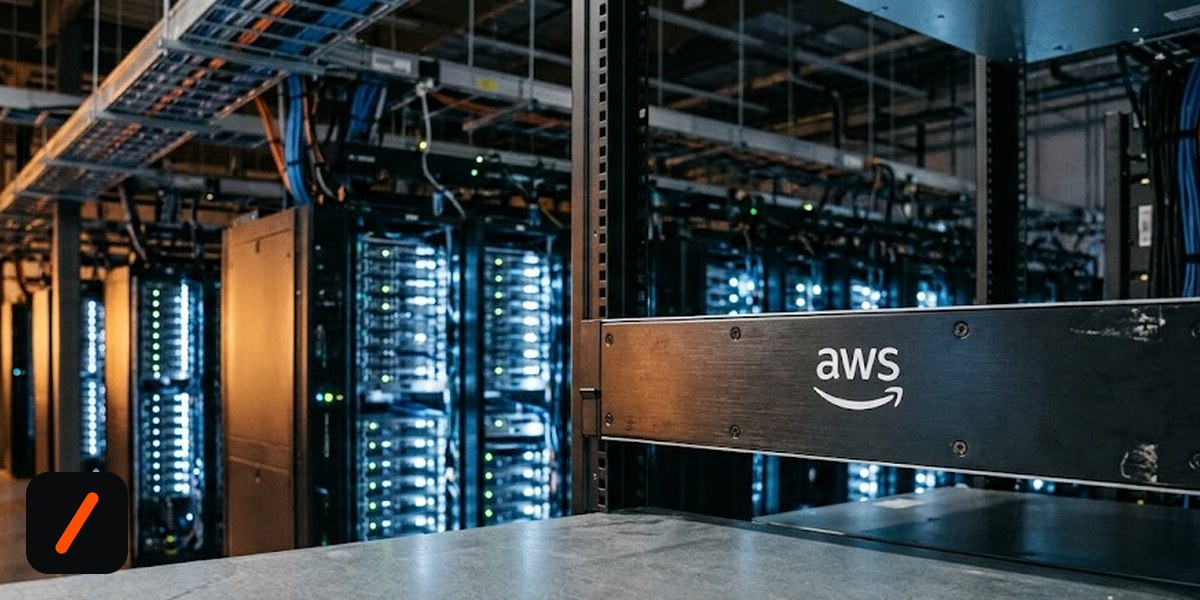
Recursive Superintelligence signed a $410 million multi-year compute agreement with Amazon Web Services on July 28. The interesting number is not $410 million. It is the ratio. Recursive has raised $650 million since leaving stealth in May, which means roughly 63 percent of every dollar the company has ever taken in is now committed to one vendor's machines.
Most startups do not look like that. Payroll is normally the largest line item at a company this young, and cloud spend is something finance tries to talk down every quarter. Recursive has inverted it on purpose, and the company says so plainly: the budget that would traditionally go to headcount and operations goes into compute instead, because the plan is to automate its own research loop rather than staff it.
RelatedGimlet Labs Raises $300M at $3B to Bet Against Nvidia Lock-In
What did Recursive actually sign?
A multi-year collaboration worth $410 million, announced through Amazon's own press channel, which puts it above the usual tier of vendor-blog partnership language. Richard Socher, the company's CEO and formerly chief scientist at Salesforce, framed it as buying access to a scale of experimentation almost nobody else can run: "Partnering with AWS gives us the infrastructure to run self-improving AI research at a scale very few teams in the world are capable of."
AWS vice president Jason Bennett described the demand curve that makes this kind of contract attractive to a cloud provider: "Self-improving AI creates a compounding demand for compute, every research loop generates the next experiment." Read that as a sales thesis. A customer whose workload grows as a function of its own output is a customer whose bill grows without a salesperson doing anything.
Notably absent from the announcement: which silicon. Amazon did not say whether this runs on Trainium, on Nvidia hardware rented through AWS, or some blend. For a deal of this size that omission is doing work, and it is the first thing worth watching.
What is "self-improving AI" here, concretely?
The pitch is a closed research loop. A system proposes an experiment, runs it, checks the result, and uses what it learned to pick the next experiment, without a human deciding each step. That is the part that consumes compute in a way headcount never could. A team of researchers is bounded by how fast people think. A loop is bounded by how many GPUs you can keep saturated in parallel, which is exactly what the phrase "elasticity to run those loops in parallel at massive scale" in Amazon's announcement is describing.
Recursive claims its automated research system beat a two-year-old human leaderboard record and reached state-of-the-art results on three benchmarks. Which benchmarks, and by how much, the announcement does not say. Treat that as a claim awaiting a paper, not a result.
Why would you concentrate 63 percent with one vendor?
Because at this scale you are not really buying compute, you are buying a reservation. Capacity in 2026 is allocated, not purchased on demand, and a committed multi-year contract is how a company without its own data centers gets a guaranteed slice. The alternative is bidding for spot capacity against every other lab, which is fine until the week you need ten thousand accelerators and so does everyone else.
The cost is the obvious one. Recursive now has a fixed obligation that does not shrink if the research thesis stalls. Cloud commitments of this shape typically bill against the commitment whether or not you consume it, so a quiet quarter is still an expensive quarter.
| Detail | Disclosed | Not disclosed |
|---|---|---|
| Deal size | $410M, multi-year | Exact term length |
| Hardware | "purpose-built compute" | Trainium vs Nvidia vs mix |
| Capacity | None given | Accelerator count, cluster size |
| Results | SOTA on three benchmarks | Which benchmarks, margins |
| Products | "first public results" | Ship date, what it is |
What it means for the market
The signal for investors is not in Amazon's revenue line. $410 million spread across several years is immaterial to a company of AWS's size. The signal is in the customer mix. Amazon has spent two years watching Microsoft own the marquee AI-lab relationship, and landing a Socher-founded lab is a credibility purchase as much as a revenue one. Expect Amazon to keep announcing these, and expect the announcements to keep omitting capacity numbers.
The sharper thing to watch is on the cap table. Nvidia and AMD are both investors in Recursive, alongside Alphabet's GV. Chip vendors funding companies whose main expense is chips is a circular flow that has drawn increasing scrutiny this year, and it is the same structure that made Nvidia's larger financing arrangements a story earlier this month. It is not improper, and both firms invest broadly. But when a supplier's investment returns partly as its own revenue, growth figures get harder to read, and anyone modeling accelerator demand should be discounting for it.
RelatedNvidia put $5B into a startup with no product
For founders, the read is narrower and more useful: a compute-first cost structure is now a fundable thesis. If your pitch is that a loop replaces a research team, investors in mid-2026 will write the check. Our Funding Tracker and the ranked Biggest AI Funding Rounds page both show how quickly the median AI round has drifted toward infrastructure-shaped spending.
- May 2026Recursive exits stealth $650M raised; GV, Nvidia and AMD named as backers
- Jul 28, 2026$410M AWS agreement announced Multi-year, via Amazon's press channel
- NextFirst public results Benchmark claims need a paper to stand up
What could go wrong
Self-improvement loops have a well-documented failure mode: they optimize the metric you gave them, then keep going long after the metric stops meaning anything. A loop that selects its own next experiment will happily spend a hundred thousand dollars of compute climbing a benchmark that does not generalize. Human researchers are slow, but they notice when the work has stopped being interesting.
The second risk is simpler. If the thesis needs another year and the money is spoken for, Recursive raises again on terms set by how the first public results land. That is a lot of weight on one demo.
- The silicon question. If this turns out to be Trainium-heavy, it is Amazon's most significant proof point for its own chips to date. If it is Nvidia rented through AWS, it is a landlord deal.
- A real paper. "State of the art on three benchmarks" with no benchmarks named is a press release, not a result. Named benchmarks with error bars would change the story.
- Headcount. If Recursive stays small while the compute bill runs, the automation thesis is holding. Aggressive hiring would quietly contradict it.
- Whether the structure spreads. One lab spending 63 percent of a round on cloud is an outlier. Three would be a category.
Our take
Strip away the superintelligence framing and this is a bet that compute substitutes for people at a favorable exchange rate. That bet is testable, which is more than can be said for most claims in this category, and the test arrives when the first public results do.
What gives us pause is not the ambition, it is the concentration. Recursive has converted most of its optionality into a fixed obligation before shipping anything, and it did so with two of its own chip suppliers sitting on the cap table. If the research works, nobody will care about the structure. If it does not, the structure is why the runway ended early.
- OfficialRecursive Signs $410 Million, Multi-Year Collaboration with AWS Amazon press center, the deal announcement and both executive quotes
- ReportingRecursive Superintelligence signs $410M compute deal with Amazon TechCrunch, independent confirmation and the $650M raise figure
- FundingGenZTech Funding Tracker Our running record of confirmed AI rounds
Original analysis by GenZTech. Deal terms per Amazon's announcement; the 63 percent figure is our arithmetic on the disclosed $410M and $650M.