
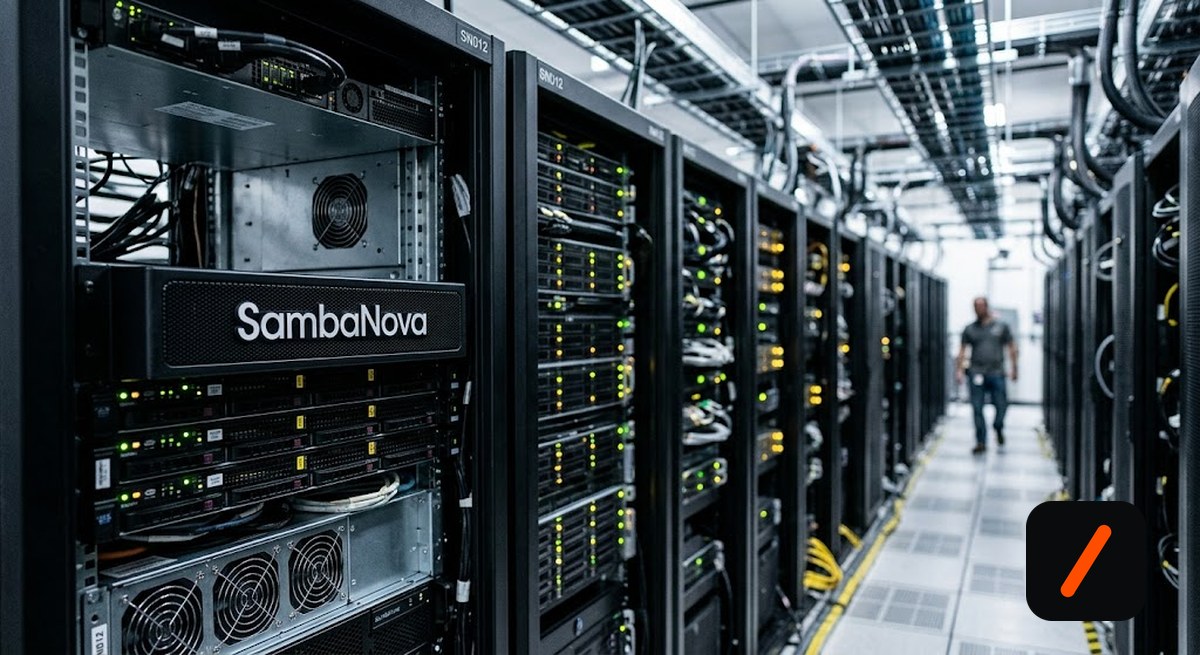
General Compute, an AI inference cloud founded last year, has taken a $400 million loan from tech investment firm Upper90 secured against its chips, and those chips are not Nvidia GPUs. They are SambaNova SN50 accelerators built only to run models, not to train them. As far as anyone in the asset-backed lending market can tell, this is the first time inference-specific silicon has been accepted as loan collateral, and that makes it a more important deal than its size suggests: lenders have just declared that a second class of AI hardware holds its value well enough to borrow against.
- Upper90 lent General Compute $400 million, roughly 27 times the $15 million seed the company raised in May 2026, with the SN50 fleet pledged as security.
- Upper90 pioneered this structure in 2021 with a chip-backed loan to Crusoe, a model later adopted at scale by CoreWeave. Every prior deal used training GPUs.
- General Compute claims its SambaNova-based cloud serves inference up to 16 times faster than GPU-based clouds, and the SN50 needs no water cooling, which shortens data center deployment.
- The signal for the industry is that inference capacity now has a residual value a credit committee will underwrite, opening debt financing to companies that never buy a training cluster.
What actually happened?
Upper90 extended General Compute a $400 million credit facility secured by the company's inference chips, a deal first reported by Tim Fernholz at TechCrunch on July 17, 2026. General Compute is young. It was founded by chief executive Finn Puklowski and chief technology officer Jason Goodison, and it closed a $15 million seed round only in May 2026 to build a cloud dedicated to running trained models rather than building them. The company buys its accelerators from SambaNova, whose SN50 part is designed for inference workloads specifically.
RelatedGimlet Labs Raises $300M at $3B to Bet Against Nvidia Lock-In
The ratio is what stands out. A company that raised $15 million in equity two months ago just borrowed more than 26 times that amount. That is only possible because the lender is not underwriting the startup, it is underwriting the hardware. If General Compute fails, Upper90 takes the chips and sells or redeploys them. The entire question a credit committee had to answer was whether an SN50 fleet is worth something to somebody else.
Why does collateralizing inference chips matter?
Until now, the answer to that question was only ever tested on Nvidia training GPUs. Upper90 co-founder and chief executive Billy Libby has said the firm pioneered chip-backed financing in 2021 with a loan to data center startup Crusoe, and the structure has since become widely used, most visibly by CoreWeave, which built a business on borrowing against GPU fleets. Every one of those deals rested on the same premise: an H100 or a B200 is a liquid, scarce, universally wanted asset, so a lender can treat it like an aircraft or a shipping container.
Inference chips did not obviously qualify. They are more specialized, they come from a smaller vendor with a smaller installed base, and there is no deep secondary market for them the way there is for Nvidia parts. Accepting them as collateral means Upper90 concluded that inference demand is now durable enough, and the hardware fungible enough, to carry a loan. That is a judgment about the shape of the AI market, not just about one startup.
What makes the SN50 financeable when other accelerators are not?
This is the part most coverage skipped, and it is the actual mechanism. Three properties do the work.
First, the workload is generic. A training cluster is often configured for one customer's specific run and can sit idle between contracts. An inference fleet runs whatever model is pointed at it, so its utilization tracks aggregate demand for AI serving rather than any single tenant's roadmap. From a lender's perspective that is a far more stable cash flow to lend against.
Second, the deployment physics are friendlier. General Compute says the SN50 does not require water cooling and is more power efficient than comparable GPU systems. That sounds like an operations detail and is really a financing detail. Air-cooled hardware can go into existing data center halls without a retrofit, which means the collateral can be moved and re-racked somewhere else quickly if the borrower defaults. Liquid-cooled racks are far harder to relocate, and collateral you cannot move is collateral you cannot easily sell.
Third, General Compute claims its cloud delivers inference up to 16 times faster than GPU-based clouds. Treat vendor throughput claims with the usual caution, since they depend heavily on model, batch size and precision, but the direction matters. If inference-specific silicon genuinely beats general-purpose GPUs on serving economics, then the chips have a buyer even in a downturn, which is precisely what a secured lender needs.
| Collateral property | Inference fleet (SN50) | Training fleet (Nvidia GPU) |
|---|---|---|
| Secondary market depth | Thin, vendor-specific | Deep and global |
| Cooling requirement | Air, no water loop | Increasingly liquid |
| Redeployment speed | Fast, fits existing halls | Slow, needs retrofit |
| Revenue pattern | Recurring serving demand | Lumpy, contract-driven |
| Tenant concentration | Many small API customers | Few very large tenants |
| Precedent as collateral | First deal, July 2026 | Established since 2021 |
What it means for the market
The most direct read is for SambaNova. It is private, and we covered its $1 billion Series F at an $11 billion valuation earlier this month, so there is no ticker to watch. But a lender accepting SambaNova parts as security is a meaningful third-party validation of the company's install base, arguably a stronger one than another funding round, because a credit committee has downside exposure that an equity investor at a growth valuation does not.
The read for Nvidia is more nuanced than a headline suggests. Nothing here dents training demand. What it does is create a financing on-ramp for competitors in the serving half of the market, which is the half that grows with usage rather than with model releases. Investors watching Nvidia's share of AI capital expenditure should treat inference-specific debt markets as an early indicator of where the marginal dollar goes, since debt availability, not chip supply, is often what caps a challenger's deployment rate.
RelatedVelaura AI Hits $1B+ Value on a Chip Power Play
For CoreWeave and the neocloud group, the signal is competitive. Their moat has partly been access to cheap hardware-secured debt. If that structure now extends to inference-only operators with much smaller equity bases, more entrants can scale without raising dilutive rounds. Our funding tracker and the ranked biggest AI funding rounds page both show how much of this sector's growth has been equity financed so far. Debt changes that math.
- 2021Upper90 lends to Crusoe against GPUs First chip-backed structure
- 2023-2025CoreWeave scales GPU-secured debt Structure becomes standard
- May 2026General Compute raises $15M seed Builds on SambaNova SN50
- Jul 17, 2026Upper90 lends $400M against inference chips First of its kind
- 2027Watch for a second inference-backed lender Confirms a real market
Who is affected by this?
Three groups. Inference-first startups gain a financing route that did not exist a week ago, which lowers the equity they need to reach scale. Alternative silicon vendors, SambaNova, Groq, Cerebras and the custom-ASIC crowd, benefit because bankability is a genuine barrier to adoption: buyers hesitate to standardize on hardware nobody will lend against. And incumbent neoclouds face new competition from operators who can now match their capital structure without matching their equity raise.
Enterprise buyers are affected indirectly but materially. More financeable inference capacity should mean more serving supply, and serving supply is what sets token prices. If this structure repeats, the cost of running models in production falls faster than the cost of training them.
- A second deal. One transaction is an experiment. If another lender writes inference-backed paper by mid-2027, a real asset class exists.
- The advance rate. Neither party disclosed how much was lent per dollar of hardware. That number, when it leaks, tells you what lenders truly think SN50 residuals are worth.
- SambaNova resale prints. Any secondary sale of SN50 systems sets the mark the whole structure depends on.
- Utilization disclosure. Inference-backed debt only works at high, stable utilization. Watch whether General Compute publishes any.
Our take
The number to ignore is $400 million. The number that matters is the ratio: a two-month-old balance sheet supporting a nine-figure secured facility. That only happens when the lender has stopped pricing startup risk and started pricing hardware risk, and it is the clearest evidence yet that inference has become an infrastructure business rather than a software one.
We would still flag the obvious fragility. This structure assumes a liquid market for SambaNova hardware that has never actually been tested by a default. GPU-backed lending had years of scarcity to prove its residuals; inference silicon has an unproven secondary market and a single vendor behind it. If serving demand ever softens, the collateral and the borrower's revenue deteriorate at the same time, which is exactly the correlation secured lenders are supposed to avoid. Our read is that the deal is genuinely a first, genuinely important, and priced for a world where inference demand only goes up.
- ReportingTechCrunch: Why the first GPU financiers are turning to inference chips , original report by Tim Fernholz
- AggregatorTechmeme item confirming the deal terms , independent confirmation of the collateral structure
- ReferenceGenZTech funding tracker , running record of confirmed AI rounds
- ReferenceBiggest AI funding rounds, ranked , context on equity versus debt financing
Original analysis by GenZTech. Deal first reported by TechCrunch.