
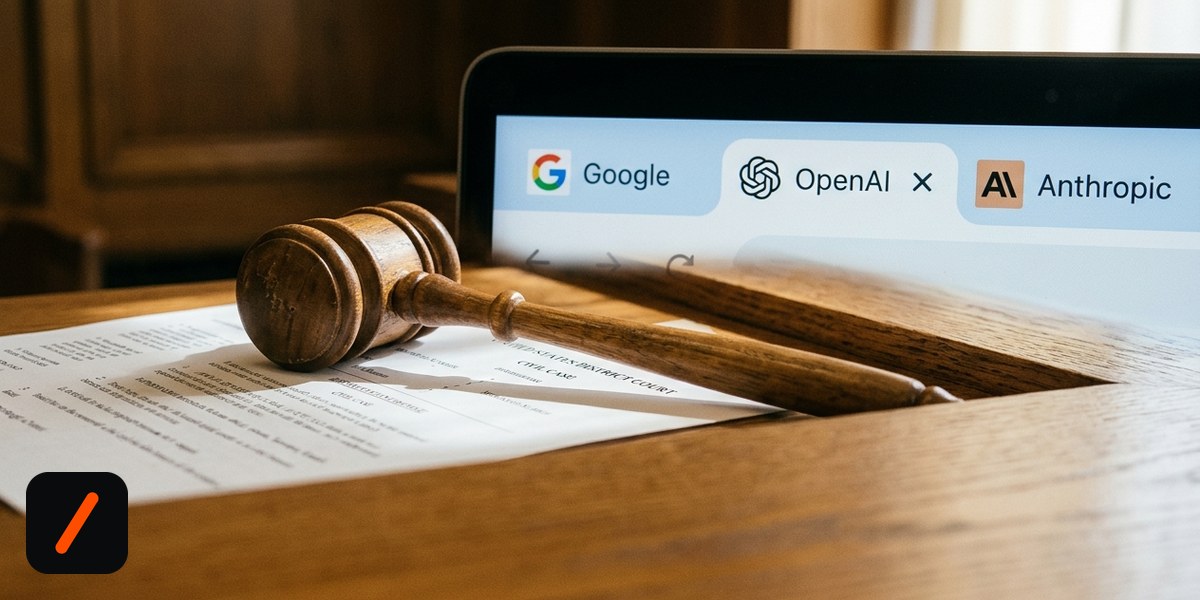
Four subscribers to ChatGPT, Claude, Grok and Gemini filed a proposed class-action lawsuit Friday accusing Anthropic, OpenAI, SpaceXAI and Google of illegally agreeing to slow down AI development. The case, filed in the U.S. District Court for the Northern District of California, centers on a single week: an essay Anthropic CEO Dario Amodei published on September 12 calling for industrywide cooperation on decelerating AI progress, and same-day public agreement from OpenAI's Sam Altman, SpaceXAI's Elon Musk and Google DeepMind's Demis Hassabis.
- Filed September 19 by four named plaintiffs, represented by lead attorney Nick Rowley, seeking status as a nationwide class of paying AI subscribers.
- The core claim: an agreement among the chief AI rivals to make their progress slower than competition would otherwise produce has an anticompetitive effect on consumers paying for those subscriptions.
- The complaint leans on Amodei's own essay, which anticipated antitrust scrutiny and asked the U.S. government to mediate, or at minimum issue a narrow waiver for safety-related conversations between labs.
- Representatives for Anthropic, OpenAI, Google and SpaceXAI had not responded to requests for comment as of Saturday.
What does the lawsuit actually claim?
The complaint is built on a straightforward antitrust theory: Section 1 of the Sherman Act bars competitors from agreeing to restrain output or otherwise limit how hard they compete, and the plaintiffs argue that publicly promising to slow a race for better AI models qualifies. Their framing is specific. The suit doesn't allege a secret pricing cartel or a backroom deal over server capacity. It alleges that four direct rivals, in full public view, agreed their pace of improvement should be slower than an unconstrained market would produce, and that subscribers paying monthly fees for Claude, ChatGPT, Grok and Gemini are the ones who lose value from that restraint.
RelatedDavid Sacks Tells OpenAI, Anthropic to Pace Themselves
What actually happened on September 12?
Amodei's essay proposed that the leading labs coordinate on safety-driven deceleration rather than racing each other toward more capable systems without a shared brake. He acknowledged the obvious legal wrinkle inside the essay itself: getting competitors to agree on pace, even for safety reasons, brushes up against antitrust law, and he wrote that U.S. government mediation, or a narrow waiver specifically for safety conversations between labs, would help. Altman, Musk and Hassabis each responded publicly that same day, expressing agreement with the substance of Amodei's proposal. None of the four companies has said their responses amounted to a binding commitment.
Why is a safety pitch now being read as collusion?
Because antitrust law generally does not care why competitors coordinate, only whether they did. A cartel built around "we're doing this for safety" is not automatically exempt from Section 1 the way, say, a genuine joint safety-testing standard set by regulators might be. Amodei flagged that exact tension in his own essay, which is part of what makes this complaint unusually easy to write: the plaintiffs aren't reconstructing a hidden agreement from indirect evidence, they're pointing at an essay and three public replies and arguing the pattern itself is the violation. Whether four public statements made on the same day rise to an actual "agreement" under antitrust law, rather than four companies independently reaching similar conclusions and saying so, is the question a judge will eventually have to answer.
Who's actually named, and how different are they?
The four defendants sit in very different corporate structures, which matters for how exposed each one is. Anthropic is privately held and is the one that published the essay at the center of the case. OpenAI operates its consumer and API business through a capped-profit arm under a nonprofit parent. SpaceXAI, Elon Musk's AI venture, is also privately held. Google DeepMind is a division of Alphabet, the only publicly traded company among the four, which puts it in a different disclosure and investor-relations position than the other three the moment a court filing starts drawing headlines.
| Defendant | Role in the alleged pact | Ownership status |
|---|---|---|
| Anthropic | Published the September 12 essay proposing the slowdown | Privately held, backed by Amazon and Google |
| OpenAI | Sam Altman publicly agreed with Amodei's proposal the same day | Capped-profit arm under a nonprofit parent |
| SpaceXAI | Elon Musk publicly agreed the same day | Privately held |
| Google DeepMind | Demis Hassabis publicly agreed the same day | Division of publicly traded Alphabet (GOOGL) |
What it means for the market
Alphabet is the one name here that reports quarterly earnings to public shareholders, so it's the company most likely to face investor questions about litigation exposure on the next earnings call, even though the suit is at its earliest possible stage and has not survived a motion to dismiss. OpenAI and Anthropic are both still raising money from private investors who will read this filing as one more data point on regulatory risk in a sector already drawing FTC and DOJ attention. None of that means the case is strong. It means the signal for anyone with money in these companies, public or private, is to watch how each defendant characterizes the September 12 exchange in its first public response, since that framing will shape how seriously courts and regulators take the underlying theory.
RelatedDario Amodei Calls for AI Industry to Slow Down
What happens next in court?
This is day one of what is typically a long process. The next real milestone is usually a motion to dismiss, where defendants argue the complaint hasn't alleged an actual agreement, just parallel public statements that competitors are free to make independently. If the case survives that, discovery would start probing whether any private communications preceded or followed the public exchange, since a paper trail beyond the public essay and replies would matter far more than the essay itself. Regulators are a separate track entirely. The FTC and DOJ have both been active on AI competition questions this year, and a private lawsuit built around a clean public timeline like this one is exactly the kind of case that can draw a parallel government look, even if the private suit itself moves slowly.
- Sep 12, 2026Dario Amodei publishes an essay urging AI labs to coordinate on slowing development for safety.Amodei's own essay flags possible antitrust exposure.
- Sep 12, 2026Sam Altman, Elon Musk and Demis Hassabis each respond in public agreement.All three replies land the same day as the essay.
- Sep 19, 2026Four subscribers file a proposed class action in the Northern District of California.Lead attorney: Nick Rowley.
- Not yet setA response from any of the four companies, or a motion to dismiss.None had commented as of Saturday.
- The first company statement. Whether Anthropic, OpenAI, SpaceXAI or Google frame the September 12 exchange as informal opinion-sharing rather than coordination, which is the core distinction the case will turn on.
- A motion to dismiss. Whether the defendants argue the plaintiffs have alleged parallel public statements, not an actual agreement to restrain output, a common early move in Sherman Act Section 1 cases.
- Regulator interest. Whether the FTC or DOJ, both already active on AI competition issues, open a parallel inquiry rather than leaving this to private plaintiffs.
- Copycat suits. Whether other subscribers or state attorneys general file similar complaints now that the theory is public.
Our take
The legal theory here is more interesting than it is obviously strong. Courts have historically been cautious about treating parallel public statements, without more, as proof of an illegal agreement, since competitors are allowed to reach similar conclusions independently and say so out loud. What makes this complaint sharper than a typical parallel-conduct case is that Amodei's own essay names the antitrust risk before the lawsuit does, which plaintiffs will use to argue the defendants knew exactly what they were doing. That cuts two ways. It's evidence of self-awareness, not necessarily evidence of a binding pact. Whether "please can we all agree to go slower" ever crosses the line into an actionable restraint of trade is a genuinely open legal question, and this case is now the vehicle that will test it.
- WireAP: Lawsuit says Anthropic, OpenAI, SpaceXAI and Google made illegal agreement on AI slowdown filing details, plaintiffs' claims, and company non-responses
- WireWashington Times: Lawsuit says Anthropic, OpenAI, SpaceXAI and Google made illegal agreement independent pickup of the same AP wire story
- WireClickOrlando: Lawsuit says Anthropic, OpenAI, SpaceXAI and Google made illegal agreement on AI slowdown additional wire pickup with matching filing details
Original analysis by GenZTech Team, based on the sources cited above.