
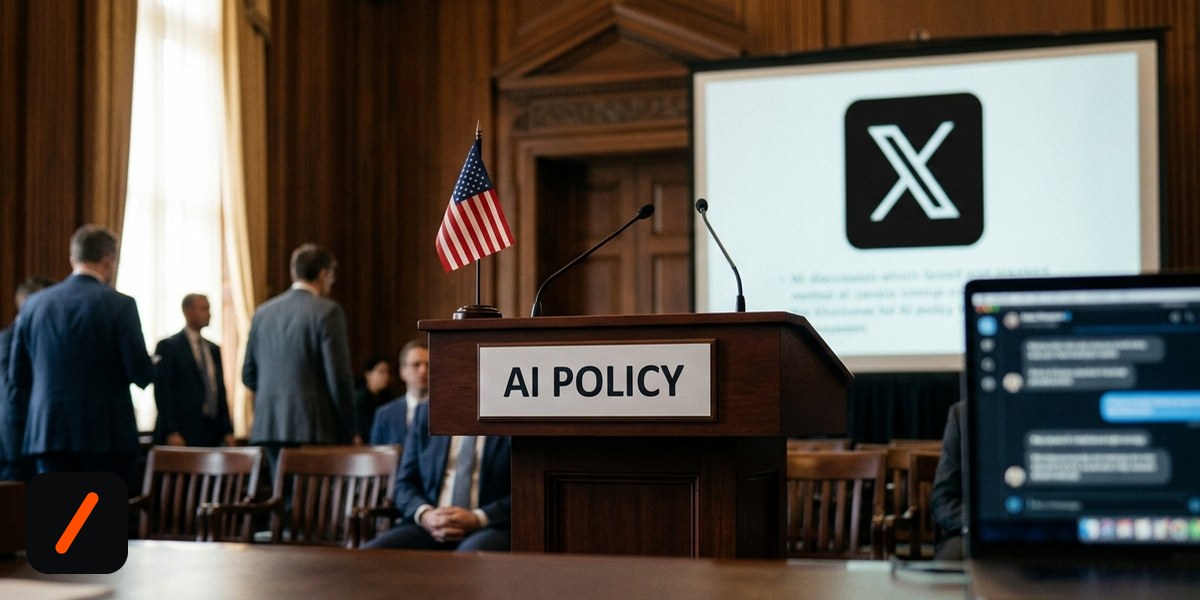
David Sacks, chair of the President's Council of Advisors on Science and Technology and the former White House AI and Crypto Czar, publicly rebuked Dario Amodei's call to slow down frontier AI today, in a lengthy X post roughly 29 minutes before it started circulating on Hacker News. His message to OpenAI and Anthropic: if you actually believe capability gains need pacing, nothing is stopping you from doing it yourselves.
- Sacks posted a lengthy response on X telling OpenAI and Anthropic they don't need external regulation to slow down, writing "go ahead" if they believe it's warranted.
- He accused Anthropic of running a regulatory capture strategy built on fear, holding it largely responsible for a wave of state level AI laws he considers damaging to smaller startups.
- He questioned the motives behind researcher Jacob Coxon's viral Anthropic resignation and cited researcher Evan Hubinger's existential risk estimates as the kind of rhetoric he distrusts.
- The pushback lands the same week a bipartisan Senate bill would turn frontier AI safety testing from a voluntary pledge into a legal duty, sitting oddly next to Sacks' own "handle it yourselves" argument.
What did Sacks actually say?
The response came as a lengthy thread working through Amodei's essay point by point, and Sacks did not bury the lede. "Dario has written that we need to 'pace the frontier,' and Sam has agreed," he wrote, referencing Altman's public backing of the call. "People may be surprised by my response: go ahead." His case: neither company needs anyone's blessing to slow down, because both already sit on top of the market they'd be pacing. "You guys are the frontier," he wrote. "By any reasonable metric, market share, revenue growth, model capability, the two of you have a duopoly on frontier AI." If pacing is really the right call, Anthropic and OpenAI can just do it, today, without asking Washington to write it into law first.
RelatedDario Amodei Calls for AI Industry to Slow Down
Why is he pushing back right now?
Sacks didn't stop at "you can do this yourselves." He questioned why the two firms want outside rules at all. "Stop pretending the motivation to slow down is purely altruistic," he wrote. "You face massive product-liability exposure if your products enable a truly damaging cyberattack." His read: calls for industry-wide standards double as insurance, spreading legal and reputational risk across every competitor instead of leaving Anthropic or OpenAI to carry it alone. He put the sharpest version of that argument plainly: "The easiest way not to build superintelligence is for you to agree not to build it," framing coordinated pacing as a deal that quietly locks smaller rivals out.
What's the part most coverage is missing?
Here's the tension nobody covering this seems to be naming directly. Sacks' whole argument rests on Anthropic and OpenAI not needing anyone else's permission to pace themselves voluntarily. That framing might not survive September. A bipartisan Senate bill introduced this month by Amy Klobuchar, John Thune, and Ted Cruz would convert frontier AI safety from a pledge into an actual legal duty of care: mandatory pre-release testing, independent third-party audits, standardized risk reporting, and power for the federal government to block release of a model it deems hazardous, with a court-appeal path for developers who disagree. If that bill moves, "go ahead and do it yourselves" stops being a live option and becomes the law regardless of what Silicon Valley prefers. Sacks is arguing against regulation from a seat that might not get to keep making that argument much longer.
Who does this actually affect?
The immediate targets are Anthropic and OpenAI, the two labs Amodei and Altman named directly. But the argument generalizes to every frontier lab with the resources to slow down without going out of business, a short list today. Sacks' references to Coxon and Hubinger point at Anthropic specifically. Coxon resigned and issued public warnings about self-improving AI, and Sacks questioned whether the sudden viral spread of that resignation was organic, noting Coxon reportedly canceled a scheduled podcast appearance with Jason Calacanis. Hubinger, an Anthropic researcher who has estimated more than a 10 percent chance of AI existential risk within a decade, gets cited as the kind of internal rhetoric Sacks distrusts. Meta stayed mostly out of the fight. Its chief AI officer, Alexandr Wang, offered a different frame, arguing alignment research should gate scaling rather than an industry-wide pause: "Alignment is fundamental to delivering personal superintelligence for everyone... alignment can be the gating factor for scaling."
What does this mean for the market and the valuations?
None of this is investment advice, but the timing lines up with real money on the table. Sacks pointed out that Anthropic has reportedly been targeting a $2 trillion valuation ahead of a future IPO, a number that only holds up if regulators and the public keep treating its safety positioning as a credible differentiator, not a marketing layer. OpenAI has said it won't go public in 2026 at all, which changes its incentives: a private company facing less quarterly scrutiny can afford a slower, more symbolic commitment to pacing than one facing public shareholders. Both companies have financial reasons to want this framed a certain way, and neither reason is really about existential risk.
RelatedAnthropic Researcher Quits, Warns AI Could Be 'Out of Control'
What happens next?
Two things move on separate but connected tracks. Publicly, watch whether Amodei or Altman respond directly, and whether Anthropic addresses the regulatory-capture accusation instead of letting it sit. Legislatively, watch the Senate bill's progress, since its mandatory testing and audit requirements would make Sacks' entire "you don't need anyone's permission" framing moot the moment it becomes law. A bipartisan bill and a former crypto czar's public opposition landing in the same news cycle isn't a coincidence: it's the same fight in two venues at once.
- Does Amodei or Altman respond publicly? Silence would read as more telling than a rebuttal.
- Does the Senate bill get a committee vote? That's the moment "voluntary self-policing" stops being a real choice.
- Does Anthropic address the regulatory-capture accusation directly? Ignoring it lets Sacks' framing stick by default.
- Do other frontier labs, beyond Meta, stake out a position? Right now this is mostly a three-way argument.
Our take
Sacks' strongest point and his weakest point are the same sentence. Telling Anthropic and OpenAI to pace themselves without waiting for permission is fair: if they really believe capability gains need slowing, nothing except their own boards and investors is stopping them. But the same post accuses Anthropic of manufacturing fear to capture regulators, which sits strangely next to "you should self-regulate," since self-regulation only works if the public trusts the company doing it, and Sacks is actively working to make sure it doesn't. He can't really have it both ways: either Anthropic's safety concerns are credible enough that voluntary pacing would mean something, or they're manufactured, in which case telling the company to "go ahead" is a hollow dare aimed at a target he's already decided is acting in bad faith. The Senate bill is the more interesting story here, because it doesn't care which version of Sacks' argument is right. If it passes, the whole debate about voluntary versus mandatory becomes academic.
- ReportingTradingView/Benzinga: Sacks tells OpenAI, Anthropic they can slow down themselves direct quotes from the X thread
- ReportingTribune India: frontier AI slowdown debate intensifies includes Alexandr Wang's alignment framing
- LegislationCryptopolitan: Senate bill would make frontier AI safety a legal pledge the Klobuchar-Thune-Cruz bill
- ReferenceGenZTech: our coverage of Amodei's original essay yesterday's context
Original analysis by GenZTech. Sources: TradingView/Benzinga, Tribune India.