
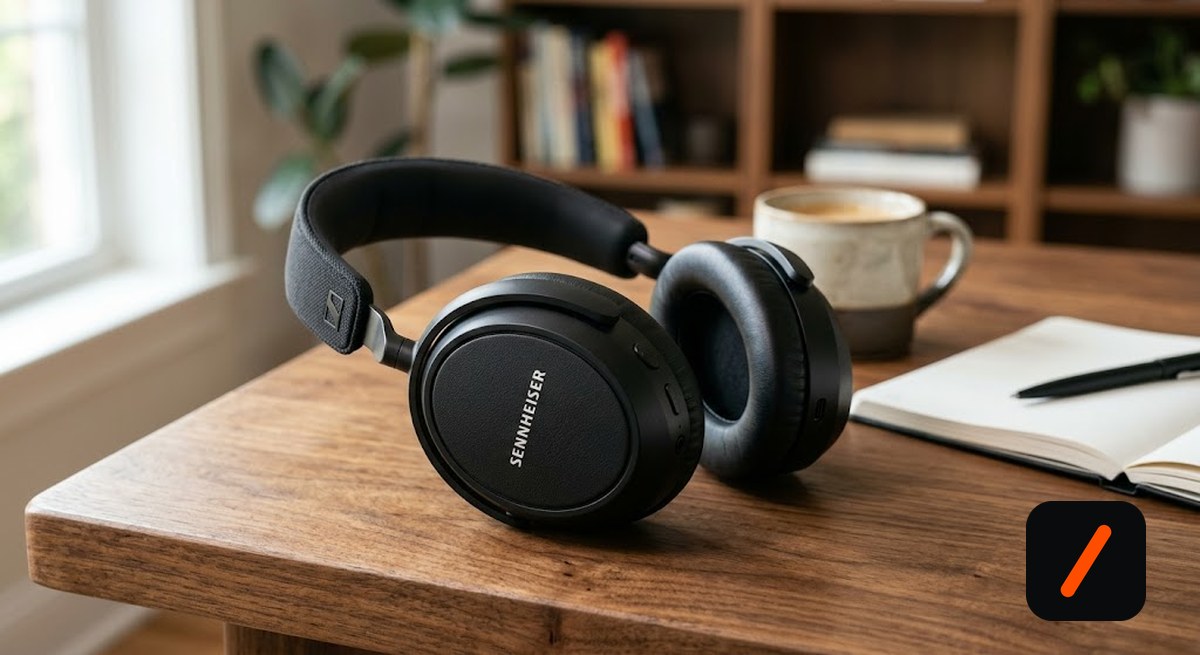
Sennheiser's new Momentum 5 Wireless does something almost no premium headphone dares: it makes the battery user-replaceable, swappable with a Phillips-head screwdriver, so the part that usually kills these devices can be renewed instead of retiring the whole pair. Beneath that, it keeps the familiar Momentum 4 shape and 42mm transducers but adds higher-resolution audio and Dolby Atmos with head-tracking. In a category built around sealed, disposable designs, the repairability story is the real headline.
- The Momentum 5 Wireless ships a user-replaceable battery you can swap with a screwdriver, greatly extending usable lifespan.
- It reuses the proven 42mm transducers and Momentum 4 styling but with meaningfully improved performance.
- New audio features include higher-resolution playback and Dolby Atmos with head-tracking.
- Against sealed rivals from Sony and Bose, the pitch is longevity over disposability.
Why is a replaceable battery a big deal?
Because the battery is what usually ends a headphone's life. Lithium cells degrade with every charge cycle, and after a few years a sealed pair holds noticeably less charge with no fix short of a costly, warranty-voiding teardown or replacement. By making the cell swappable with a common screwdriver, Sennheiser turns the failure point that forces upgrades into routine maintenance. For a $300-plus product people expect to keep for years, that is a genuine shift, and it lands as right-to-repair pressure pushes the whole industry away from glued-shut, disposable design.
RelatedApple Watch Ultra 4: $799 and 50 Hours of Battery
What else changed from the Momentum 4?
Sennheiser played it conservative on hardware and focused on the internals. The Momentum 5 keeps the same 42mm transducers and a look close to its 2022 predecessor, but delivers improved audio performance, support for higher-resolution playback, and Dolby Atmos with head-tracking for spatial audio that shifts as you turn your head. That is a sensible strategy: the Momentum line already had a strong acoustic reputation, so refining the sound and adding modern spatial features, rather than redesigning the whole product, keeps the identity intact while catching up to rivals on features.
| Trait | Momentum 5 | Sony / Bose flagships |
|---|---|---|
| Battery | User-replaceable | Sealed |
| Spatial audio | Dolby Atmos + head-track | Yes |
| Drivers | 42mm, hi-res | Proprietary |
| Design ethos | Longevity | Sealed premium |
Who should care?
Anyone who keeps headphones for the long haul and resents replacing a good pair over a dead cell. The replaceable battery also appeals to the sustainability-minded, since extending a device's life is the single biggest way to cut its footprint. Frequent travelers get a bonus: a swappable cell means a spare can extend a long trip without hunting for an outlet. Buyers chasing the absolute best noise cancellation may still prefer Sony or Bose, but for people who weigh durability alongside sound quality, this is a rare option that treats longevity as a feature.
Does this pressure the rest of the market?
It should. Sennheiser proving a flagship can offer a replaceable battery without looking cheap or bulky undercuts the industry's standard excuse that sealed designs are necessary for a premium feel. With regulators in the EU and elsewhere pushing repairability rules, a marquee product that already complies is both good marketing and good positioning. If it sells well, expect competitors to quietly rediscover that batteries can, in fact, be designed to come out.
RelatedGalaxy Z Flip 8 Grows Its Cover Screen and Adds Qi2 Charging
- Battery availability. Replaceable only helps if Sennheiser sells the cells for years.
- Reviews on ANC. Whether noise cancellation matches Sony and Bose decides head-to-heads.
- Price. The repairability premium has to stay reasonable to matter.
- Rival response. A successful launch could nudge the category toward serviceable design.
Does repairability actually sell?
The open question is whether buyers reward serviceability at the register or merely applaud it in principle. Repairability has strong survey support and growing regulatory backing, but consumers have historically chosen thinner, sealed designs when forced to trade. Sennheiser is testing whether that calculus has shifted, and it picked a smart battleground: headphones are expensive enough to keep for years, and the failure mode, a dying battery, is one everyone understands. If the Momentum 5 sells well without feeling bulky or cheap, it becomes proof that durability can be a selling point rather than a compromise, and rivals who leaned on sealed designs will have to explain why.
Our take
The Momentum 5's spec sheet is a solid, expected upgrade; its design philosophy is the interesting part. Making the battery serviceable is a small mechanical decision with an outsized message: this is a product built to be kept, in a category that has trained us to throw good headphones away. Sennheiser is betting that durability and repairability are becoming real purchase criteria, not just talking points, and the regulatory wind is at its back. If buyers reward it, the sealed-flagship orthodoxy starts to look less like a technical necessity and more like a choice, one that companies made because disposability sells replacements. That is a good thing to see challenged by a pair of headphones you can actually open.
- OfficialSennheiser Momentum 5 Wireless product page
- ReportingGear Patrol 2026 audio releases
- ReferenceTechRadar headphone reviews and comparisons
Original analysis by GenZTech. Figures current as of July 2026.