
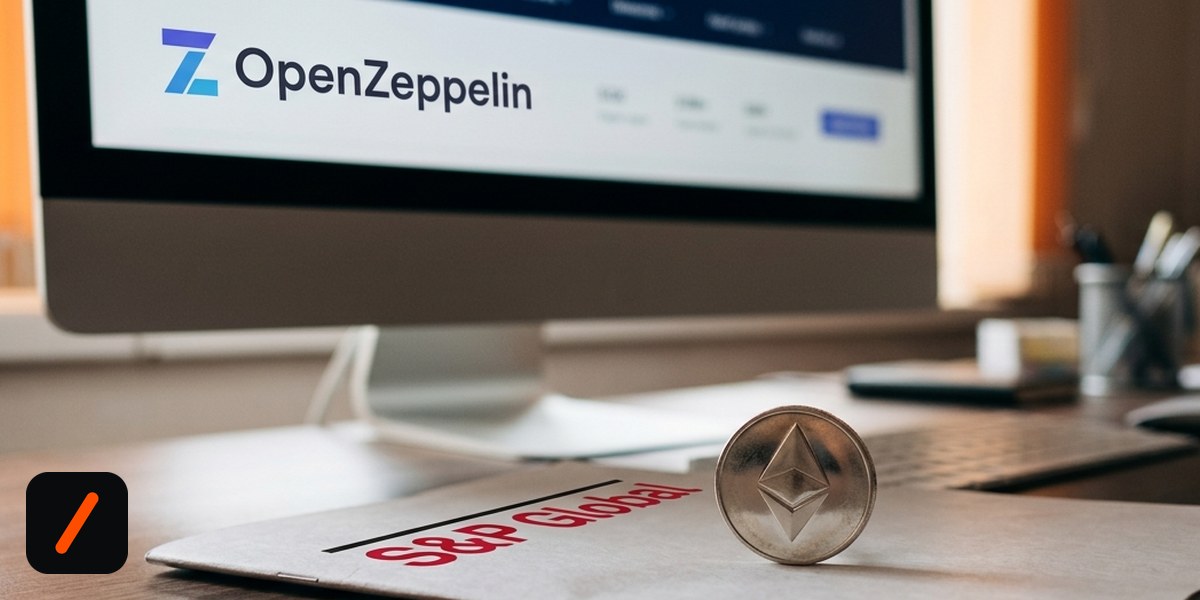
S&P Global, one of the three big credit rating agencies, has agreed to acquire OpenZeppelin, the company whose open-source code secures most of the stablecoins and tokenized funds moving money onchain. The deal was announced September 17, 2026, terms undisclosed. S&P Global says it will not meaningfully affect its financials, but the signal is bigger than the price tag: a firm that grades corporate debt for a living just bought the toolkit it would need to grade smart contracts too.
- S&P Global (NYSE: SPGI) announced the deal September 17, 2026: terms undisclosed, closing subject to customary conditions.
- OpenZeppelin's Contracts library underpins more than $37 trillion in value transferred, including most major stablecoins and tokenized funds.
- OpenZeppelin keeps its name and CEO Demian Brener, who now reports to Yann Le Pallec, President of S&P Global Ratings.
- OpenZeppelin has pledged every released version of its libraries stays open source permanently and cannot be withdrawn.
Why would a ratings agency want a code library?
S&P Global Ratings already publishes stability assessments for stablecoins, and its parent owns S&P Dow Jones Indices, so putting a number on digital assets is not new territory. What it lacked was direct access to the code those assets run on. OpenZeppelin's Contracts library is the closest thing crypto has to a building code: most ERC-20 tokens, ERC-721 collections, access-control systems and upgradeable proxies borrow from it instead of writing security logic from scratch. Owning the company that maintains it gives S&P Global a direct line into how the assets it might one day rate are actually built. Le Pallec put it plainly: "Our digital assets strategy centers on bringing trusted data, benchmarks and transparent risk assessment to markets as they move onchain." S&P Global frames it as complementing existing risk assessment work, building toward a next generation of onchain security assessments and benchmarks, and the timing tracks regulation already moving: the SEC approved a five-year innovation exemption for tokenized stock trading on September 18 and 19, 2026, which we covered here, creating exactly the kind of regulated onchain market where a rated smart contract becomes a sellable product.
RelatedSmart contracts, explained: code that runs itself
What does OpenZeppelin actually bring to the deal?
OpenZeppelin was founded in 2015, older than most of the tokens it now secures. It has completed more than 900 security engagements and surfaced more than 10,000 vulnerabilities before they reached production, the track record that turned a code library into an industry default. The product line goes beyond audits: Contracts Wizard, a Contracts MCP server, Upgrades Plugins for safely modifying deployed contracts, plus Relayer, Monitor, UI Builder, Safe Utils and Role Manager. Brener framed the acquisition as continuation, not pivot: "OpenZeppelin's standards, technology, and expertise already power the infrastructure behind the world's leading stablecoins, tokenized funds, DeFi protocols, and onchain markets." He described the goal as making "the standard our team and community built" become "the standard the next generation of global finance runs on." Post-close, OpenZeppelin stays a separate business unit under its own name, with Brener staying on as CEO.
Does this kill OpenZeppelin's open-source promise?
This is the question every Solidity developer asked within minutes, and it has a cleaner answer than most acquisition worries do. OpenZeppelin Contracts ships under the MIT license, so anyone can already fork the codebase today and keep maintaining it independently. OpenZeppelin's own announcement goes further than the license requires, committing that "every released version remains open source permanently and cannot be withdrawn by anyone, and future versions stay open source." Audits, engineering and ecosystem programs continue unchanged, and the tool suite keeps running. So the library is not the real risk. The real risk is neutrality: can a security firm owned by a ratings agency still fail a client's contract, especially when that client is also a prospective ratings customer, or does the incentive to sell a bundled rating quietly soften what counts as a pass. That is a governance question, not a code question, and it is the one worth watching.
| OpenZeppelin (now S&P) | Trail of Bits | Certik | |
|---|---|---|---|
| Owner | S&P Global, pending close | Independent | Independent |
| Open-source library | Yes, pledged permanent | No flagship library | No flagship library |
| Ratings tie-in | Direct, via S&P Ratings | None | None |
| Distribution | Inherits S&P issuer relationships | Developer-focused client base | Retail-facing scoring |
| Framing | Owned by a rating agency | Independent auditor | Independent auditor |
When does this actually close?
S&P Global has not given a timeline beyond the usual "subject to customary closing conditions." Advisors are already lined up on both sides, Jefferies and Clifford Chance for S&P Global, FT Partners and Cooley for OpenZeppelin, the standard sign that documentation and regulatory review are underway rather than this being a loose agreement in principle.
RelatedStablecoins, explained: crypto’s quiet killer app
- 2015OpenZeppelin founded Its library becomes the default Solidity security standard.
- 2026-09-17S&P Global announces the acquisition Terms undisclosed, no material impact on results expected.
- 2026-09-18SEC approves tokenized stock exemption Five-year innovation exemption, announced the next day.
- TBDDeal closing Subject to customary closing conditions.
What does this mean for the market?
For S&P Global itself, this is a small deal by dollar value, and the company says so directly: no material impact on financial results expected. The signal is strategic. It shows where a ratings agency sees its next growth line, and buying technical credibility is cheaper than building it. For issuers, the read is more concrete: stablecoin and tokenized fund managers can now pair a code audit with a name institutional allocators already trust for risk grading, a combination that did not exist as one vendor relationship before September 17. Circle (NYSE: CRCL), a major stablecoin issuer under close regulatory scrutiny, is a plausible customer for that kind of bundled assessment, though nothing here suggests a specific deal is in motion. The signal for investors is that ratings-style products are becoming a real revenue category in onchain finance.
Our take
The open-source angle is a distraction from the real story. Nobody is going to fork Contracts and route around OpenZeppelin, because the value was never just the code, it was the trust that came from an independent team maintaining it. What S&P Global bought is that trust, plus a pipeline into every issuer who will eventually need a rated onchain product. Think of it less like a tech acquisition and more like a ratings agency buying the inspection firm that certifies the buildings it later rates. That works fine as long as the inspection stays honest. The moment audits and ratings become a package deal sold together, developers and regulators should start asking who is checking the checker.
- Bundled products. Whether S&P Global launches a combined audit-plus-rating offering for stablecoins and tokenized funds.
- Audit independence. Whether OpenZeppelin's public audit reports change in tone or disclosure once the deal closes.
- Closing timeline. No date given yet; regulatory review of a ratings giant buying a crypto security firm is worth tracking.
- Issuer uptake. Whether issuers like Circle publicly reference OpenZeppelin or S&P in their compliance marketing.
- OfficialS&P Global press release the acquisition announcement, September 17, 2026.
- OfficialOpenZeppelin announcement the company's statement, including the open-source pledge.
- ReferenceOpenZeppelin Contracts on GitHub the MIT-licensed library at the center of the deal.
- ReportCoinDesk independent reporting on the deal.
- ReferenceGenZTech: SEC tokenized-stocks exemption the regulatory move two days after this deal.
Original analysis by GenZTech. Source: S&P Global press release.