
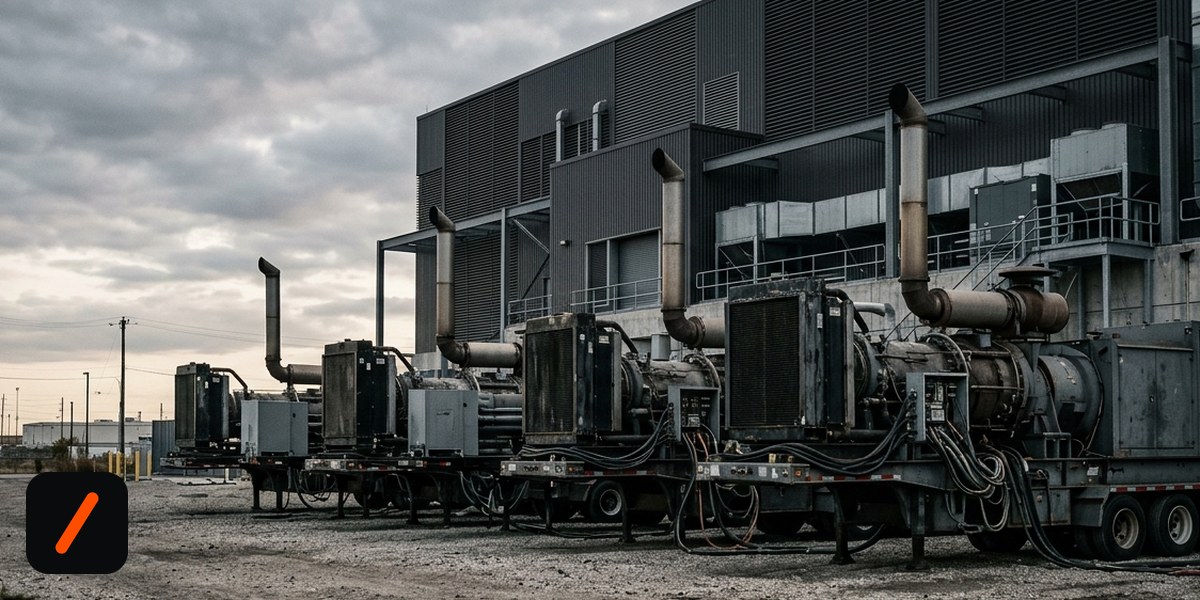
SpaceX said this week it will remove all 69 unpermitted, trailer-mounted gas turbines powering xAI's Colossus 2 data center in Southaven, Mississippi, the first units gone as early as August, the last by July 2027. The company is framing it as a cleanup. Arif Gasilov, a partner at environmental consultancy Gasilov Group who has been quoted on this exact buildout by Reuters, Newsweek, and Al Jazeera, reads the same announcement as something narrower and less flattering: a company retiring a fleet it was going to retire anyway, timed to buy goodwill while a federal lawsuit over two years of unpermitted operation is still unresolved.
The turbines aren't shrinking the site's power supply, they're being swapped for 41 permanently permitted units totaling 1.2 gigawatts, approved by Mississippi regulators back in March and already under construction. NAACP, the Southern Environmental Law Center, and Earthjustice sued in April over 27 of the unpermitted turbines, a number that has since grown to 69 while the case sat unresolved. In June, the Justice Department moved to intervene and asked the court to dismiss the suit outright, citing national and energy security. In July, EPA issued guidance exempting "islanded" AI data center power plants like this one from Acid Rain Program emissions caps. We asked Gasilov what the removal pledge actually changes, and his answer is that it changes less than the announcement wants people to believe.
RelatedSpaceX will run xAI's unpermitted turbines until July 2027
Does the Removal Agreement Actually Resolve the Lawsuit?
"I would say the agreed order buys time rather than resolving anything," Gasilov said. "The lawsuit's main question, whether these turbines count as a stationary source, is still open after it." That distinction matters more than it sounds. SpaceX's defense has rested on classifying the turbines as mobile equipment, exempt from the Clean Air Act construction permits that stationary sources require, the same reading utilities lean on during hurricane recovery or a failed substation, not a two-year power source for a gigawatt-class training cluster. An agreement with Mississippi's environmental regulator to remove the turbines by a set date says nothing about whether running them without a permit for two years was ever legal in the first place. Courts can still find a violation, assess penalties, and order relief for conduct that has already stopped. A state agreement isn't a consent decree, and if the removal date slips, grid-scale construction slips routinely, the plaintiffs' recourse is negotiation, not contempt.
Where Do 69 Mobile Turbines Actually Go?
Gasilov's sharper prediction is about what happens to the turbines themselves once they leave Southaven, and it turns on a detail buried in how SpaceX assembled the fleet in the first place. "I also think the loophole gets copied," he said. "Musk bought APR Energy, a temporary power company whose fleet does not match the permitted permanent plant, so the mobile turbines will probably move to the next site rather than get retired." APR Energy's entire business is renting mobile generation for exactly this kind of gap, and its fleet is built for redeployment, not decommissioning. A fixed 1.2-gigawatt plant made of permanent 16.48-to-50-megawatt units has nothing in common with a fleet of trailer-mounted turbines designed to roll in and roll out. If Gasilov is right, "removal" from Southaven isn't the end of these 69 turbines' working life. It's a relocation to whichever AI campus needs bridge power next, running the same playbook this site already proved works: energize fast on mobile generation, absorb the legal risk, convert to permitted capacity once the permanent plant catches up.
Is Local Opposition Losing the Fight at the Federal Level?
Southaven's Clean Air Act suit started as county-level environmental justice organizing, backed by national legal groups. What sharpened Gasilov's read on where this ends up isn't the lawsuit itself, it's who showed up on the other side of it. "On the federal angle, what we keep seeing is that opposition wins at the county level but loses at the regulatory dockets," he said, "and the DOJ move plus the EPA exemption extend that pattern to the federal level." The Justice Department's June intervention argued that cutting power to the site threatens national, economic, and energy security, explicitly invoking the Department of War's reliance on AI, and asked the court to dismiss the suit with prejudice. Six weeks later, EPA's exemption for islanded AI data center power plants touched close to 60 facilities nationwide, not just this one. Neither move required the turbines to be legal. Both moves made challenging them harder.
RelatedMicrosoft and Oracle Are Betting the House on AI Data Centers
- 69. Unpermitted turbines at Southaven today, up from the 27 named in the NAACP's original April lawsuit.
- 256 to 453. Premature deaths per year Gasilov's own research estimates from proposed behind-the-meter gas generation at US data centers, at a 2028 baseline.
- 1.2 GW / 41. The size and unit count of the permanently permitted plant already under construction to replace the mobile fleet.
- ~60. Facilities nationwide covered by EPA's July exemption for islanded AI data center power plants, not just this one site.
Our Take
Gasilov's read doesn't dispute that 69 turbines are leaving Southaven. It disputes what leaving means. A removal date is not a legal resolution, the stationary-source question the lawsuit was built on stays open regardless of what SpaceX does with the hardware. And a mobile fleet bought from a company whose entire business is renting temporary power doesn't have an obvious reason to be scrapped once it's no longer needed in Mississippi, it has an obvious next customer. The federal moves that arrived in the six weeks before this announcement, DOJ's intervention and EPA's islanded-plant exemption, didn't settle any of that either. They just made it more expensive to keep fighting it. The number worth watching from here isn't 69. It's wherever that fleet shows up next.
- BackgroundGENZ TECH: SpaceX will run xAI's unpermitted turbines until July 2027 — our original coverage of the removal announcement, lawsuit timeline, and DOJ/EPA moves.
- ReferenceZenodo: replication data for behind-the-meter gas health-damage estimates — the research behind the premature-deaths figure cited above.
Quotes gathered directly by GENZ TECH from a source who volunteered to comment on this story, with full attribution as agreed. Details current as of August 2026.