
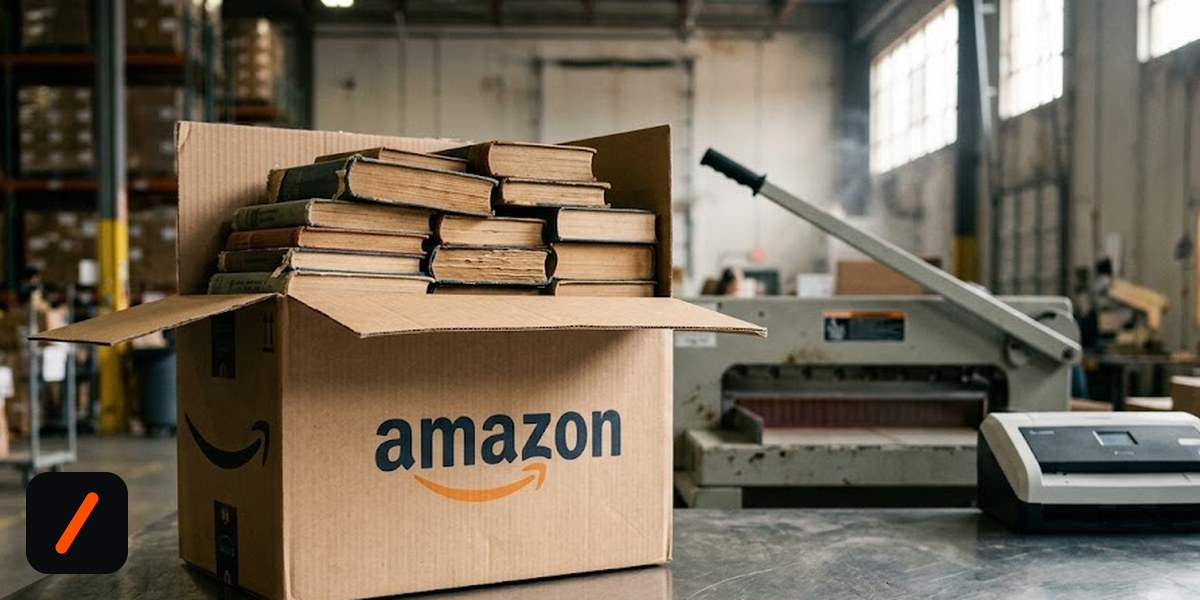
404 Media hid an Apple AirTag inside a used book, shipped it out with roughly a thousand others bought through the marketplace Biblio, and followed the ping across the country for several weeks. It stopped moving inside Amazon warehouse LAS8 in Las Vegas, at an internal operation called VGT3 where, according to posts on Amazon employee forums, staff receive book shipments, cut the bindings off, and scan the ISBNs. The investigation went live this morning, and it is the first physical evidence tying Amazon to the buy, scan, destroy pipeline that Anthropic only disclosed under court order.
The method is what makes it land. Almost everything the public knows about AI companies feeding printed books into scanners has come from discovery in litigation or from a vendor's own marketing copy before it got deleted. Nobody had simply watched a single book travel and reported where it stopped.
RelatedBig Tech's $1T AI lease bill isn't on the books
- The route ran roughly 2,400 miles. A California airport, then Milwaukee Mitchell International, then a two week hold at the Trifinity distribution center in Kenosha, Wisconsin, then a truck stop in Grand Junction, Colorado, then LAS8 on Nicco Way in Las Vegas.
- Amazon confirmed the buying and nothing else. Its entire statement: "Amazon purchases books through commercial channels to help develop and improve the products and services our customers use." It declined to say why bindings get cut, how many facilities like VGT3 exist, or what it makes of the backlash.
- Destroying the book is part of what keeps this legal. Judge William Alsup's June 2025 ruling in Bartz v. Anthropic found that buying print books, digitising them and training on the files is fair use, so long as the print copy is not kept alongside the scan.
- The only brake that has actually worked so far is reporting. ISBNdb pulled its AI bulk sourcing pages nine days after 404 Media described them, then denied the service had launched. No regulator was involved at any point.
Why does cutting the binding matter so much?
A bound book is slow to digitise. You either photograph each spread on a cradle scanner, which is careful and expensive, or you slice the spine off and run loose pages through a sheet feeder at hundreds of pages a minute. The second option is roughly an order of magnitude cheaper per volume, and it ends with the book in a recycling bin.
That is not a side effect of the process. In the Bartz ruling, the destruction was load bearing. Alsup's reasoning treated the scan as a format shift of a copy the buyer already owned, which works only if one copy continues to exist rather than two. Keep the print book and you have arguably made an extra copy. Shred it and you have merely changed the medium. The cheapest workflow and the legally safest workflow turned out to be the same workflow, which is why every operation that has surfaced since looks identical.
How does the Amazon evidence compare with what we already knew?
Three separate operations are now public, and each surfaced through a completely different mechanism. That matters, because it tells you how thin the reporting surface is.
| Amazon | Anthropic | ISBNdb | |
|---|---|---|---|
| How it surfaced | AirTag in a tracked shipment | Unsealed filings in Bartz v. Anthropic | Its own sales pages, since deleted |
| What happens to the book | Bindings cut, ISBNs scanned, per staff forums | Scanned then discarded under Project Panama | Sourced in bulk, scanning done elsewhere |
| Confirmed scale | Unknown, Amazon would not say | Millions of print copies | Orders of 1,000 to 1,000,000 books |
| Company response | One sentence, no answers | Compelled by litigation | Denied the service ever launched |
| Legal consequence | None known | $1.5B settlement, for piracy not scanning | None, no action was filed |
Notice what is missing from the right hand column of every row: a regulator, a librarian, an auditor. Anthropic's exposure came from authors who sued over pirated files, and the settlement covered downloads from LibGen and Books3, not the pallets of legally bought hardcovers that got sliced. The scanning itself has never been the thing anyone paid for.
- Early 2024Anthropic starts Project Panama bulk buys used books, routes them through digitisation contractors
- Jun 2025Alsup rules in Bartz v. Anthropic scanning lawfully purchased print books is fair use
- Apr 2026Booksellers report a buying surge scarce pre-2022 editions, some sellers going from ~20 books a week to hundreds
- Aug 2026ISBNdb pulls its AI sourcing pages nine days after coverage, and denies the service existed
- Aug 17, 2026The AirTag pings inside Amazon LAS8 first physical trace of a specific book reaching a specific scanning floor
Who actually loses when a scarce edition gets sliced?
Not the text. The words survive in the scan, and for most mass market titles a thousand other copies survive too. The loss is narrower and harder to argue about in a courtroom: it is the object. Booksellers in the Netherlands told reporters earlier this year that bulk orders were hitting out of print titles where their copy may have been one of very few left anywhere. Marginalia, bindings, printing variants, inscriptions, dedication pages, the physical evidence that book historians work from, none of that is in an ISBN and none of it is in the scan.
Used booksellers are in an awkward spot too. Bulk orders are real revenue for a trade that runs on thin margins, and the buyer usually arrives through an intermediary under an NDA, so the seller often cannot tell an AI lab from a library. Several have started asking. Some have started refusing. Neither is a policy.
RelatedAI Datacenter Debt Isn't Subprime. It's Something Quieter.
What does this mean for Amazon specifically?
Amazon has spent two years positioning itself as the infrastructure layer of the AI economy rather than a frontier lab: Bedrock, Trainium, the multibillion dollar stake in Anthropic. Running its own physical book digitisation line points the other way. You do not cut bindings in Las Vegas unless you want training corpora you control outright, which suggests the Nova model family and whatever follows it are meant to run on data Amazon owns rather than data it licenses.
The signal for investors is not a legal one, because there is currently no legal exposure here to price. It is a capex and strategy tell. Physical acquisition at this scale is slow, staffed, and expensive compared with scraping, and companies only pay for it when the cheap sources are exhausted or too contaminated to use. Watch whether Amazon discloses anything about training data provenance in its next filings, and watch whether any of the big publishers move from licensing talks to litigation now that a warehouse address is on the record.
- Whether Amazon says anything else. A single sentence that does not deny the scanning is not a denial. If it stays silent through the next earnings cycle, treat the practice as ongoing and routine.
- Whether anyone sues over lawfully bought books. Bartz covered piracy. The destroy after scan model has never been challenged directly, and it is the obvious next case.
- Whether marketplaces add provenance rules. Biblio, AbeBooks and eBay could require disclosure of bulk buyer intent tomorrow. None have.
- Whether rare book dealers organise. A shared do not sell list, or a flag on scarce titles, would be the first supply side brake that does not depend on a journalist with a tracking device.
Our take
The uncomfortable part of this story is not that Amazon buys books. It is that a reporter had to mail a tracking device across four states to learn something that ought to be a line item in a model card. There is no disclosure requirement for training data acquisition, so the accountability mechanism has defaulted to investigative journalism plus the occasional unsealed exhibit, and that scales to roughly a handful of companies a year while the buying happens continuously.
We would rather see the argument had honestly. Digitising a print run so a model can read it is defensible, and the courts have already said so. Doing it without telling anyone which books, at what volume, from which sellers, is what turns a defensible practice into a story about a warehouse in Las Vegas with a T-rex holding a book for a logo. Amazon could publish the ISBN list tomorrow. That it has not is the actual news.
- Investigation404 Media: We Tracked a Shipment of Rare Books the AirTag log, the LAS8 address, and Amazon's statement
- Fact checkSnopes: are AI companies destroying rare books? what is documented versus what is inferred
- BackgroundFuturism on bulk buying of antique books bookseller accounts of the 2026 order surge
- ContextOur coverage of the $1.5B Anthropic settlement what the payout did and did not cover
Original analysis by GenZTech, reported from 404 Media's investigation published 17 August 2026.