
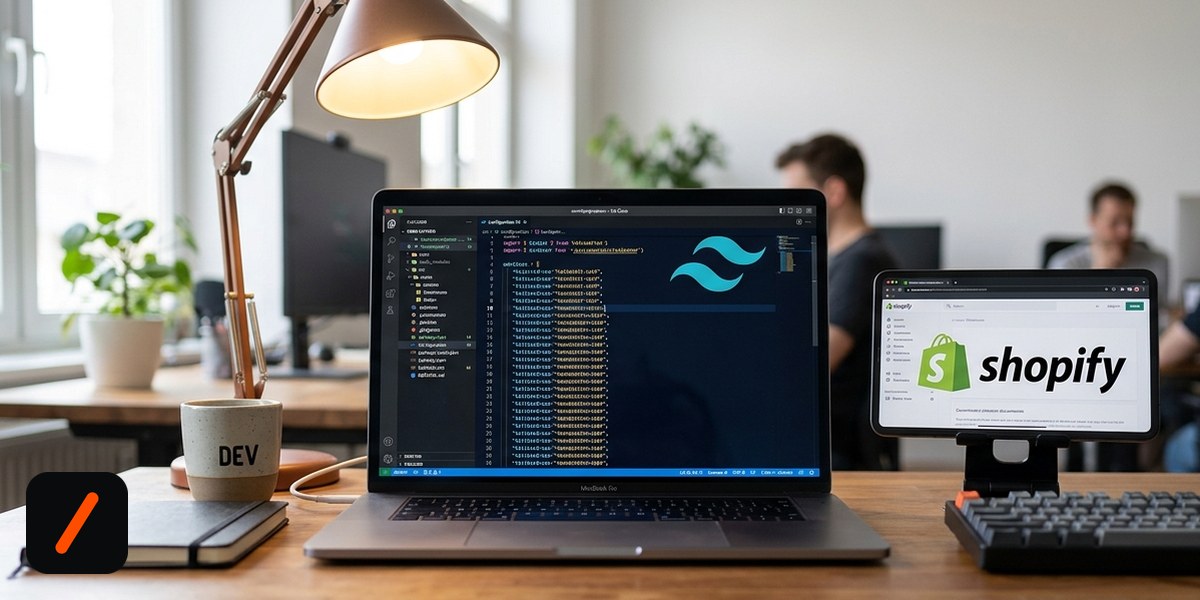
Shopify announced this morning that it is acquiring Tailwind Labs, the small team behind Tailwind CSS, giving the open-source styling framework a corporate parent eight months after AI-driven traffic loss forced the company to gut its own engineering team. Tailwind CSS itself stays MIT-licensed and free. What changes is who signs the paychecks, and the reason for that change is one of the cleanest examples yet of a business model AI quietly broke.
- Shopify is acquiring Tailwind Labs; Tailwind CSS stays MIT-licensed and free, and the team keeps maintaining it.
- Tailwind CSS installs over 110 million times a week and ships inside ChatGPT, X, Cloudflare and Reddit, among others.
- The deal follows a January 2026 crisis: Tailwind Labs laid off 75% of its engineers after revenue fell roughly 80% from its peak, a drop founder Adam Wathan blamed directly on AI tools.
- Tailwind Plus and ui.sh, the paid products that used to fund the framework, stop taking new signups; existing customers keep their access.
What did Shopify actually announce?
Adam Wathan, Tailwind Labs' founder, published the news on the Tailwind blog: his team is joining Shopify, and the open-source project isn't changing hands at all, it stays under the same MIT license it has always shipped under. He gave three reasons: Shopify offers "a stable long-term home" for a framework millions of sites depend on, he wants to build Tailwind in service of a real, complex product where the team hits the same problems users do, and Shopify was one of the first large companies to bet on Tailwind at scale, so the fit isn't a stretch. The numbers behind that last point are hard to argue with. Tailwind CSS gets installed more than 110 million times every week, nine years after Wathan first shipped it, and it's running inside ChatGPT, X, Cloudflare, Reddit and Shopify itself.
RelatedCloudflare Buys VoidZero, the Company Behind Vite
Why was a framework that popular in financial trouble?
Because popularity and revenue had quietly come apart. In January, Wathan posted that Tailwind Labs had just laid off 75% of its engineering team, cutting it from four engineers to one, and he didn't soften why: "the brutal impact AI has had on our business." Traffic to Tailwind's documentation, historically the only place people discovered the company's paid products, had fallen about 40% from its peak even as the framework itself became roughly three times more popular by his estimate. The mechanism is simple once you see it: a developer who used to search Tailwind's docs for a utility class now just asks an LLM to write the class for them, gets a correct answer instantly, and never lands on a page that mentions Tailwind Plus, ui.sh, or a sponsorship. Usage went up. The one channel that turned usage into money went dark.
What actually changes for developers using Tailwind?
Less than the headline suggests, for most people. The core framework, the compiler, the CLI, all of it stays MIT-licensed, open source and free, and Wathan's team keeps leading it. The change lands on the paid side: Tailwind Plus (formerly Tailwind UI, the component library) and ui.sh both stop accepting new customers. If you already bought in, your access doesn't move. If you were about to buy a license, that door is closed, permanently, not paused. That's the part of the announcement drawing the most pushback in developer forums, since it removes an on-ramp some teams were relying on, even as it removes the exact product line that AI had already made hard to sell.
| What changes | After the Shopify deal | Before (Tailwind Labs, independent) |
|---|---|---|
| Tailwind CSS license | MIT, unchanged | MIT |
| Core team | Same team, now Shopify employees | Independent company |
| Tailwind Plus signups | Closed to new customers | Open, paid |
| ui.sh signups | Closed to new customers | Open, paid |
| Existing customers' access | Unchanged | – |
| Primary funding source | Shopify | Docs-driven product sales |
Why does Shopify want a CSS framework's team?
Shopify isn't buying a revenue stream, it's buying craft and a name developers already trust, the same logic it applied when it became one of Ruby on Rails' biggest corporate backers years ago. Tailwind is embedded across Shopify's own theme ecosystem and its merchants' storefronts already, so bringing the people who build it in-house turns an external dependency into an internal one, with Wathan's stated bonus of using Shopify's own complex product surface as a permanent stress test for the framework. For Shopify, it is a cheap way to buy goodwill in the developer community and lock in stewardship of a tool its platform quietly depends on.
RelatedAWS buys DuckLabs, but DuckDB itself stays independent
What it means for the market
There's no ticker to watch here directly. Tailwind Labs was private and terms weren't disclosed, so this isn't a stock-moving event for Shopify (NYSE: SHOP) on its own. The signal is strategic rather than financial: it's a tell that Shopify is willing to spend to secure developer-facing infrastructure it depends on, and a data point for anyone tracking how AI is reshaping venture-backed and bootstrapped open-source businesses that monetized through documentation, tutorials, or component marketplaces. Investors in that adjacent space, from component-library startups to dev-tool SaaS with a docs-driven funnel, should read this as a live case study, not an isolated story.
- Does Tailwind CSS itself stay untouched? The MIT promise is easy to make on day one; watch the release cadence over the next year for signs of it slowing to "maintenance mode."
- Who else takes this exit? If AI is squeezing every docs-funded, open-core tool the same way, expect more small teams behind popular OSS projects to look for a corporate home rather than fight the traffic decline alone.
- What happens to existing Tailwind Plus buyers long-term? "Access unchanged" for now; watch whether support and updates for a discontinued product line quietly slow.
- Does Wathan stay hands-on? Founder-led projects that get acquired often keep the founder for a year or two as a retention condition; his continued public presence is worth tracking.
Our take
This is one of the cleanest natural experiments yet for what AI is doing to open-source economics, and it's worth sitting with the numbers: usage tripled, and revenue still fell 80%. That is not a company failing to compete. It's a company whose entire monetization channel, the documentation page, got quietly deleted from the developer's workflow by tools that can now answer the question the docs used to answer. Selling to Shopify is a rational, even good outcome for Tailwind's users: the framework survives, stays free, and gets a funding source that doesn't depend on ad impressions on a docs page nobody visits anymore. But it's a warning shot for every other open-source maintainer whose business model assumes a human will still read the manual. Fewer and fewer will.
- OfficialTailwind is joining Shopify Adam Wathan's announcement on the Tailwind blog
- ReportingTailwind Labs lays off 75 percent of its engineers DevClass, January 2026, on the layoffs behind this deal
- CommunityHacker News discussion developer reaction to the acquisition
- ReferenceTailwind CSS background on the framework
Original analysis by GenZTech. Story developing; deal terms were not disclosed at publish time.