
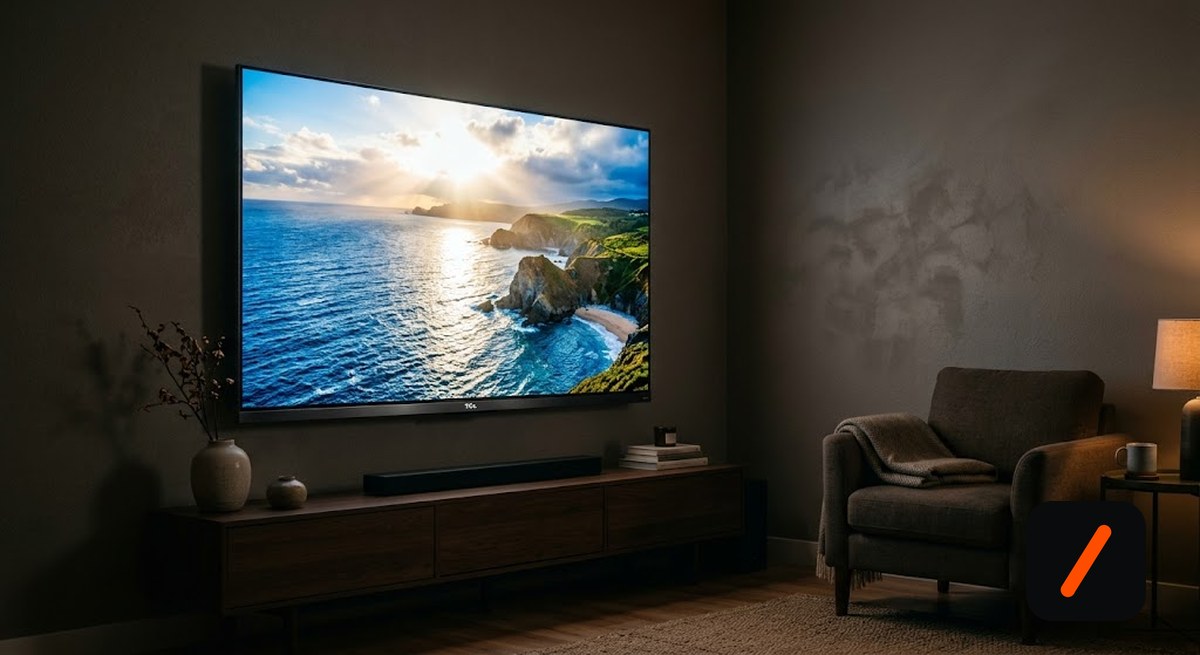
TCL’s 2026 flagship Mini-LED TV has been measured at peak brightness near 10,000 nits with more than 20,000 local dimming zones, the most of any consumer television tested so far. It runs Google TV with Gemini baked in and a 144Hz panel for gaming, and it is a statement about where Mini-LED is heading against OLED.
- Reviewers measured peak brightness near 10,000 nits, a figure OLED panels cannot approach.
- The panel packs 20,000+ local dimming zones, more than any consumer TV tested, sharpening contrast control.
- It runs Google TV with Gemini AI built in and a 144Hz panel aimed at PC and console gamers.
- The pitch: Mini-LED can now deliver brightness and contrast that challenge OLED without OLED’s burn-in risk.
What did TCL actually build?
TCL’s top 2026 set is a Mini-LED TV that reviewers measured near 10,000 nits of peak brightness with over 20,000 local dimming zones, the highest zone count in a consumer TV to date. Mini-LED uses thousands of tiny backlight LEDs grouped into dimming zones behind an LCD panel; more zones means finer control over which parts of the screen are lit, which tightens contrast and reduces the blooming halo around bright objects on dark backgrounds. It ships with Google TV and Gemini AI integrated, plus a 144Hz refresh rate that targets gamers running high-frame-rate PCs and consoles.
RelatedPixel 11 Starts at $899 as Google Raises Every Price
Why do brightness and zone count matter?
These are the two numbers that define the Mini-LED versus OLED debate. OLED wins on absolute contrast because each pixel emits its own light and can switch fully off, giving perfect blacks and no blooming. Its weakness is peak brightness and the lingering risk of burn-in. Mini-LED counters with raw luminance OLED cannot match, which matters enormously for HDR content and for viewing in bright rooms, where OLED can look dim. The knock on Mini-LED has always been blooming from having too few, too-large zones. Pushing past 20,000 zones is TCL directly attacking that weakness: the more zones, the closer Mini-LED gets to OLED-like local control while keeping its brightness and durability edge.
Who is this for?
Bright-room viewers and HDR enthusiasts first. If your living room has windows, 10,000 nits of headroom is transformative in a way OLED owners quietly envy. Gamers are the second audience, courted by the 144Hz panel. The Gemini integration is the platform play: the TV as another surface for Google’s assistant, useful to some and ignorable to others. The one caveat every spec sheet hides is that peak brightness is a small-window measurement; no panel sustains 10,000 nits across a full white screen, so the headline number describes highlights, not the whole image.
- Real-world blooming. 20,000 zones on paper still needs good processing. Independent reviews of dark-scene handling are the real test.
- Price. Flagship Mini-LED that beats OLED on brightness is only disruptive if it undercuts OLED on price, TCL’s usual strategy.
- OLED’s answer. Brighter tandem-OLED panels are the counter; watch whether they close the luminance gap.
What is the catch with the headline numbers?
Spec-sheet superlatives on TVs deserve a careful read, and this set is a good example of why. Peak brightness figures like 10,000 nits are measured on a small bright window against a dark field, the best case a panel can produce. No television sustains that across a full white screen, because the power draw and heat would be enormous, so the number describes how intensely a small highlight, a glint of sun on water, a lamp in a night scene, can pop, not how bright the whole picture gets. That highlight performance is genuinely valuable for HDR, but it is not the same as overall brightness. The dimming-zone count is similarly nuanced: 20,000 zones is a lot, yet a 4K panel has roughly 8 million pixels, so even at this density each zone still covers hundreds of pixels. That is why Mini-LED can still show faint blooming around a bright object on black, and why the quality of the processing that drives those zones matters as much as the raw count. The engineering here is real and the numbers are records, but they describe specific strengths rather than a blanket win. A buyer should care about how the set handles a starfield or subtitles on a dark scene, which is where zone control is tested hardest.
RelatedAmazfit Balance 3 Pushes 21-Day Battery and Sapphire
Our take
The story here is not one TV, it is Mini-LED maturing to the point where OLED’s brightness advantage is simply gone and its contrast advantage is narrowing. TCL has spent years competing on specs-per-dollar, and a 10,000-nit, 20,000-zone flagship is that strategy aimed at the very top of the market. OLED still owns perfect blacks and off-angle pixel precision, and that matters in a dark room. But for most people watching HDR in a normal, sometimes-bright living space, this is the more useful kind of impressive. The number that will decide its impact is the one TCL has not led with yet: the price.
Original analysis by GenZTech. Figures current as of July 2026. Source: TechRadar.