
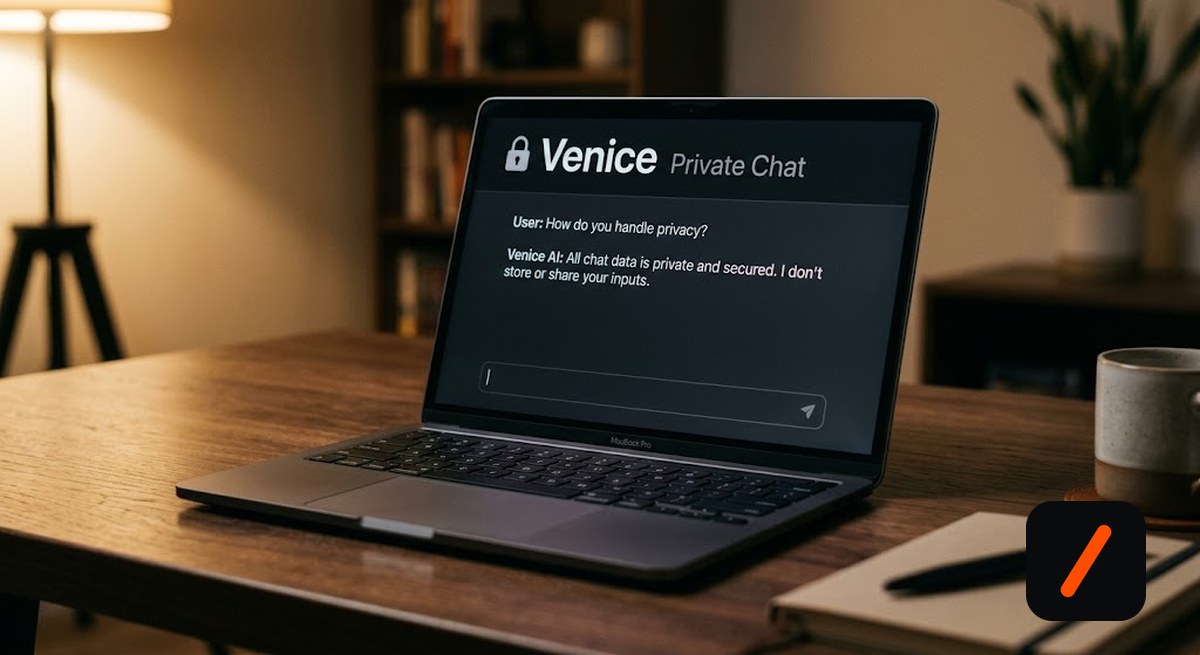
Venice, a two-year-old startup offering private, surveillance-free access to a wide range of AI models, has raised a $65 million Series A led by Dragonfly at a $1 billion valuation. The bet is simple and pointed: as AI folds deeper into daily work, some users will pay for a provider that does not log, profile or train on their prompts.
- $65M Series A led by Dragonfly, setting a $1B valuation on a company founded roughly two years ago in Sheridan, Wyoming.
- The product: access to many AI models through a privacy-preserving layer that avoids the data collection baked into mainstream providers.
- The thesis is that privacy is a durable wedge against incumbents whose business models depend on data.
- A unicorn valuation on a Series A signals investor conviction that private AI is a real category, not a niche.
What did Venice raise, and for what?
Venice closed a $65 million Series A led by crypto-and-frontier-tech investor Dragonfly, at a valuation of $1 billion. The company, based in Sheridan, Wyoming and around two years old, sells access to a broad set of AI models through a layer designed to avoid the surveillance that comes standard with mainstream providers: it aims not to retain prompts, profile users or feed conversations back into training. The raise is meant to scale that product and the infrastructure behind it.
RelatedFireworks AI Raises $1.5B Series D at $17.5B Valuation
Why would privacy be worth a unicorn valuation?
Because the default AI providers have a structural conflict with it. The largest model companies monetize scale and, in various ways, the data that flows through them; retention and profiling are features of that model, not bugs. That leaves a gap for anyone who treats prompts as strictly private. The users who care are not everyone, but they are valuable: professionals handling sensitive material, businesses wary of leaking strategy into a vendor’s logs, and privacy-conscious individuals. A billion-dollar Series A valuation says Dragonfly believes that segment is large and durable enough to build a real company on, rather than a feature the incumbents can casually copy without undermining their own economics.
What is the catch?
Trust and cost. A privacy pitch only works if users believe the claims, which means the burden of proof on Venice is heavier than on a normal AI reseller; any lapse is fatal to the brand. And routing around data collection does not make the underlying compute cheaper, so Venice competes on principle against providers who can subsidize access with data-driven business models. The company is essentially betting that enough people will pay a fair price for privacy to outrun that disadvantage.
- Verifiability. The strongest version of this product proves its privacy claims technically, not just in a policy. Watch for that.
- Incumbent response. If private AI grows, expect the big providers to ship a paid privacy tier as a defensive move.
- Enterprise pull. The clearest path to durable revenue is businesses that cannot legally leak prompts. See if Venice leans there.
What it means for the market
The signal for investors is that privacy is emerging as a fundable AI category rather than a checkbox. A $1 billion Series A valuation on a two-year-old company is aggressive, and it reflects a thesis that the data-hungry default of mainstream AI creates room underneath it. The read-through for the incumbents is that a privacy-first challenger, if it gains traction, pressures them to offer verifiable no-retention tiers, which complicates their data economics. For the broader venture landscape, it is another data point that investors are funding infrastructure and trust layers around AI, not just more models. This is analysis, not investment advice.
RelatedGeneral Intuition Raises $320M to Train AI on Games
Is there a real market for paying for privacy?
The skeptical view is that people say they value privacy and then choose free and convenient every time, and there is history to support it. But the AI context changes the calculus in a way that matters. When you paste a contract, a medical question, a codebase or a business plan into a model, you are handing over material that is far more sensitive than the browsing exhaust privacy products usually fight over. Professionals are already nervous about what leaves their machine, and companies have concrete legal reasons not to leak client data or strategy into a vendor's logs. That is a narrower audience than everyone, but it is an audience with real willingness to pay and real stakes, which is exactly the kind of beachhead a durable business is built on. The question for Venice is whether it can convert that latent concern into paid usage faster than the incumbents ship a good-enough privacy tier of their own. Its advantage is focus and a brand built entirely on the promise; its disadvantage is that trust in a privacy product is fragile and expensive to earn. The $1 billion valuation says investors think the concern is real and monetizable. The next year is where that thesis either finds paying customers or does not.
Our take
Privacy is one of the few wedges a startup can drive against companies whose entire model assumes data flows through them, and Venice is driving it hard. The valuation is rich for a Series A, which raises the bar it has to clear, but the strategic logic is sound: incumbents cannot fully match a no-data pitch without hurting their own economics. The company that wins this category will be the one that makes privacy verifiable rather than promised. That, more than the funding number, is the thing to track.
- FundingGenZTech Funding Tracker tracked rounds and valuations
- ReferenceTech Startups funding roundup July 2026 rounds
Original analysis by GenZTech. Figures current as of July 2026. Source: Tech Startups.