
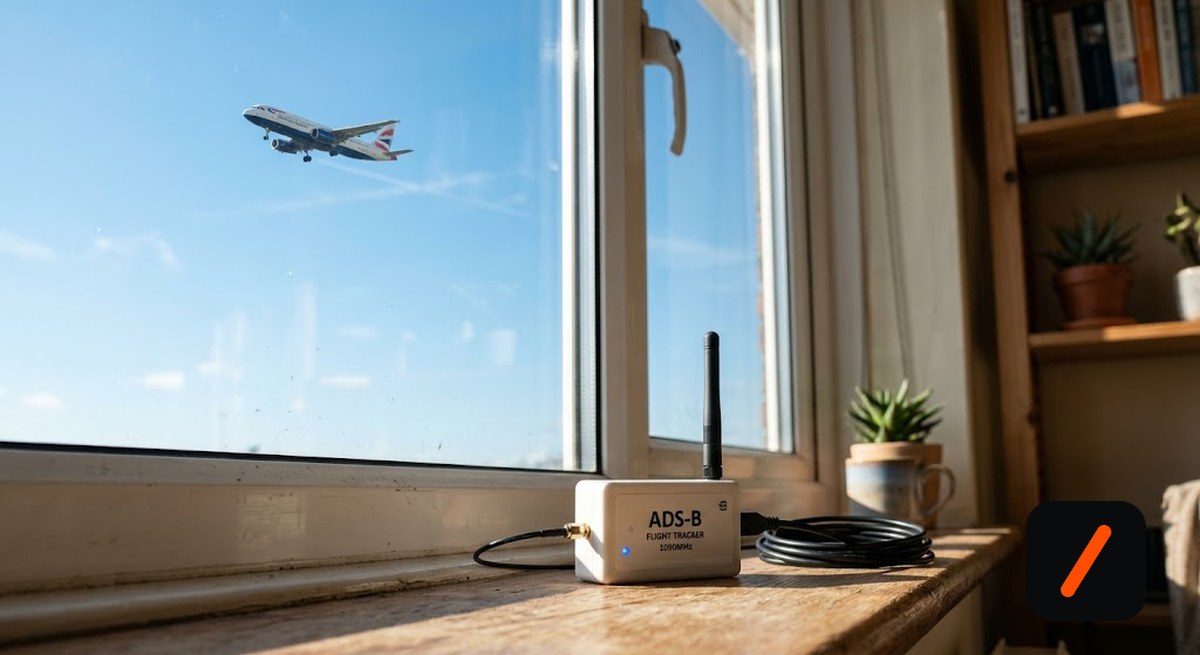
Wingbits is turning flight tracking into a decentralized physical infrastructure network: it pays WINGS tokens to anyone who installs a small antenna and shares live aircraft data, building an aviation-tracking layer on Solana. After a testnet year that reached 2,100 active stations tracking 120,000 unique flights a day across 85 countries, the project launched its WINGS token in April and now ties token value directly to real data sales through a buyback-and-burn model.
- Hardware earns tokens. Install an antenna, feed live ADS-B flight data to the network, and earn WINGS, the same operator-incentive model that powers DePIN.
- Real scale already. On Solana testnet, Wingbits hit 2,100 active stations and 120,000 unique flights per day across 85 countries.
- Revenue backs the token. Half of the revenue from selling flight data is used to buy back and burn WINGS, linking data demand to token supply.
- It is funded and live. Wingbits raised $9.2 million in total and launched WINGS in April 2026, listed on Kraken plus DEXs Orca and Raydium.
What is Wingbits?
Wingbits is a decentralized physical infrastructure network, a DePIN, for aviation on Solana. The premise is simple: aircraft broadcast their position over a system called ADS-B, and anyone with a small antenna can receive those signals. Wingbits pays people in WINGS tokens to install that hardware and feed live flight data into a shared network, then sells the aggregated data to buyers who need reliable global flight tracking. It is the same operator-incentive playbook that built Helium's wireless network and Hivemapper's maps, applied to a niche, aviation data, with real commercial demand.
RelatedSilencio Turns Idle Phones Into a Global Noise Sensor Net
How does the token model work?
Value is meant to flow from real data sales, not just emissions. Operators earn WINGS for contributing verified data, with authenticity enforced through a Proof-of-Location mechanism that confirms a station is really where it claims to be, which matters when the whole product is trustworthy positioning data. On the demand side, when Wingbits sells flight data, 50% of that revenue is used to buy back and burn WINGS. That directly links real-world data sales to token supply: the more the network's data is worth to buyers, the more tokens are removed from circulation. It is the sustainability model DePIN projects are increasingly judged on.
What has it actually achieved?
More than most DePIN pitches. In its first year on Solana testnet, Wingbits scaled to 2,100 active stations tracking 120,000 unique flights per day across 85 countries, and it reported over 2,000 pre-orders for its custom hardware, built in partnership with the positioning network GEODNET. A 2025 satellite integration extended coverage into a "Space-to-Ground" tracking network, filling gaps where ground stations are sparse. The project raised $5.6 million in a round backed by Borderless Capital and Bullish Capital among others, bringing total funding to $9.2 million, and launched WINGS in April 2026, listed on Kraken plus the DEXs Orca and Raydium.
How does it fit the DePIN landscape?
DePIN in 2026 is being sorted into projects with real end-user demand and those living on token emissions alone. Compute and storage networks like Render, Filecoin, and Akash have led that shift because AI created hungry buyers for their capacity. Wingbits is a bet that aviation data is a similarly real market: airlines, logistics firms, and analytics providers need accurate, global flight tracking, and a decentralized network can supply it more cheaply and with broader coverage than centralized incumbents. Its niche is narrower than compute, but its demand is concrete, which is exactly what the sector now rewards.
RelatedGrass Hits 2.5M Nodes Selling Bandwidth for AI Web Data
What could go wrong for Wingbits?
Plenty, as with any young DePIN. The central risk is the revenue-versus-emissions balance: if token rewards to operators outpace the data revenue that funds buybacks, the token can slide and operator economics break down, the failure mode that has undone weaker networks. Competition is real too, established flight-tracking providers already sell global ADS-B data and have deep customer relationships, so Wingbits must prove a decentralized network offers better coverage or price, not just a novel structure. Hardware dependence adds friction: growth relies on people buying and installing antennas, and supply, cost, or shipping issues can throttle expansion. And like all tokens, WINGS is exposed to broad crypto sentiment regardless of network fundamentals. The aviation-data thesis is genuinely promising, but execution on the demand side is what will decide whether the loop sustains itself.
Our take
Wingbits is one of the more grounded DePIN stories, because it starts from a real data product and a real buyer base rather than a token in search of a use. The buyback-and-burn tied to data sales is the kind of demand-side mechanism that separates durable networks from emissions treadmills, and the testnet scale shows the model attracts operators. The risks are the usual ones: whether data revenue grows fast enough to sustain rewards as emissions taper, and whether it can defend its niche against established flight-tracking providers. But as an example of DePIN aimed at a genuine market, Wingbits is worth watching. This is not financial advice.
- OfficialWingbits — Official site
- ReferenceWingbits — Mainnet and WINGS token
- DataDePINscan — network analytics
Original analysis by GenZTech. Details current as of July 2026. Network figures per Wingbits and DePINscan. Not financial advice.