
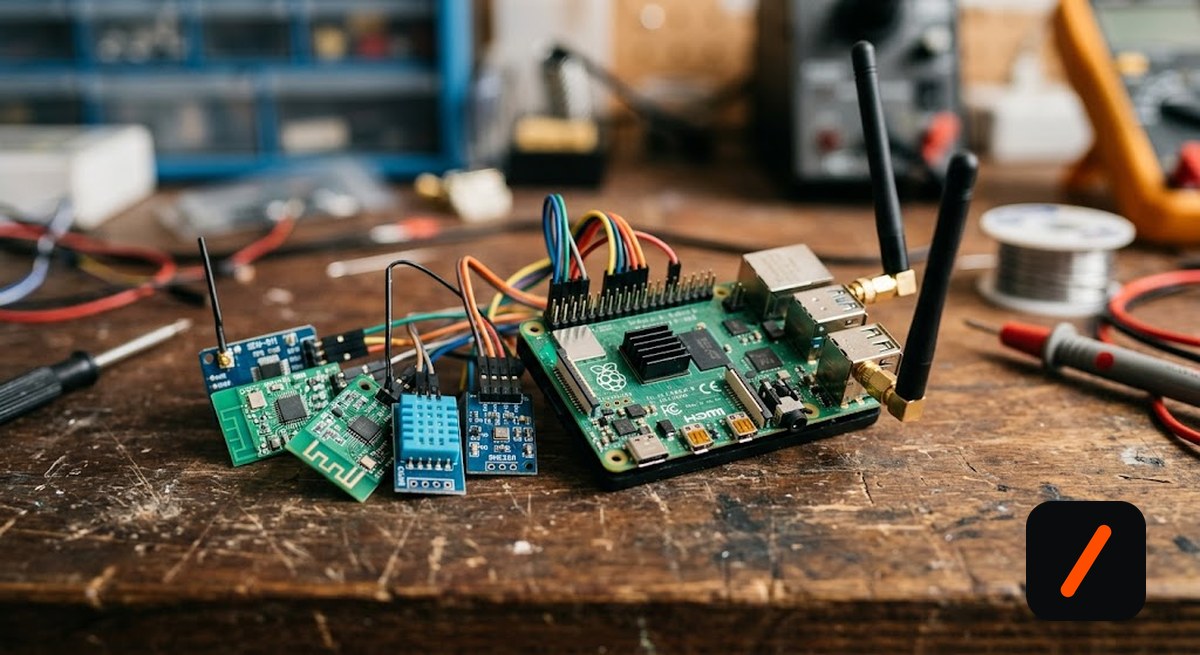
IoTeX is repositioning itself around a specific thesis: that its network of roughly 40 million connected devices can become a data layer for AI. By pairing DePIN hardware with modular blockchain infrastructure and a partnership with the modular AI chain 0G, IoTeX wants to turn real-world sensor and device data into a resource that AI models can train and reason on, a bet that the scarce input for physical-world AI is trustworthy real-world data, not more compute.
- The asset: around 40 million connected devices feeding real-world data into the IoTeX network.
- The thesis: AI for the physical world is bottlenecked by trustworthy real-world data, which DePIN networks are built to collect.
- The stack: modular infrastructure plus a 0G partnership to handle AI-scale data and compute.
- The framing: IoTeX wants to be the layer that turns device data into machine-usable intelligence, not just another DePIN token.
What is IoTeX trying to become?
IoTeX started as a blockchain platform focused on the Internet of Things and connected devices, and it is now recasting that foundation as infrastructure for AI. The core idea is that its network of roughly 40 million connected devices continuously generates real-world data, location, movement, environmental, sensor readings, and that this data is exactly what a growing class of AI systems needs. Rather than competing in the crowded market for decentralized compute, IoTeX is staking out the data side: collecting, verifying, and making available the physical-world information that models reasoning about the real world cannot get from the internet alone. It is a deliberate repositioning from IoT chain to DePIN-AI data layer.
RelatedNodle Turns Idle Phones Into a Bluetooth DePIN
Why is real-world data the bottleneck?
Language models learned from the internet, but a huge and growing category of AI, robotics, autonomous systems, physical-world agents, needs data the internet does not contain: what is actually happening in specific places, measured by real sensors, in real time. That data is expensive and hard to collect at scale, and it needs to be trustworthy, because a model acting in the physical world cannot afford to train on fabricated or manipulated inputs. This is where DePIN networks have a genuine structural advantage: they already incentivize large fleets of real hardware to collect verifiable real-world data. IoTeX's argument is that as AI moves off the screen and into the physical world, whoever supplies trustworthy real-world data at scale owns a valuable, defensible position.
What does the 0G partnership add?
Handling AI-scale data requires infrastructure built for it. 0G is a modular AI-focused blockchain protocol designed for the throughput and data availability that AI workloads demand, and partnering with it lets IoTeX combine its device network and real-world data with a stack capable of moving and serving that data at AI scale. The modular approach, separating data availability, execution, and consensus into specialized layers, is increasingly how crypto infrastructure is built for demanding workloads. For IoTeX, the partnership is about credibility and capability: proving that its data can flow into AI pipelines through infrastructure purpose-built for the job, rather than being bottlenecked by a general-purpose chain never designed for AI-scale data.
What are the risks and the reality check?
Two honest caveats. First, the DePIN-AI narrative is powerful and, so far, more promise than proven revenue for most projects; the hard part is turning a large device network and a compelling thesis into paying customers who actually buy the data. Second, IoTeX operates in a crowded field where many networks are chasing the same intersection of DePIN and AI, and having devices is not the same as having demand. The verification challenge is also real: the entire value proposition rests on the data being trustworthy, which requires robust mechanisms to prevent spoofing and manipulation across millions of independent devices. The 40-million-device figure is an impressive top of funnel, but the network's success depends on what flows out the bottom into real AI applications.
RelatedSilencio Turns Idle Phones Into a Global Noise Sensor Net
What it means for the sector
IoTeX's repositioning is a useful signal about where DePIN is heading in 2026. The sector is maturing past pure token speculation toward utility, and the most credible utility story right now is feeding AI, whether compute, like the GPU networks, or data, like IoTeX is attempting. The projects that will matter are the ones where external customers actually pay for the service, and the DePIN-AI data angle is one of the more defensible versions of that bet because trustworthy real-world data is genuinely scarce. For observers, IoTeX is worth watching as a test case: if a device-heavy network can convert its data into real AI demand, it validates a model many DePIN projects will chase; if it cannot, it underscores how far the gap remains between an impressive network and a paying market.
- Real data demand. The decisive metric is whether AI developers actually pay for IoTeX's real-world data.
- Verification integrity. The value collapses if device data can be spoofed; watch the anti-manipulation mechanisms.
- 0G integration results. Whether the modular stack delivers AI-scale throughput in practice.
- Competitive position. How IoTeX differentiates in a crowded DePIN-AI field where many claim the same ground.
Our take
IoTeX is making one of the more intellectually honest bets in DePIN: that the scarce input for physical-world AI is verified real-world data, not compute, and that a network of 40 million devices is a credible way to supply it. The thesis is genuinely strong, because language models are saturated on internet text while robotics and physical agents are starving for trustworthy sensor data, and DePIN is structurally good at collecting exactly that. The 0G partnership adds the infrastructure credibility the pitch needs. The gap, as always in DePIN, is between narrative and revenue: having the devices and the story is necessary but not sufficient, and the network still has to prove that real AI customers will pay for its data and that the data can be trusted. It is a bet worth taking seriously, and one whose outcome will say a lot about whether DePIN's AI pivot is real.
Original analysis by GenZTech. Based on IoTeX and partnership disclosures as of July 2026.