
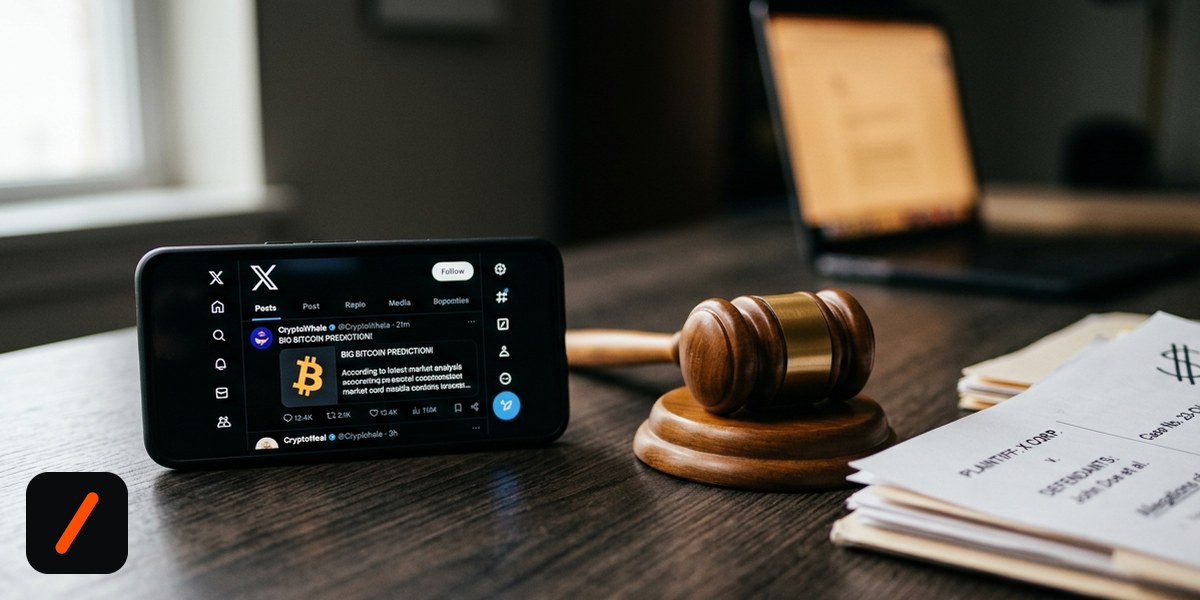
X Corp has sued two named defendants and a group of unidentified account operators in the UK High Court, accusing them of running a coordinated bot network across six Bitcoin-focused accounts to fraudulently collect at least £207,384 ($278,000) from its Creator Revenue Sharing program. The scheme allegedly ran for close to three years, from August 2023 to February 2026, before X's own fraud team caught it.
- X filed suit on September 17 in the UK High Court against Vivek Kumar Sen, Zamyang Sherpa and unidentified co-operators, claim number BL-2026-001161.
- Six accounts, including @Vivek4real_, @Bitcoin_Teddy and @saylordocs, allegedly reposted and liked each other's near-identical content to fake the "genuine, human" engagement that Creator Revenue Sharing pays out on.
- X suspended the accounts on August 18, roughly a month before filing, and says investigating and unwinding the fraud alone cost it more than £75,000.
- The company wants the money returned with damages, interest and legal costs, and no defense has been filed as of publication.
What exactly did X allege in the lawsuit?
X Internet Unlimited Company and X Corp filed particulars of claim in the High Court of England and Wales on September 17 against Vivek Kumar Sen, Zamyang Sherpa and a list of unidentified co-defendants operating under the accounts named in the suit. The claim describes a coordinated ring: six primary accounts, all enrolled in Creator Revenue Sharing between August 2023 and February 2026, that allegedly posted identical or substantially similar Bitcoin-market commentary and then reposted, liked and replied to each other's posts on a rotating basis. Three further accounts, X says, existed largely to pile onto that engagement from the outside, repeatedly reposting and replying to the six primary accounts to make the traffic look organic to X's fraud-detection systems.
RelatedApple Responds to $1.8M Fake Bitcoin Wallet Lawsuit
X's filing calls the result a "false appearance of genuine, human communication and interaction," the exact quality its payout formula is built to reward and its abuse-detection systems are built to filter out. The company suspended all nine accounts on August 18, then spent roughly a month building the case before filing. It is now asking the court to order repayment of the full amount plus damages, interest, and its legal and investigative costs, which it separately estimates at more than £75,000.
How does X's Creator Revenue Sharing program actually pay out, and why is it exploitable?
Creator Revenue Sharing is funded entirely by X Premium subscriptions rather than by ad impressions directly, a change X made in October 2024 specifically to move away from a system that had been gamed through fake ad-heavy reply threads. Under the current model, X scores "quality engagement": replies, likes, bookmarks and time spent, but only from other Premium subscribers, and pays creators roughly $2 to $10 per thousand qualifying Premium engagements every two weeks through a connected Stripe account. To even qualify, an account needs at least 5 million organic impressions over a trailing three-month window and, as of this year, 2,000 verified followers, up from the original 500.
The design assumes that engagement from paying Premium subscribers is a reasonable proxy for real audience interest, since a bot account would need its own active Premium subscription to count. What the lawsuit alleges is that the defendants got around that by controlling both sides of the loop themselves, running enough of their own Premium-subscribed accounts to like, reply to and repost content from their own primary accounts, and by posting duplicate content across accounts to inflate impression counts that fed the eligibility threshold in the first place. It is a small-scale, self-referential version of the same problem every engagement-based payout system faces: if a metric becomes the target, someone will eventually try to manufacture the metric rather than the thing it was supposed to measure.
Why did it take nearly three years to catch?
The earliest of the six accounts entered the program in August 2023, within weeks of the ads-revenue-sharing scheme's original launch, when eligibility screening and fraud tooling were comparatively thin. X has spent the years since tightening the program twice: first by switching the payout basis from ad impressions to verified engagement in October 2024, then by roughly quadrupling the follower threshold this year. Both changes were framed publicly as quality improvements, but they also happen to be exactly the kind of friction that makes a coordinated engagement ring harder to sustain, which may be part of why the pattern finally surfaced and was flagged for suspension in August 2026, close to three years after it allegedly began.
That gap matters beyond this one case. A creator-payout system that took roughly three years to notice a six-account ring liking and reposting itself on a predictable rotation is not primarily a story about clever fraud; it is a story about how much manufactured engagement a platform's own abuse detection can absorb before it becomes worth chasing in court rather than just quietly clawing back through the payout pipeline.
RelatedBitcoin's 3-Month High Is a Treasury Bond Story, Not a Crypto One
Who's affected, and what happens next in court?
Directly, it is the two named individuals, Sen and Sherpa, plus whoever the unidentified co-defendants turn out to be once discovery proceeds. No defense has been filed as of this writing, so the allegations remain exactly that, allegations, and the defendants have not yet had a chance to respond in court. More broadly, it is a warning shot at the wider Bitcoin-and-crypto commentary ecosystem on X, a corner of the platform where reply-guy engagement farming for tips, follows and now Creator Revenue Sharing payouts has been an open secret for years. X naming specific handles and dollar figures in a public UK court filing, rather than handling it quietly as a Terms of Service enforcement matter, signals it intends this case to be visible: a deterrent aimed at the next ring considering the same trade, not just a debt-collection exercise against two people.
What it means for the creator economy on X
X is privately held inside xAI now, so there is no ticker to move here, but the case still lands on a real economic nerve: the credibility of paid engagement as a business model. Every platform running a creator fund, from YouTube's Partner Program to Meta's Reels bonuses, prices content partly on interaction volume, and every one of them fights the same arbitrage between "engagement that reflects real interest" and "engagement engineered to look like it." A public lawsuit with named defendants and a specific pound figure is a stronger signal to would-be scheme operators than a quiet account ban, and it is also a signal to legitimate creators that X is willing to spend real legal money defending the integrity of a program it wants advertisers and Premium subscribers to keep trusting.
- Aug 2023First of the six primary accounts enrolls in X's revenue-sharing program. Weeks after the ads-revenue scheme's original launch.
- Oct 2024X switches the payout basis from ad impressions to verified Premium engagement. A quality fix that also raises the bar for gaming the system.
- Feb 2026The last of the six primary accounts joins the alleged ring. Nearly three years after the first.
- Aug 18, 2026X suspends all nine accounts named in the eventual suit. Investigation reportedly costs the company over £75,000.
- Sep 17, 2026X files suit in the UK High Court, claim BL-2026-001161. Seeks repayment, damages, interest and costs.
- NextDefendants' response and discovery on the unidentified co-operators. No defense filed as of publication.
- Whether the unidentified defendants get named. Discovery could reveal a larger network than the six accounts specified in the initial filing.
- Whether X publishes more enforcement numbers. A single £207K case is unlikely to be the only one; expect this filing to be a template for future public suits rather than a one-off.
- Whether other Bitcoin/crypto-adjacent accounts quietly go dark. Public suits tend to trigger self-suspensions among adjacent rings hoping to avoid the same treatment.
Our take
The interesting part of this story is not that people tried to game a creator-payout algorithm; someone always does. It is that X chose litigation over quiet enforcement. Banning the accounts and clawing back the money through Stripe would have made the problem disappear with zero public accountability either way. Suing in open court, naming real people, and putting a specific pound figure in a public filing is a more expensive and more visible path, and it only makes sense if X wants the case to function as advertising: proof, aimed at the next person weighing whether a rotation of six accounts can quietly extract five figures a month, that the juice is not worth the legal squeeze anymore.
- LegalUK High Court, Business and Property Courts, claim BL-2026-001161 X Internet Unlimited Company and X Corp v. Sen, Sherpa et al., filed September 17, 2026
- OfficialX Creator Revenue Sharing Terms eligibility, payout basis and program rules
- ReferenceSocial Media Today: X updates Creator Revenue Share requirements follower-threshold and engagement-basis changes over time
Original analysis by GenZTech. Read the original coverage from CoinDesk.