
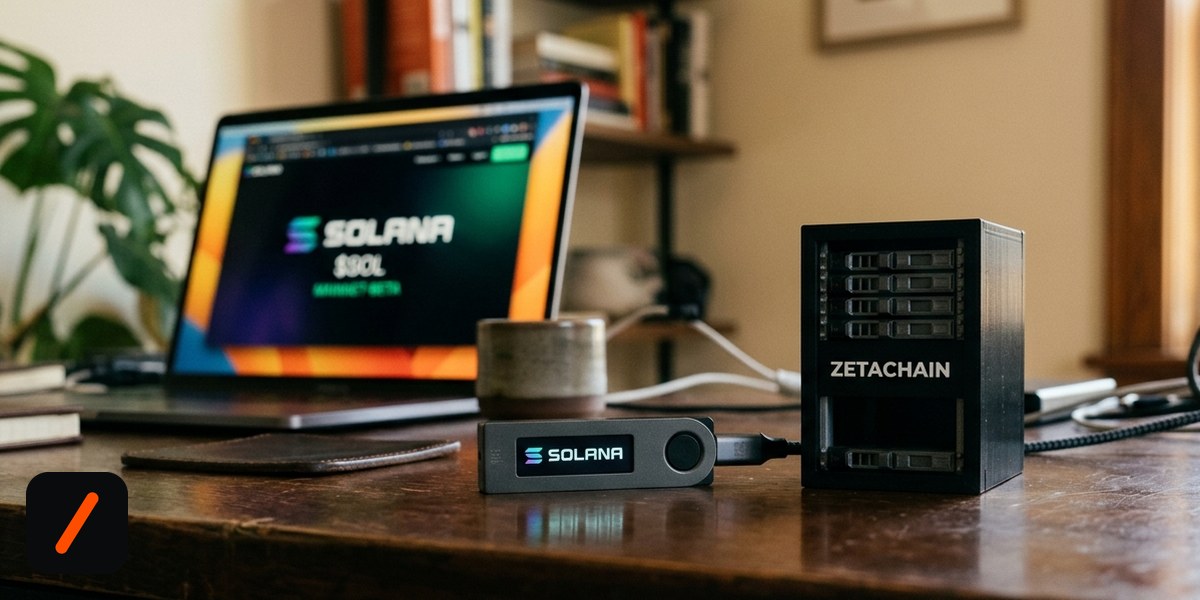
ZetaChain's community just voted to shut down the blockchain it spent three years building, and hand the keys to Solana instead. Proposal 68 closed at 14:58 UTC on September 20, 2026, with 99.4% of votes cast in favor and 58% of eligible stake turning out, well clear of the 40% quorum needed to make the result binding.
- Proposal 68 passed 99.4% in favor with 58% voter turnout, clearing ZetaChain's 40% quorum on September 20, 2026.
- ZETA converts 1:1 into a native Solana SPL token; the ticker, total supply, and vesting schedules don't change.
- The migration also carries Anuma, ZetaChain's AI app with over 300,000 users, onto Solana.
- A second, still-unscheduled vote has to pass before any tokens move or the L1 actually goes dark.
What did ZetaChain's community actually vote for?
Proposal 68 authorizes two things: converting ZETA into a native Solana SPL token at a flat 1:1 rate, and beginning the process of winding down the ZetaChain Layer 1. It does not set a shutdown date. A second proposal still has to pass to define the snapshot block height, the claim process holders will follow, exchange coordination, and the actual date the L1 stops producing blocks. The vote that just passed only excludes ZETA already living on Ethereum and BNB Chain, which sit outside this migration entirely. So nothing moves yet. What changed is that the team now has explicit community authorization to build and execute the migration plan, instead of having to guess whether holders would tolerate the idea at all.
RelatedSolana Launches Stake-Weighted On-Chain Governance
Why would a Layer 1 vote to shut itself down?
Because running one is expensive in a way that has nothing to do with gas fees. ZetaChain's own explanation, cited in the proposal, put it plainly: "As a Cosmos SDK chain, ZetaChain inherits every upstream advisory and patch, and each one has to be coordinated across dozens of independent validators." Translate that out of governance-speak: every time the Cosmos SDK or Tendermint consensus layer ships a security fix, someone has to convince dozens of independently operated validators to upgrade in a coordinated window, or risk a chain halt or a fork. That's a permanent tax on engineering time, and it scales with the number of validators, not with how many people actually use the chain. ZetaChain launched mainnet in January 2024 after raising $27 million in August 2023, built specifically as an "omnichain" network for moving assets and messages across other blockchains. Two and a half years later, the team is admitting that job doesn't require owning a chain at all.
What is Anuma, and why is it steering this decision?
Anuma is ZetaChain's answer to the actual question a chain has to answer eventually: what do people use it for? Launched in February 2026, it's a "private AI" chat app built around a Private Memory Layer, meaning a user's conversation history and model preferences are encrypted and stored under their control, portable across different AI models instead of locked to one vendor. By September 16, 2026, ZetaChain says Anuma had crossed 301,195 users and processed more than a million requests across 35 different AI models. That's the part of this story that isn't really about blockchains at all: an app-layer product found traction while the chain underneath it didn't. The team's own framing leans into that gap directly: "What Solana's AI stack still lacks is the application layer: an app people use every day, with memory that belongs to them." Anuma migrates to Solana alongside the token, which is the real thesis here. ZetaChain isn't retiring; it's admitting Solana already has the users and liquidity its own chain never built, and moving the one product that worked to where the audience already is.
| Attribute | ZetaChain L1 (today) | ZetaChain on Solana (proposed) |
|---|---|---|
| Consensus & validators | Cosmos SDK, Tendermint BFT, ZetaChain's own validator set | None to maintain; inherits Solana's existing validator set |
| ZETA token | Native L1 gas and governance token | Solana SPL token, converted 1:1, same supply |
| Security upkeep | Team must coordinate every Cosmos SDK/Tendermint patch across dozens of validators | Inherited from Solana's own client and validator upgrades |
| Anuma AI app | Runs on ZetaChain's own infrastructure | Migrates to Solana, taps its existing DeFi and consumer liquidity |
| Cross-chain messaging | ZetaChain's original omnichain protocol | Not yet defined; expected in the second proposal |
What happens to ZETA holders and validators next?
Nothing, immediately. The conversion is 1:1, the ticker and total supply stay the same, and vesting schedules for team and investor allocations are unaffected. Staking continues to run on the current chain during the transition window. What's missing is the mechanical detail: the exact block height at which balances get snapshotted, how holders on exchanges versus self-custody wallets actually claim their Solana-native ZETA, and the date validators stop producing new blocks. All of that sits in a second proposal that hasn't been drafted publicly yet. Validators keep running the existing chain in the meantime, since there's currently nothing else for them to do.
- Aug 2023ZetaChain raises $27 million Seed/Series A funding ahead of mainnet
- Jan 2024ZetaChain mainnet launches Cosmos SDK omnichain network
- Feb 2026Anuma AI app launches Private Memory Layer chat app
- Sep 16, 2026Anuma passes 300,000 users 1M+ requests across 35 models
- Sep 17, 2026Solana migration first announced Ahead of the governance vote
- Sep 20, 2026, 14:58 UTCProposal 68 passes, 99.4% in favor 58% turnout, cleared 40% quorum
- TBDSecond proposal: snapshot height, claim process, shutdown date Not yet scheduled
What does this mean for ZETA and the market?
ZETA's price fell roughly 2.5% in the 24 hours after the vote, even with 99.4% of participating stake voting yes. That's not really a contradiction. A holder can agree the L1 has no independent future and still price in the real uncertainty sitting between here and a working migration: no confirmed shutdown date, no published claim mechanism, and the standard bridging and exchange-support risk that comes with any token moving chains. The signal for investors watching this space isn't "sell the news," it's that governance approval and market confidence are separate questions, and the market is withholding judgment until the second proposal turns intentions into a concrete plan with dates attached.
RelatedCFTC Invokes Emergency Powers to Keep Kalshi Live in NY
Does this set a precedent for other app-specific L1s?
It's a live question worth watching. ZetaChain is a Cosmos SDK chain that never attracted enough independent developer activity to justify running its own validator set and its own security patch cycle. That description fits a long list of other app-specific and "purpose-built" L1s launched during the 2022-2023 chain boom, most of which are quietly running on skeleton usage today. If ZetaChain's Solana migration goes smoothly and ZETA holders end up better off for it, the math becomes hard for other teams in the same position to ignore: keep paying the sovereignty tax for a chain nobody uses, or fold into wherever the users and liquidity already are.
- The second proposal. Snapshot height, claim mechanics, and a real shutdown date are what turn this from an authorization into an actual migration.
- Exchange support. Whether major exchanges list the Solana-native ZETA cleanly, or holders face withdrawal friction during the swap window.
- Anuma's growth curve. The AI app is the actual product here; its user count on Solana is the real test of whether this move pays off.
- Copycat proposals. Watch other underused Cosmos SDK L1s for similar "abandon our own chain" governance votes over the next few months.
Our take
Strip away the token mechanics and this is a surprisingly candid admission: ZetaChain spent two and a half years and $27 million building a blockchain whose main job turned out to be coordinating security patches across validators, for a chain whose one real product is a chat app. That's not a failure so much as a lesson the whole app-specific-L1 category is going to keep relearning. Owning your own consensus layer is a serious liability when your actual product is a single application, not a platform other people build on. Moving to Solana trades sovereignty for someone else's user base, someone else's liquidity, and someone else's patch schedule. Given what ZetaChain's own chain had actually attracted after two years, that trade looks less like retreat and more like the obvious move a year too late.
- GovernanceZetaChain Governance Forum Proposal 68 discussion and vote record
- ReportingThe Block Vote results, team statements, and market reaction
- ReportingSolana Compass Migration terms and Anuma user figures
Original analysis by GenZTech. Primary source: ZetaChain Governance Forum.