
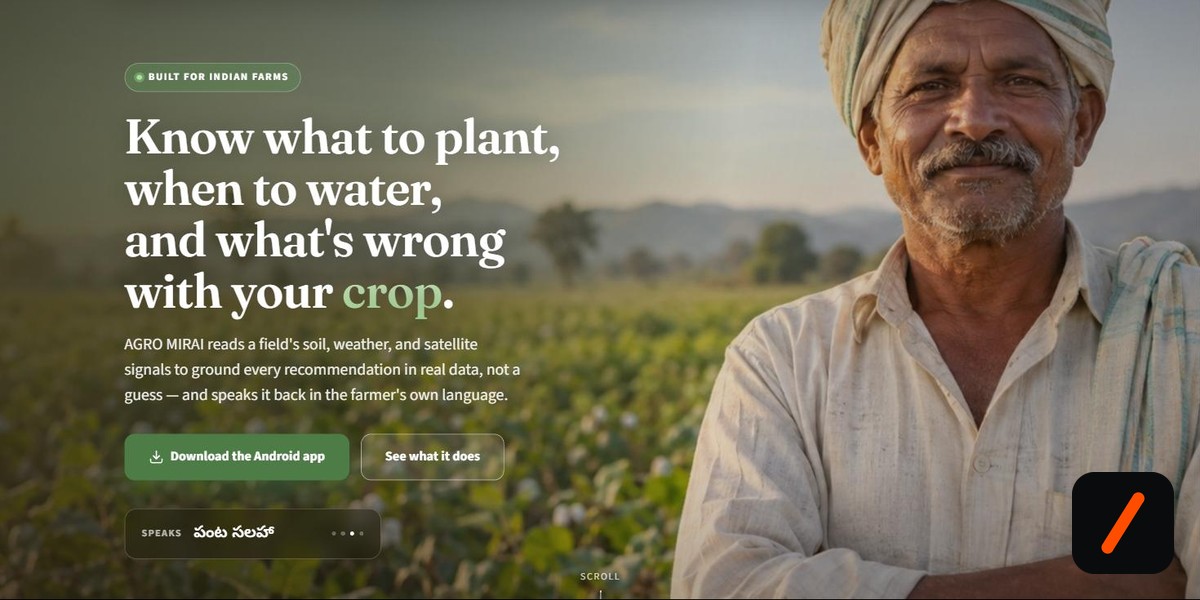
Agro Mirai is a smart farming advisor for Indian farms that answers three questions: what to plant, when and how much to water, and whether a crop is at risk of disease. It builds every answer from the farmer's own field data (live weather, soil records and satellite images of crop health) instead of a generic lookup table, shows its reasoning, and reads the advice aloud in English, Kannada, Telugu or Hindi. Ritesh Bonthalakoti built it solo as a final-year capstone project, and it ships as a live website, a Flask API and an Android app.
- Crop advice ranks 22 crops against FAO EcoCrop temperature, soil pH and texture ranges plus the field's real 12 months of rainfall.
- Irrigation advice runs a daily FAO-56 root-zone water balance and refuses to guess when weather data is too stale.
- Disease risk comes from a MobileNetV2 leaf-photo model, with a weather and satellite rule-based score as a fallback.
- Every advisory is translated and spoken in four languages, and farmers sign in with name, phone and an OTP, no password.
What does Agro Mirai do?
"Agro Mirai turns live weather, soil, and satellite data into plain-language crop, irrigation, and disease-risk advice for Indian farmers, spoken back in their own language," Ritesh told us. A farmer registers a field with its location, soil and the crop that was sown. Agro Mirai then pulls live weather from Open-Meteo, soil properties from SoilGrids, and NDVI, a satellite measure of how green and healthy a crop is, from Google Earth Engine, and turns all three into a single advisory.
RelatedThis Student Built a Tutor That Maps Your Course as a 3D Graph
Crop recommendation ranks 22 crop types against the FAO EcoCrop database's ranges for temperature, soil pH and soil texture, combined with the field's actual rainfall over the past 12 months, and then checks regional suitability against ICAR and state agriculture data. Disease risk uses a MobileNetV2 image model trained on the PlantVillage dataset when the farmer uploads a leaf photo; with no photo, or if that service is down, a weighted score over humidity, rainfall, temperature and the NDVI trend fills in. Each recommendation comes with a human-readable explanation, SHAP values for the trained models and a factor breakdown for the rule-based one.
Why build it this way?
"I wanted to see if I could build something genuinely useful for real farmers rather than another generic dashboard," Ritesh said. "Every recommendation is grounded in real data (FAO soil/crop science, satellite NDVI, live weather) instead of a black-box guess, with the reasoning shown, not hidden." That last part matters for the people it is built for. A farmer deciding whether to spend money on water or pesticide has good reason to distrust a number with no explanation, and advice that says why, in the farmer's own language, is far easier to act on.
Language is the other half of the design. Every advisory is translated and read aloud in English, Kannada, Telugu or Hindi, using AI4Bharat's IndicTrans2 for translation, AI4Bharat speech models, and Piper for English and Hindi voices. The home page even cycles its "speaks" badge through the scripts. Sign-in is just a name, a phone number and a one-time code, because a password is one more barrier for a first-time smartphone user.
What was the hardest part?
"The hardest part was the irrigation model," Ritesh said, "getting a real FAO-56 water balance working reliably with incomplete real-world weather data, without ever just falling back to a fake number when something was missing." FAO-56 is the UN Food and Agriculture Organization's standard method for crop water needs. Each day it estimates how much water the crop and soil lose to evaporation and transpiration, adds effective rainfall, and tracks how much of the root zone's usable water is gone. When that depletion passes a crop-specific threshold, the plant starts to suffer, so the model can say how many days remain before the field needs water.
The code shows how the missing-data problem is handled rather than hidden. If a day has humidity and wind readings, it uses the full Penman-Monteith equation; if not, it falls back to the simpler Hargreaves-Samani formula, and records which one it used. Backup weather sources often lag a few days, so short gaps at the end are filled by repeating the previous day's weather with zero rain and marked as estimated. More than five made-up days in a row and the model treats the data as stale; too few days of weather and it returns nothing at all instead of a confident-looking guess. Water-holding capacity is mapped from USDA soil ranges to Indian soil types, and each crop has its own root depth and allowed depletion.
| Trait | Agro Mirai | Generic farm advice app |
|---|---|---|
| Input | Your field's weather, soil and satellite data | Region and crop only |
| Irrigation | Daily FAO-56 water balance | Fixed calendar tips |
| Reasoning | Shown with every recommendation | Rarely explained |
| Missing data | Flagged, or no answer given | Silent defaults |
| Language | Spoken in 4 languages | Mostly English text |
How is it built?
The back end is a Python Flask API with a strict pipeline: data acquisition, a storage layer, a feature builder, the three models, an explanation service and a decision engine that assembles the final advisory. Storage follows the repository pattern, so the same code runs on SQLite in development and Supabase Postgres in production. The API has a frozen /v1 for backward compatibility and a /v2 with per-farmer data isolation. A rule Ritesh calls "degrade, never fail" runs through everything: the satellite source falls back to a local NDVI cache, the image model falls back to rules, and missing data returns a clear error rather than a crash.
RelatedThis Polish Student Team Built a Pension Calculator That Actually Tells You What to Change
Farmers use a React Native and Expo Android app with over-the-air updates; admins get a web dashboard; the heavy image and voice models run as separate containerised services so the main API stays light. The project has around 70 test files mirroring the source layout, and a CI check that guards the shared data contract. The repository was created in late August 2026 and has around 274 commits; the project describes itself as solo-built.
- Aug 2026Repository created final-year capstone project
- Sep 2026Live site and Android app agromirai.vercel.app, API on Render
- 29 Sep 2026Latest push around 274 commits
Our take
Agriculture apps are one of the most common student project ideas in India, and most stop at a dashboard of weather charts. Agro Mirai is different in the part that is hardest to fake: it uses agronomy standards like FAO-56 and EcoCrop instead of invented thresholds, shows its reasoning, is honest when the data is not good enough, and talks to farmers in their own language. The engineering around it, fallbacks for every service, a tested pipeline and separate model services, is the kind of discipline that decides whether a tool like this survives contact with patchy rural connectivity. It is a capstone that reads like a product.
Agro Mirai was built by Ritesh Bonthalakoti. Try it or read the code: live site · GitHub · riteshbonthalakoti.pages.dev.
- Built something? Doesn't need to be finished or fancy: a side project, a hackathon build, or a class project you're proud of counts.
- Email hello@genztech.blog with what you built, why you built it, a link, and your name plus college.
- See every spotlight so far at genztech.blog/campus-radar.
- InterviewRitesh Bonthalakoti email answers to GenZTech, September 2026
- Officialriteshbonthalakoti/agro-mirai README and source (soil_water_balance.py)
- OfficialAgro Mirai live site and Android app download
- ReferenceFAO Irrigation and Drainage Paper 56 the crop water method the irrigation model follows
Reporting based on a direct interview with Ritesh Bonthalakoti and the public repository. Hero image is a screenshot of the Agro Mirai website taken by GenZTech. GenZTech has not field-tested the recommendations.