
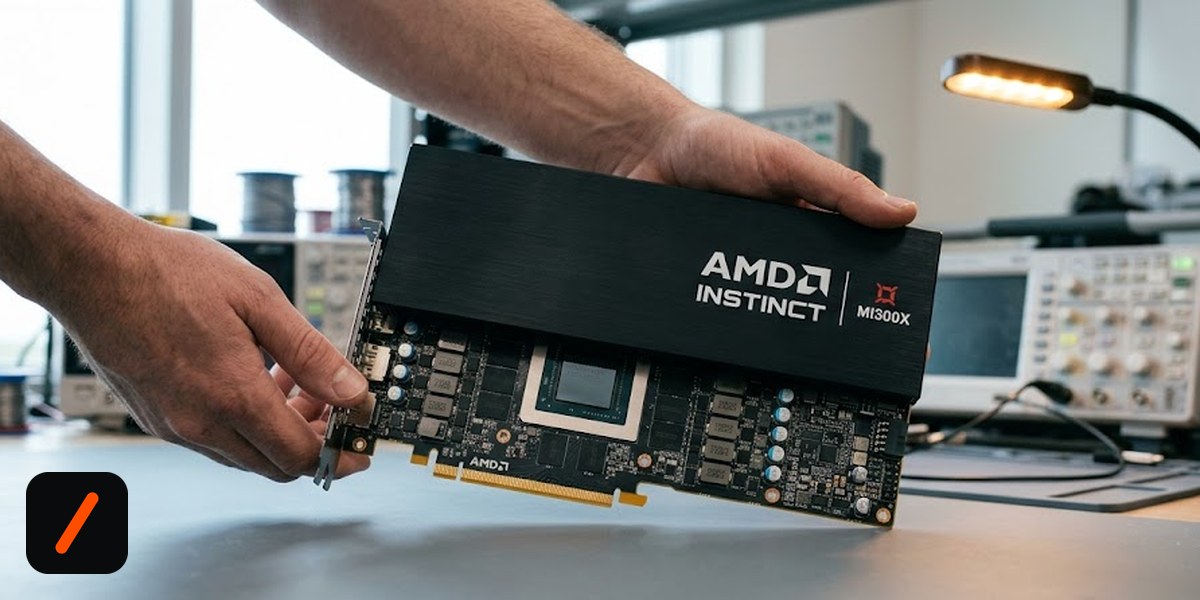
AMD is buying a chip company whose founding premise is that you should stop storing model weights in memory and print them into the silicon instead. The deal for Toronto-based Taalas was announced on August 6, terms undisclosed, expected to close in Q4 2026 pending regulatory approval. It is a real acquisition rather than a talent grab, and it is the most interesting architectural bet a large chipmaker has placed on inference in a while.
Taalas was founded in 2023 and has raised roughly $219 million. It builds what it calls model-specific integrated circuits. Where a GPU is a general-purpose engine that reads a model out of high-bandwidth memory a few billion times a second, a Taalas part has one model fused into it at fabrication.
RelatedInfineon Acquires C2i to Solve AI Power Delivery
What does "etched into silicon" actually mean?
The die is split into two regions. A mask-ROM recall fabric holds the weights, physically encoded in the metal layers. An SRAM recall fabric holds the things that genuinely have to change at runtime: key-value cache, fine-tuning adapters. There is no HBM in the design at all.
That single omission is the whole thesis. HBM is the expensive, power-hungry, supply-constrained part of every AI accelerator shipping today, and for token generation it exists almost entirely to feed weights to compute units. Remove the fetch and you remove the bottleneck. Taalas's first chip, HC1, was fabricated on TSMC's 6nm node, which is deliberately unglamorous: when the model is the circuit, you do not need a leading-edge node to win on throughput per watt.
How fast, and how much should you believe?
Taalas said in February 2026 that HC1 served Meta's Llama 3.1 8B at 16,960 tokens per second per user, which it framed as 48 times faster than Nvidia GPUs and 8.5 times faster than Cerebras, at roughly a tenth of the power. HC2, due this summer, targets 20 billion parameters per chip, with 50 accelerators pipelined to hold a trillion-parameter model.
Those are vendor numbers and nobody outside the company has reproduced them on a matched harness. They are also not surprising numbers. A chip that can only run one model should beat a chip that can run any model at running that one model. The interesting question was never whether the architecture is faster in a benchmark, it is whether the inflexibility is survivable in a business.
The catch is the point
Once a Taalas part is fabricated, it runs the model it was built for. A new model means a new mask set. The company's mitigation is that only two metal layers change, which makes a re-spin cheaper than a fresh design but still a fab cycle, measured in months rather than the minutes it takes to load new weights onto a GPU.
| Taalas MSIC | GPU + HBM | Wafer-scale (Cerebras) | |
|---|---|---|---|
| Weights live in | Mask ROM on die | HBM stacks | On-wafer SRAM |
| Change the model | Re-spin, 2 metal layers | Reload, minutes | Reload |
| HBM required | No | Yes | No |
| Process node | TSMC 6nm | Leading edge | Leading edge |
| Best fit | One high-volume model | Anything | Large models, low latency |
That narrows the customer list sharply. This is not a product for an enterprise that wants to swap between whatever topped the leaderboard last month. It is a product for model developers, their infrastructure partners, and inference providers running one model at enormous volume, where the economics of a fab cycle amortize across billions of tokens.
What AMD wants with it
AMD says it will fold Taalas into its accelerator roadmap and build system-level products alongside Instinct GPUs, EPYC CPUs, the Helios rack platform and ROCm. The shape it describes is disaggregated inference: GPUs handle prompt processing, where you need flexibility and raw parallelism, and token generation is offloaded to Taalas-based parts, where you mostly need to not be memory-bound.
That division is a genuinely good match for how inference costs actually break down. Prefill is compute-heavy and bursty. Decode is memory-bandwidth-heavy and relentless, and it is where the power bill lives. Splitting them across two kinds of silicon inside one rack is a more coherent story than AMD has told about inference so far.
What it means for the market
For AMD, this is a cheap option on a large asymmetry. Terms were not disclosed, and against a company that raised $219 million the price is almost certainly a rounding error next to the $20 billion Nvidia committed in its Groq licensing arrangement. If disaggregated racks work, AMD has a differentiated inference story instead of a slower-GPU story. If they do not, the write-down is small.
RelatedNvidia's Groq 3 LPU Bets Inference Isn't a GPU Problem
For Nvidia, the signal is that the second and third players have both now decided the way to attack CUDA is to not fight it, and to go after the decode half of the workload with specialized parts. That is a real competitive vector, though nothing here touches training, where Nvidia's position is untouched.
The more interesting exposure is memory. HBM demand has been the constraint and the margin story for SK Hynix, Micron and Samsung, and it is the same squeeze now pushing DRAM prices into consumer laptop pricing. Architectures that delete HBM from the inference bill of materials are, at scale, demand destruction for the highest-margin memory product in the industry. Not this year, and not at Taalas's current volumes. But if AMD ships racks where the token-generating silicon carries no HBM at all, the assumption that inference growth automatically means HBM growth stops being safe. That is the number to watch, and the direction is the opposite of consensus.
For TSMC, a serious customer pulling volume onto a mature 6nm node is quietly good news for utilization of capacity everyone else has moved past.
Our take
The bear case writes itself: model churn is the fastest-moving variable in this industry, and committing a mask set to a specific set of weights looks like building a factory for last season's product. Taalas is betting that churn slows at the top, that a handful of models will serve the overwhelming majority of tokens, and that serving those cheaply is worth losing the ability to serve anything else.
That bet is more defensible than it was two years ago. Token volume is concentrating into a small number of very popular models, and the cost per token is now a line item that infrastructure teams argue about. AMD does not have to be right about the whole market. It has to be right that a few models get big enough to deserve their own silicon.
- An independent benchmark. Until someone outside Taalas runs HC1 or HC2 on a neutral harness against an H200 or B200, the 48x figure is marketing.
- Which model gets etched first. The choice of launch model tells you who AMD thinks the customer is. An open-weights model points at infrastructure providers, a partner's proprietary model points at a single anchor deal.
- HC2 slipping. It was announced for summer 2026. A quiet delay through the acquisition close would say the 20-billion-parameter target is harder than advertised.
- Helios integration detail. AMD's disaggregated pitch only matters if it shows the interconnect and scheduling story. Vague roadmap slides at the next financial analyst day would be a bad sign.
- OfficialAMD Newsroom , acquisition announcement, 2026-08-06
- ReportingAMD acquires Taalas to boost inference by etching models into silicon , The Register, 2026-08-06
- ReportingAMD buys Taalas, startup that hardwires AI models into its silicon , CNBC, funding total and deal framing
- ReferenceTaalas , HC1 and HC2 architecture and performance claims
- BenchmarkGenZTech AI Coding Leaderboard , how we treat vendor-reported versus independent numbers
Original analysis by GenZTech. Deal details from The Register and CNBC.