
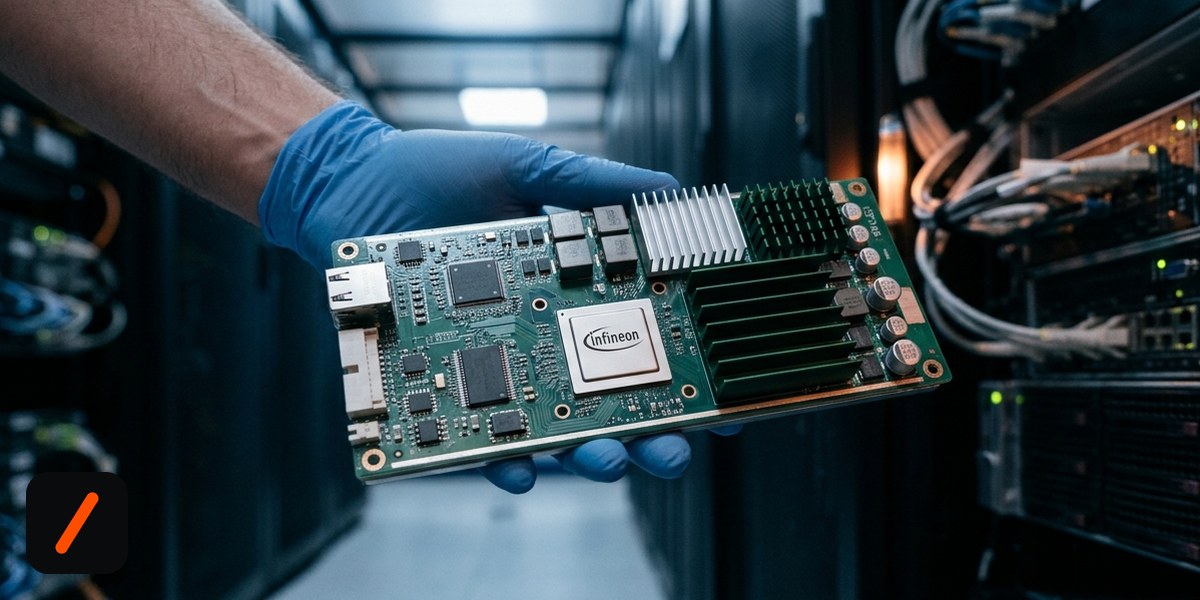
Infineon Technologies said on August 25, 2026 that it's buying C2i Semiconductors, a fabless startup out of Bengaluru that builds the digital controllers regulating how power flows inside AI servers. The deal itself is small and quiet. What it signals isn't: power delivery, not raw compute, is turning into the tightest bottleneck in scaling AI data centers.
- Infineon will acquire C2i Semiconductors, an India-based maker of software-defined multiphase controllers and smart power stages for AI data center hardware.
- The deal is expected to close in Q3 2026, pending customary closing conditions. Neither company disclosed a price.
- C2i's digital power expertise slots into Infineon's existing silicon, silicon carbide, and gallium nitride power portfolio, plus its vertical power delivery work.
- The strategic logic is "software-defined power": pairing advanced power semiconductors with real-time digital control across the entire path from the grid to the processor core.
What did Infineon actually announce?
Infineon is acquiring C2i Semiconductors outright, folding the startup's engineering team and IP into its power systems business. The deal is expected to close in the third quarter of 2026, contingent on the usual regulatory and closing conditions that accompany a cross-border semiconductor acquisition. Financial terms weren't disclosed, so there's no public number for deal size, and no word yet on what happens to C2i's existing roadmap or headcount post-close. Worth stating plainly rather than guessing at.
RelatedAMD buys Taalas, betting on AI models etched into silicon
What is clear is the shape of the fit. Infineon already sells power semiconductors across three material platforms: standard silicon, silicon carbide for high-voltage efficiency, and gallium nitride for high-frequency switching. It also has its own vertical power delivery push, which is about shortening and simplifying the physical path power takes from a board to a chip. C2i brings the piece Infineon didn't have in-house at the same depth: digitally controlled, software-tunable multiphase regulation designed specifically for AI accelerators.
What does C2i actually make, and why did Infineon want it?
C2i builds multiphase controllers and smart power stages, the components that take incoming power and step it down, in tightly coordinated phases, to the low, high-current voltage a processor core actually needs. The "smart" and "software-defined" part is the differentiator. Older voltage regulator designs were largely fixed-function analog circuits, tuned once for a given load profile and left alone. C2i's approach treats that regulation as a live, programmable system: firmware and control loops that can adjust phase count, switching behavior, and response speed in real time as a chip's power draw spikes and settles, which is exactly what happens constantly during AI training and inference.
That programmability matters because AI accelerators don't draw power the way a laptop CPU does. Load can swing from near-idle to full throttle in microseconds as a model shifts between compute phases, and a regulator that can't react fast enough either wastes energy compensating for margin it doesn't need, or risks a voltage droop that can crash a training run outright. Infineon gets a team that has already built and shipped that capability for AI-specific workloads, instead of developing it from scratch.
Why is power delivery suddenly the bottleneck in AI data centers?
Every new generation of top-end AI accelerators has drawn meaningfully more power per chip than the one before it, a trend that's tracked the industry's push toward denser compute and larger models. Racks that used to house modest, air-cooled servers now pack accelerators pulling more than a kilowatt each, wired into liquid-cooled enclosures that themselves need careful power and thermal engineering. The compute side of that equation gets most of the attention. The power side has quietly become just as hard.
Here's the mechanism. A processor drawing over a kilowatt at low voltage needs enormous current, and delivering that current cleanly, without excessive resistive loss and without voltage sagging under a sudden load spike, is a genuinely difficult analog and control-systems problem. Fixed-function voltage regulators built for yesterday's workloads don't have the headroom or responsiveness for today's. That's the whole reason "software-defined power" exists as a category: you need control loops that can adapt on the fly, phase-shed when load drops to save energy, and phase-add instantly when a training step spikes demand, all without letting the voltage rail wobble enough to corrupt a computation or trip a fault. Get it wrong and you waste power as heat, or crash the workload the data center exists to run. That's why power delivery now sits alongside cooling and grid capacity as a real constraint on how fast AI infrastructure can scale, and why a controller specialist like C2i became worth acquiring rather than building from zero.
Who does this actually affect?
Hyperscalers and AI infrastructure builders are the ultimate beneficiaries if this works: better power delivery means denser racks, fewer thermal and stability failures, and less wasted electricity per unit of compute, which matters enormously at data-center scale. For chip designers building the next generation of accelerators, having a power partner that can co-design digital control alongside the silicon itself, rather than bolting on a generic regulator late in the process, changes how tightly power and compute can be engineered together.
RelatedGoogle Launches Four TPUs Into Orbit With Project Suncatcher
For rival power-semiconductor makers, this is a competitive signal more than an immediate threat. Infineon isn't the only company that sells into AI power delivery, and the specialized, software-defined multiphase segment C2i occupies is small enough that this one acquisition doesn't lock up the market. But it does confirm that the companies with deep analog and power expertise, not just the GPU and accelerator vendors, are where a meaningful slice of AI infrastructure value is migrating.
What does this mean for AI infrastructure investors?
Infineon trades publicly (ETR: IFX, OTC: IFNNY), and the signal here isn't really about C2i, which was private and never had a public valuation to react to. It's about what the deal says regarding where chip giants think the money is going. As AI infrastructure capex keeps climbing, the picks-and-shovels argument is shifting from "just buy the GPU maker" toward the less glamorous layer underneath it: power conversion, voltage regulation, thermal management. Infineon folding in a specialized power-control team is a data point that analog and power-semiconductor specialists are becoming a genuine acquisition target category. That's a signal worth tracking for adjacent power-semiconductor names as the buildout continues, not a recommendation to act on any single stock.
- Deal close in Q3 2026. Watch for confirmation the acquisition has actually closed, and whether any financial terms surface once regulatory filings catch up.
- C2i's team and roadmap. No public statement yet on retention, integration timeline, or whether C2i's existing products continue under the Infineon brand.
- Competitor moves. Whether onsemi, Texas Instruments, Vicor, or Monolithic Power Systems make comparable acquisitions in digital power control over the following quarters.
- Infineon's AI data-center revenue mix. Future earnings calls should show whether this segment starts showing up as a distinct growth line.
Our take
The headline reads like routine consolidation, a big chip company buying a small one, but the underlying problem is the interesting part. AI has spent the last few years being described almost entirely in terms of FLOPs, memory bandwidth, and interconnect. Power delivery got treated as plumbing. That's changing because the plumbing is now failing to keep up: you can design the most efficient accelerator in the world, and it still won't run reliably if the last inch of the power path can't react fast enough to keep the voltage rail stable under real AI workloads. Infineon buying a software-defined power controller startup, rather than trying to build that control-systems expertise organically, is a tell that this problem is harder and more specialized than it looks from the outside. Expect more of these deals, quieter and smaller than the headline GPU announcements, but arguably just as load-bearing for whether the AI buildout actually scales the way everyone's capex plans assume it will.
Original analysis by GenZTech. Source: New Electronics