
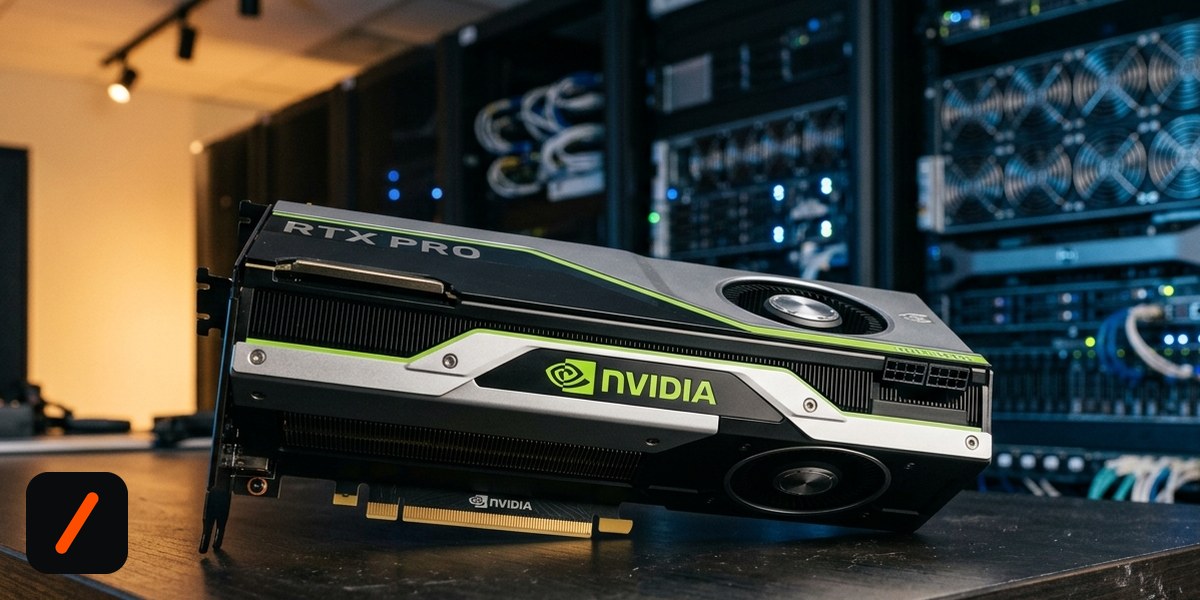
Nvidia added a new card to its professional GPU lineup this week with no keynote and no press release: the RTX PRO 5500 Blackwell Workstation Edition. It showed up quietly on Nvidia's site around September 14 marked "Coming soon," no price attached. The spec sheet explains why Nvidia isn't in a hurry to shout about it. The card carries 21,760 CUDA cores, the exact same count as the consumer GeForce RTX 5090, but pairs them with 84 GB of ECC GDDR7 memory, nearly 2.6 times what the 5090 gets. That's the story: same compute, radically more room to hold a model in memory.
Raw specs, for the record: 1,398 GB/s of memory bandwidth over what PNY lists as a 416-bit bus, up to 600 W of board power, PCIe Gen 5 x16, four DisplayPort 2.1b outputs, three ninth-generation NVENC encoders, three sixth-generation NVDEC decoders, fifth-generation Tensor cores and fourth-generation RT cores. It ships active and air-cooled by default, with a liquid-cooled version available in Nvidia's RXM form factor for denser racks.
RelatedNvidia's RTX Spark Superchip Puts an AI PC in a Box
Why does memory matter more than core count here?
Because for running large language models locally, memory is almost always the wall you hit first, not compute. A model's weights have to fit in GPU memory before a single token gets generated, and the math is blunt. A 70-billion-parameter model stored at FP8 precision needs roughly one byte per parameter, so about 70 GB just for the weights, before you add memory for the KV cache that grows as your context window fills up. Drop to 4-bit quantization and that same model shrinks to roughly 35 to 40 GB, trading some accuracy for headroom.
Now look at what each card can actually hold. A 32 GB RTX 5090 can't load a 70B model at FP8 at all, no matter how fast its cores are; you'd have to quantize hard or split the model across multiple cards. The 84 GB RTX PRO 5500 fits a 70B FP8 model plus a working KV cache on a single GPU, with room to spare. That's the entire pitch in one sentence: this card doesn't compute faster than a 5090, it just doesn't run out of room.
What is MIG, and why does it matter for a rack-mounted card?
The RTX PRO 5500 supports Nvidia's Multi-Instance GPU (MIG) technology, which can carve one physical GPU into up to two fully isolated instances, each with its own dedicated memory, cache and quality-of-service guarantees. In practice that means one card splits into two 42 GB GPUs that behave, from the outside, like separate hardware. One engineer's inference job can't starve another's, and a crash in one instance doesn't take down the other.
That's a deliberate answer to a real IT headache. Workstation GPUs are usually bought per desk, sit idle most of the day, and get fought over the rest of the time. Nvidia's pitch here is explicit: rack the RTX PRO 5500 centrally, and IT can "centralize, share, and scale workstation GPU power" across a team instead of provisioning one card per engineer. Each 42 GB MIG slice is still big enough to run a 70B model at 4-bit precision, or a full-precision 20-billion-parameter model, so two people can run genuinely separate, sizable AI workloads on hardware that used to sit under one person's desk.
Where does it sit against the rest of Nvidia's lineup?
The RTX PRO 5500 fills a gap that's been obvious since Nvidia launched the PRO 6000 and PRO 5000 Blackwell cards earlier this year. The PRO 6000 is the flagship: 24,064 CUDA cores, 96 GB of GDDR7, 600 W. The PRO 5000 sits well below it: 14,080 CUDA cores, either 48 GB or 72 GB depending on the variant, 300 W, starting at $8,599. Between them was a wide jump in both cores and memory with nothing in the middle. The PRO 5500 closes that gap from the top: it borrows the PRO 6000's full 600 W power envelope and a CUDA core count matched to the consumer 5090, but sits 12 GB under the PRO 6000 on memory.
RelatedApple's A20 Pro Is the First 2nm Smartphone Chip
| RTX 5090 | RTX PRO 5000 | RTX PRO 5500 | RTX PRO 6000 | |
|---|---|---|---|---|
| CUDA cores | 21,760 | 14,080 | 21,760 | 24,064 |
| Memory | 32GB GDDR7 | 48GB / 72GB | 84GB ECC GDDR7 | 96GB GDDR7 |
| Bandwidth | ~1.79 TB/s | not disclosed | 1,398 GB/s | ~1.79 TB/s |
| Board power | 575W | 300W | Up to 600W | 600W |
| MIG support | No | No | Yes, 2 instances | Yes, 4 instances |
| Price | Consumer card | From $8,599 | Unannounced, likely $10K+ | Enterprise pricing |
What's the signal for Nvidia's business here?
Nvidia isn't building new silicon for this card. The RTX PRO 5500's core count is identical to the GeForce RTX 5090, which strongly suggests it's the same GB202 die, binned and configured differently, with GDDR7 chips added until it hits 84 GB. That's the same trick Nvidia has run for years: one piece of silicon, sold at a consumer price with a smaller memory pool, and sold again at a professional price with a much bigger one. The workstation and data center segments are where the memory upcharge gets captured, and a card like this exists specifically to let a buyer pay for capacity rather than for raw new performance. The signal for anyone tracking Nvidia's margins is that professional-tier memory configurations, not fresh architecture, are doing a lot of the work of extending the Blackwell lineup's revenue reach this cycle.
Our take
If you're an ML engineer running 70B-class models locally and you don't need the PRO 6000's full 96 GB or its four-way MIG split, the RTX PRO 5500 is probably the better buy once pricing lands, assuming it comes in meaningfully under the PRO 6000 as the gap in specs implies it should. Two RTX 5090s in a workstation get you more raw memory bandwidth per dollar today, but you're managing model sharding across two cards instead of one, and you lose ECC memory and ISV driver certification that studios and labs actually pay for. For a shared IT deployment where multiple people need guaranteed, isolated GPU slices, this card's whole reason for existing is the two-way MIG split; buying it for a single dedicated workstation wastes that feature entirely.
- Official pricing. Press estimates put it above $10,000, but Nvidia hasn't confirmed a number, and where it lands relative to the PRO 6000 determines whether this card actually finds a market.
- Ship date. "Coming soon" with a sign-up form is all Nvidia has committed to; watch for a firm launch window.
- A Max-Q or lower-power variant. Nvidia has shipped reduced-power Max-Q versions of past workstation cards, and a quieter, lower-wattage RTX PRO 5500 would fit even more rack configurations.
- AMD's response. AMD's Instinct and Radeon Pro lines have leaned on large memory pools before; a direct high-memory workstation counter would be the clearest sign this segment is heating up.
- OfficialNvidia RTX PRO 5500 Blackwell product page full spec sheet, listed "Coming soon"
- CoverageHotHardware first detailed writeup of the listing
- CoverageTweakTown confirms bus width and lineup positioning
- CoverageWccftech core count comparison with GeForce RTX 5090
Original analysis by GenZTech. Source: Nvidia.