
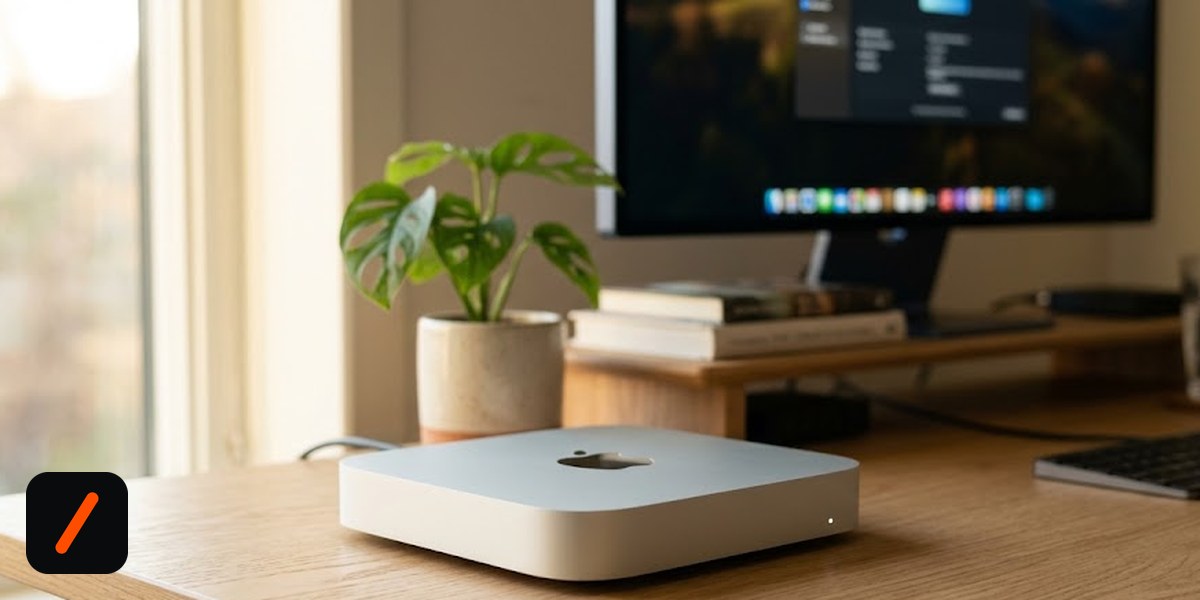
Apple's Mac mini just picked up the chip it needed to keep up with a new kind of buyer: people running AI agents locally instead of leaning on the cloud. On August 25, 2026, Apple announced refreshed Mac mini and Mac Studio lineups built around AI workloads, and the headline change is the M6, Apple's first chip manufactured on TSMC's 2-nanometer process. That puts a brand-new node in a $899 desktop computer months before it shows up in an iPhone.
- M6 is Apple's first 2-nanometer chip, and it's landing in the Mac mini before the iPhone gets the same chip generation.
- The M6's Neural Engine is a dual 16-core design, doubling the Neural Engine core count of the M5 generation.
- Apple says the new Mac mini delivers 4x the AI performance of the outgoing M4 model, with storage and graphics throughput twice as fast.
- Pricing climbs from $799 to $899, and the machine ships after September 22, 2026.
What's actually new under the hood
The Mac mini can now be configured with either of two new chips: the M6 or the M5 Pro. The M6 is the one doing the heavy lifting on the announcement. It's built on TSMC's 2-nanometer node, a first for any Apple silicon, and it ships in the Mac mini ahead of the iPhone getting the same chip generation, which is not how Apple normally sequences its hardware. Its Neural Engine is described as a dual 16-core design, doubling the Neural Engine core count of the M5 generation. Apple is pairing that with 4x the AI performance of the outgoing M4 Mac mini, plus storage and graphics throughput that are twice as fast as before. None of those improvements come from clock speed alone. They come from a smaller, denser transistor process and an AI accelerator that got structurally bigger, not just faster.
RelatedXiaomi's Xring O3 Chip Hits 5.2M AnTuTu, Cuts Qualcomm Reliance
Why does the Neural Engine matter more than the CPU here?
Running a large language model on your own machine is a different workload than editing video or compiling code. It leans almost entirely on matrix math, the kind of repetitive, parallel arithmetic that a general-purpose CPU handles poorly and a dedicated Neural Engine handles well. Doubling the Neural Engine's core count is Apple's way of saying it expects people to run inference locally, over and over, not as a novelty but as a daily habit. An AI agent that plans, checks its own output, and calls tools in a loop might run a model dozens of times to finish one task. That's a very different pattern from opening an app once and waiting for a response, and it's exactly the pattern a bigger Neural Engine is built to absorb.
Why on-device AI agents are suddenly driving demand
Both the Mac mini and the larger Mac Studio have become popular with a specific crowd: people who want to run autonomous AI agents on their own hardware rather than renting inference from a cloud provider. Reporting has pointed to tools like OpenClaw as part of what's pulling buyers toward these machines. The appeal is straightforward. Cloud inference racks up a bill every time a model runs, and an agent that calls a model constantly can get expensive fast. Doing it locally turns that recurring cost into a one-time hardware purchase, and it keeps whatever data the agent touches off someone else's servers. Demand has apparently been strong enough that some Apple retail stores reportedly ran short on current Mac mini and Mac Studio inventory before the new models have even shipped.
What does getting 2nm chips before the iPhone actually signal?
TSMC's 2-nanometer process is the most advanced node currently in volume production, and getting first access to it is not something Apple hands out casually. The iPhone has been first in line for new Apple silicon nodes for years, largely because phone volumes are enormous and Apple wants its flagship product on the newest process as soon as it's viable. Routing the M6 into the Mac mini first is a break from that pattern, and it's worth reading two ways. First, it suggests TSMC's 2nm yields are healthy enough that Apple is comfortable committing real volume to a lower-volume product ahead of its highest-volume one. Second, it suggests Apple is willing to pay a premium for early wafer allocation specifically to win the on-device AI story in its Mac lineup, even if the iPhone waits a bit longer for the same silicon. Either way, it's a decent proxy for how the leading edge of chip manufacturing is actually going, since Apple has more insight into TSMC's real production capacity than almost anyone outside TSMC itself.
| M6 | M5 Pro | M4 (prior gen) | |
|---|---|---|---|
| Process node | TSMC 2nm (N2), Apple's first | Previous-gen node | Previous-gen node |
| Neural Engine | Dual 16-core (32 cores total) | Single 16-core | Single Neural Engine (prior design) |
| AI performance vs M4 | 4x, per Apple | Not disclosed by Apple | Baseline |
| Storage & graphics throughput | 2x faster than M4 | Not disclosed by Apple | Baseline |
| Mac mini starting price | $899 (new lineup base) | $899 (new lineup base) | $799 (previous base) |
Who should actually buy this, and is the extra $100 worth it?
The $899 starting price is a real jump from the $799 the M4 Mac mini opened at, and whether that's worth paying depends heavily on what the machine is for. If you're a developer running local AI agents, fine-tuning small models, or doing anything where inference happens constantly and on-device, the doubled Neural Engine and 4x AI performance are the actual product, not a marketing bullet point. That buyer will feel the difference immediately. If you're using the Mac mini as a general desktop, for browsing, office work, or light creative tasks, the AI performance gains mostly sit unused, and the extra $100 is just a pricier computer with a chip you're not exploiting. The honest answer is that this refresh has a fairly narrow ideal buyer, even though Apple is marketing it broadly.
RelatedApple's A20 Pro Is the First 2nm Smartphone Chip
What it means for the market
The two tickers with the most direct exposure here are AAPL and TSM. Apple getting first access to TSMC's 2nm process ahead of the iPhone is a reasonable signal that TSMC's yields on that node are in good enough shape to support a customer as demanding as Apple, and that Apple is willing to pay up for early capacity to make it happen. The price increase from $799 to $899 is itself a data point: rising leading-edge wafer costs have been showing up across the chip industry, and Apple passing some of that along to Mac mini buyers is one visible piece of a cost trend that also touches companies further down the AI hardware stack, including Nvidia, AMD, and Qualcomm, all of whom compete for capacity on the same advanced nodes. The signal for investors is less about one product refresh and more about what it implies for 2nm capacity, pricing power on leading-edge chips, and how much of that cost gets absorbed by manufacturers versus passed to consumers across the industry, not just at Apple.
Our take
The most interesting part of this announcement isn't the 2nm chip itself, it's that Apple felt the need to route it into a desktop computer before a phone. That's a tell about where Apple thinks the growth is right now, and it lines up with genuinely observable demand for machines that can run AI agents without a subscription meter running in the background. Whether autonomous AI agents are really pulling enough regular people into Apple Stores to empty shelves, or whether that's a convenient story layered on top of ordinary hype-driven demand, is harder to say from the outside. What's easier to say is that the $100 price increase probably isn't a one-off. If 2nm wafers cost more to produce than the process they replace, and every major chip customer is competing for the same limited capacity, that cost has to land somewhere, and it's not going to land on margins if Apple can help it.
- OfficialApple Newsroom Mac mini and Mac Studio announcement, Aug 25, 2026
- ReferenceTechCrunch M6 chip details and $899 starting price
- ReferenceCNBC New Mac mini and Mac Studio AI upgrades
- AnalysisTech Times 2nm process framing and iPhone sequencing
Original analysis by GenZTech. Sources: Apple, TechCrunch, CNBC.