
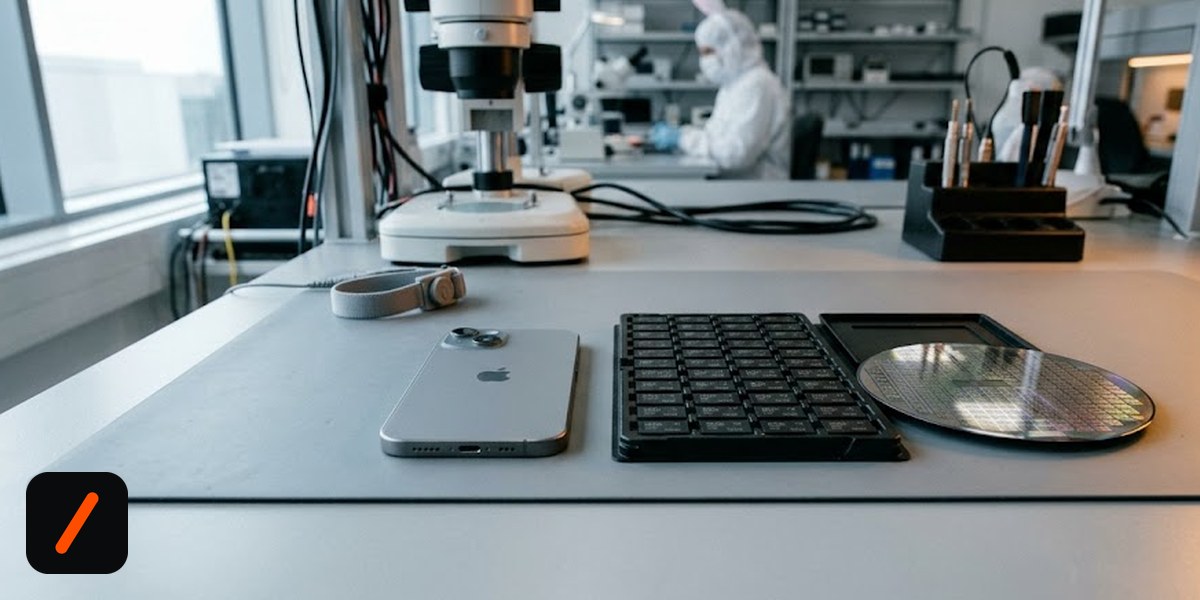
About a billion dollars of Apple's next flagship processor is finished, tested, and completely unshippable. Reports out of the supply chain this morning say TSMC is holding roughly that much value in A20 Pro wafers that cannot be packaged, not because anything went wrong with the chip, but because the DRAM that has to be fused to it in the same step has not shown up. Yields are reportedly fine. Volume is fine. The memory is the problem.
That distinction matters more than it sounds. Apple has absorbed component shortages before by building the expensive part early and buying the cheap part late. The A20 Pro removes that option, and the reason is a packaging decision Apple made itself.
RelatedApple's A20 Pro Is the First 2nm Smartphone Chip
- TSMC is reportedly sitting on around $1 billion of completed A20 Pro wafers, the first Apple silicon built on its N2 node, waiting on memory before they can be packaged.
- The A20 Pro uses WMCM (wafer-level multi-chip module) packaging, which integrates the processor and its DRAM at the same production stage. No DRAM means no finished package, and no way to stockpile ahead.
- Samsung, SK Hynix and Micron control more than 90% of global DRAM output, and they have been steering wafer capacity toward HBM for AI accelerators, which pays better.
- The iPhone 18 Pro and the foldable iPhone Ultra are under six weeks out. Expect thin launch-window inventory rather than a delayed launch.
Why can't Apple just ship the chips it already has?
Because they are not chips yet, in any usable sense. A processor coming off a TSMC line is a die on a wafer. It becomes a product when it is packaged: bonded to a substrate, connected to memory, sealed into something a phone assembler can place on a board. Apple chose to have that happen through TSMC's wafer-level multi-chip module process, which sits the SoC and its LPDDR memory on the same carrier at the same time.
The engineering case for WMCM is real. Shorter interconnects between processor and memory mean lower latency, better bandwidth per watt, and a thinner stack, all of which matter on a phone that has to run on-device models without cooking itself. The cost is that the two components stop being independently schedulable. Under the older package-on-package arrangement, Apple could accumulate packaged A-series parts for months and let the memory catch up during final assembly at Foxconn or BYD. Under WMCM there is no stage where a finished processor waits patiently for memory to appear. The wafer just sits there.
So the number reported this morning is not a write-off. It is inventory in the least useful possible form: value that has already been spent and cannot be converted into a phone until a third party ships parts.
Who actually controls the DRAM here?
Three companies, and none of them are Apple. Samsung, SK Hynix and Micron account for more than 90% of world DRAM output, with Micron reportedly the lead supplier on this part. All three have spent the past year shifting wafer starts toward high-bandwidth memory for AI accelerators, where margins are dramatically better and customers sign multi-year commitments. Conventional LPDDR for phones is competing for leftover capacity against that.
| Micron | SK Hynix | Samsung | |
|---|---|---|---|
| Role on this part | Reported lead LPDDR supplier | Secondary source | Secondary source |
| Strategic pull | HBM ramp for AI accelerators | HBM4 leadership, record profit | HBM4E sampling |
| Leverage over Apple | High: single-step packaging removes substitution time | Moderate | Moderate |
| Incentive to prioritise phones | Weak while HBM prices hold | Weak | Weak |
This is the part of the story that has been building for months. We covered the DRAM price surge driven by HBM demand in early July and the broader memory shortage shortly after. What is new is that the squeeze has stopped being a pricing story and turned into a physical blockage inside a specific, dated, high-volume consumer product.
What this does to the September launch
Apple is unlikely to move the date. The far more probable outcome is a normal keynote, normal preorders, and abnormal wait times: constrained launch-window supply, longer online ship estimates, and retail stock that empties fast and refills slowly. Apple has run this playbook before with early Pro models and it protects the launch narrative while the supply chain catches up.
The lineup makes the exposure worse. The base iPhone 18 has slipped to early 2027 and the iPhone Air 2 is not expected this fall, which leaves the iPhone 18 Pro and the foldable iPhone Ultra carrying the entire autumn. When two SKUs are the whole quarter, and the cheaper of the two is the one people actually buy in volume, there is nowhere to redirect demand.
RelatedApple's Mac Mini Gets the First M6 Chip, Built for On-Device AI
How this built up
- Mid 2025Memory makers begin shifting wafer capacity toward HBM AI accelerator demand outbids conventional DRAM
- Jun to Jul 2026DRAM and NAND contract prices spike the shortage shows up first as pricing, not as missing parts
- Jul 30, 2026Tim Cook flags supply constraints on the earnings call "significant constraints currently, with limited flexibility in the supply chain"
- Aug 6, 2026Reports place ~$1B of A20 Pro wafers in a packaging queue first time the shortage physically stops a finished flagship part
- Sep 2026iPhone 18 Pro and iPhone Ultra launch window watch ship estimates in the first 48 hours of preorders
- Early 2027Base iPhone 18 arrives by then memory pricing may be built into the sticker
What it means for the market
The signal here is that memory pricing power has reached the point where it constrains the most logistically sophisticated hardware company on earth. For Micron, SK Hynix and Samsung, a customer of Apple's size having no fast substitution path is about as strong a negotiating position as the memory business gets. SK Hynix already posted record profit on that dynamic. Investors watching the memory names should treat Apple's packaging choice as evidence that the shortage has pricing durability beyond the AI datacenter buildout, not just spot-market froth.
On the Apple side, the exposure is margin and mix rather than demand. Apple has already responded to memory costs elsewhere in the lineup, raising prices and nudging buyers toward configurations it can actually supply. Cook called the current environment a hundred-year flood on the July call, and analysts have floated meaningful price increases on the 18 Pro as a result, though Apple has confirmed nothing. Watch gross margin guidance for the December quarter and the ship-estimate slippage on day one of preorders. Those two numbers will say more than any teardown. None of this is investment advice, just where the pressure sits.
- Preorder ship dates. If the 18 Pro slips past four weeks within the first day, the packaging queue never cleared.
- Storage and RAM tier pricing. The cleanest way to pass memory costs on is to make the higher tiers cost more, not the base model.
- Micron commentary. Any language about prioritising mobile LPDDR over HBM would signal the squeeze is easing. Silence means it is not.
- Whether WMCM survives contact. If this happens again next cycle, Apple either dual-sources memory earlier or accepts that packaging is now a single point of failure.
Our take
The interesting part is not that Apple got caught by a shortage. Everyone is getting caught by this shortage. The interesting part is that Apple engineered away its own escape hatch, and did it for good reasons. Tight SoC-to-memory integration is the right call for a phone expected to run local models, and it will keep being the right call in 2027 and 2028. The trade Apple accepted, probably knowingly, is that supply chain flexibility got converted into performance per watt.
That trade is fine in a normal memory market. It is expensive in this one. And it points at something broader: as more of the industry moves to advanced packaging that fuses logic and memory, the historical trick of decoupling scarce components from abundant ones stops working. The shortage stops being a price problem and becomes a scheduling problem, which is much harder to buy your way out of. Apple is simply the first company big enough for us to watch it happen in public.
- ReportDigiTimes, Apple scrambles to secure DRAM as US$1 billion of iPhone 18 chips await packaging the originating supply-chain report, 6 August 2026
- OfficialApple, third-quarter results newsroom release the 30 July call where Cook flagged supply constraints
- ReferenceTSMC, 3DFabric advanced packaging platform the wafer-level integration family WMCM belongs to
- Report9to5Mac, iPhone 18 Pro could have limited availability after launch N2 yield commentary and fall lineup detail
- ReportMacRumors, Apple scrambling to secure memory ahead of launch supplier names and reported lifetime unit targets
Original analysis by GenZTech. Unit targets and the $1 billion packaging figure are supply-chain reporting, not Apple disclosures, and are labelled as reported throughout. Source: DigiTimes.