
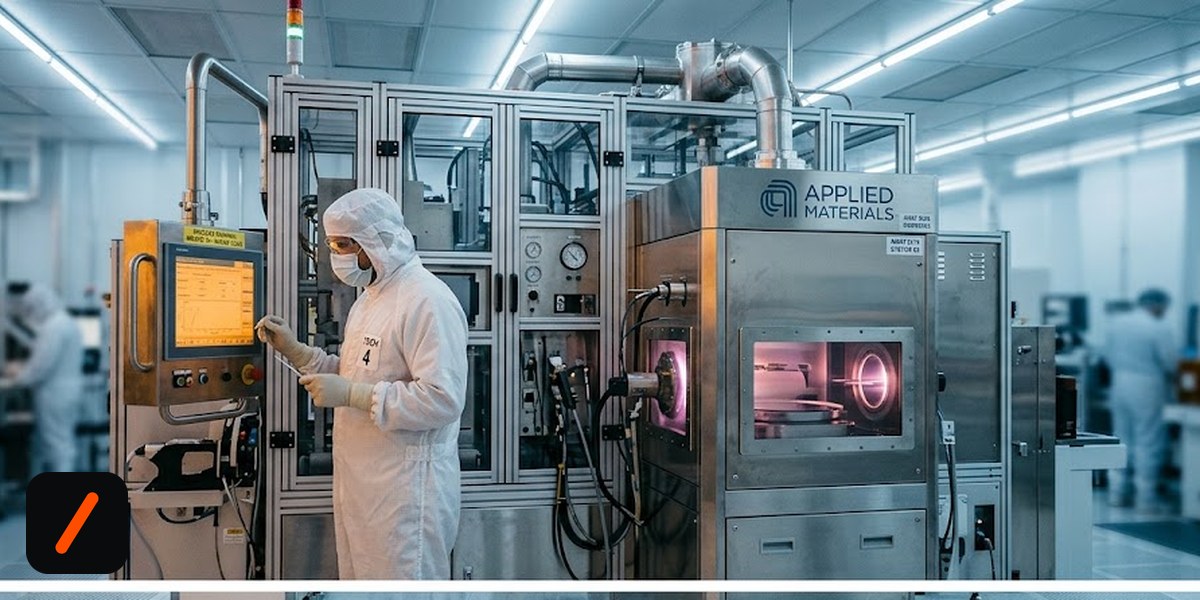
Applied Materials reported record third-quarter fiscal 2026 revenue of $9.115 billion, up 25% year over year and 15% sequentially, with non-GAAP earnings of $3.50 per share, a 41% year-over-year increase. The beat is not the story. The story is that the company raised its outlook for 2026 semiconductor equipment industry growth to over 30%, up from an earlier estimate near 20%, and guided Q4 to roughly $10.25 billion give or take $500 million.
Wafer fab equipment spending is the most honest indicator in the AI supply chain, because it is the point where enthusiasm has to become a purchase order for a machine that takes a year to build and installs into a fab that took three years to pour. A designer can announce a chip. Only a manufacturer expanding capacity signs for the lithography, deposition and etch tools that make it. Applied Materials moving its industry number by ten points in one quarter is a statement that the orders are real.
RelatedASML Raises 2026 Guidance Again as EUV Orders Surge
What the numbers actually say
Semiconductor Systems, the segment that sells the deposition, etch, and process control tools, contributed roughly $7.04 billion of the quarter. That concentration is the point: the growth is coming from equipment sold into leading-edge logic and advanced memory, not from the services and display businesses that smooth out cyclical revenue.
CEO Gary Dickerson framed the raise around demand rather than pricing, saying the rapid global adoption of AI is driving what he called unprecedented demand for the company's materials engineering solutions, and that Applied expects to grow faster than the market this year. Alongside the guidance, the company signaled plans to roughly double semiconductor system output capacity by 2028, which is a capital commitment on Applied's own side, not just a forecast about customers.
Why is the guidance revision the real news?
Equipment makers see demand earlier than anyone else in the chain except the foundries themselves. A tool ordered today installs and qualifies twelve to eighteen months out, which means Applied's 2026 industry estimate is effectively a statement about what its customers believe 2027 and 2028 wafer demand will look like. Moving that estimate by ten points is not a reaction to a good quarter. It is a reaction to order books.
There is a second signal buried in the capacity plan. Applied committing to roughly double its own semiconductor system output by 2028 means it expects the constraint to persist for years, and that it is willing to spend to relieve it. Equipment vendors do not double manufacturing capacity on a cyclical upswing they expect to reverse, because the resulting overhang is brutal when the cycle turns. That is a multi-year conviction bet.
| Applied Materials | ASML | Lam Research | KLA | |
|---|---|---|---|---|
| Core role | Deposition, etch, materials engineering | Lithography (EUV monopoly) | Etch and deposition, memory-heavy | Process control and inspection |
| AI exposure via | Leading-edge logic + advanced packaging | EUV tool allocation | HBM and DRAM capacity | Yield at leading-edge nodes |
| Read-through from this print | Direct, guidance raised | Positive, shares the same WFE pool | Positive if memory capex follows | Positive, inspection scales with complexity |
What does it mean for the stock?
The awkward fact around this print is that Applied Materials shares had been trading well below their peak despite the business accelerating, reported at roughly 27% off the high going into the results. That gap is the whole investment debate in one number. The market has been pricing semiconductor equipment as a late-cycle group heading into a digestion phase, while the company's own guidance says the cycle has not peaked.
The concrete signal for investors is not the EPS beat, which was expected, but the durability of the WFE number. If the over-30% industry estimate holds through the next two prints, the multiple compression is a mispricing. If it gets walked back toward the mid-20s, the market was right and this was a demand pull-forward. Two things settle it: China export policy, which can remove a chunk of addressable demand with a single rule change, and whether memory capex actually follows logic, since HBM expansion is the swing factor for the whole equipment group.
The read-through extends past AMAT. ASML, Lam Research, KLA and Tokyo Electron all draw from the same wafer fab equipment pool, so a raised industry number is a raised number for the group, weighted by each vendor's mix. This is factual analysis of exposure and not a recommendation to buy or sell anything.
RelatedNvidia's $96.2B Quarter Meets Its First Real Challenger
- Aug 2026Record Q3 FY26: $9.115B revenue, $3.50 non-GAAP EPS WFE outlook raised to 30%+
- Q4 FY26Guided to ~$10.25B ±$500M, EPS ~$4.02 ±$0.20 first test of the raise
- 2027Tools ordered now install and qualify revenue converts to customer wafer capacity
- 2028Applied targets roughly double semiconductor system output the multi-year conviction bet
Who is affected outside the investor conversation?
Anyone waiting on silicon. Equipment lead times are the upstream cause of the memory price increases consumers have been absorbing all year, and of the allocation fights over leading-edge capacity. More tools eventually means more wafers, but the operative word is eventually: a tool ordered in this quarter contributes wafers in 2027 at the earliest. The correct expectation is that supply relief from this capex cycle arrives after the current shortage has already repriced consumer hardware.
For anyone building on AI infrastructure, the useful takeaway is a planning one. Equipment capacity expanding through 2028 is consistent with compute staying expensive and allocation-constrained through at least 2027, because the tools being ordered now are what relieve it. Budget accordingly rather than assuming a price collapse next year.
- Does the 30%+ WFE number hold? A walk-back toward the mid-20s reframes this quarter as a pull-forward rather than a cycle extension.
- Memory capex following logic. HBM and advanced DRAM expansion is the swing factor for the entire equipment group, and it is the least certain input.
- China export policy. A single rule change can remove a material slice of addressable demand. This is the largest single downside risk to the raise.
- Capacity build execution. Doubling output by 2028 is a commitment with its own supply chain. Watch for slippage in that timeline before treating it as a given.
Our take
Equipment earnings are the least glamorous and most informative reports in the AI trade. Model announcements cost a blog post. Wafer fab equipment orders cost billions and cannot be walked back quietly, which makes a ten-point revision to the industry growth estimate a harder signal than almost anything a chip designer said this quarter.
The caveat is that this is precisely the point in a semiconductor cycle where confidence tends to peak. Applied is now guiding to accelerating growth and building capacity into it, which is exactly the posture that looks brilliant for two years and painful in the third. The number to track is not revenue, it is whether the order book still supports the story in six months.
- OfficialApplied Materials · Quarterly results the Q3 FY2026 release and financial statements
- FilingSEC EDGAR · AMAT 8-K filings the filed earnings disclosure, unmediated
- ReportingBenzinga · Applied beats Q3, issues strong guidance guidance detail and the Dickerson quote
- ReportingInvesting.com · Q3 FY2026 slides segment breakdown and the raised outlook
- ReferenceSEMI · market data industry-level wafer fab equipment tracking
Original analysis by GenZTech. Figures current as of August 2026. Source: Applied Materials investor relations.