
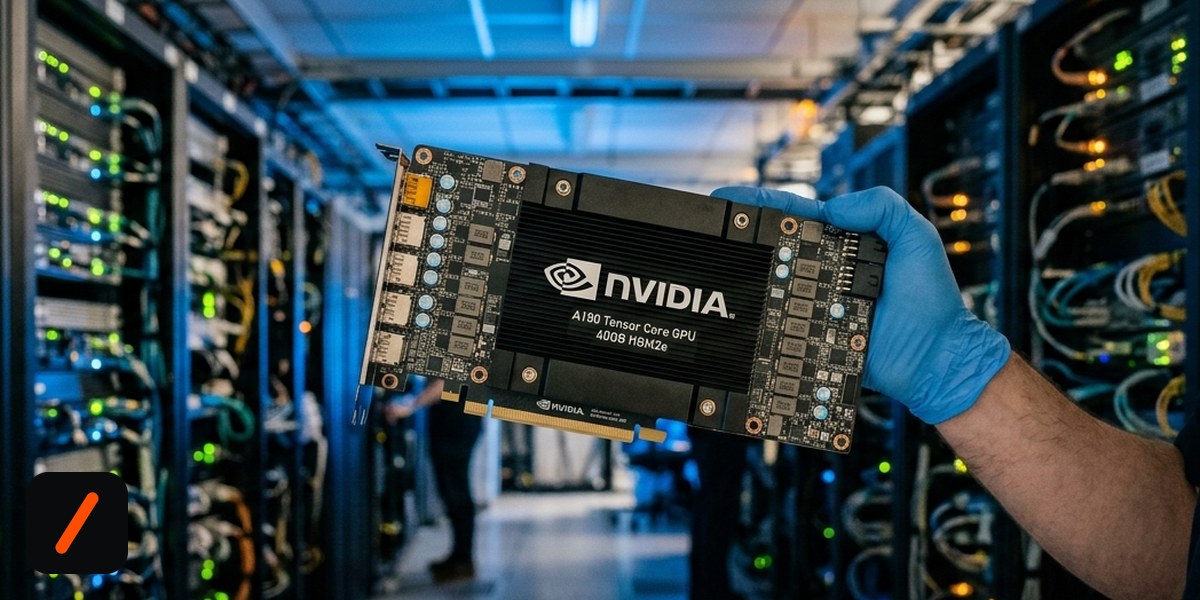
Nvidia just closed a quarter at $96.2 billion in revenue, up 106% from a year ago, and told Wall Street the next one will be bigger still. That's the easy headline. The harder one landed four days earlier, when OpenAI stood on stage at Hot Chips and said its first custom chip already beats Nvidia's current flagship on the metrics that matter for running AI models at scale.
Both things are true at once, and that's what makes this week worth sitting with instead of skimming past.
RelatedApplied Materials lifts chip-gear outlook past 30%
- Nvidia's Q2 FY2027 revenue hit $96.2 billion, up 106.0% year over year.
- Data Center revenue alone was $89.02 billion, powered by hyperscalers, enterprises, and governments buying Blackwell Ultra infrastructure for "AI factories."
- Nvidia guided Q3 revenue to about $108.0 billion, ahead of the $104.2 billion Wall Street consensus.
- Days before the report, OpenAI said its Jalapeño chip, co-built with Broadcom and Celestica, delivers 1.5x to 1.9x more AI work per watt than Blackwell at peak throughput, with 1.7x to 3.6x lower latency.
Why is Nvidia's data center revenue still surging?
The short version: Blackwell Ultra is shipping in volume now, and the buyers aren't just the usual cloud giants. Hyperscalers are still the bulk of it, but enterprises building internal AI tools and sovereign governments standing up their own national AI infrastructure are now real line items too. CFO Colette Kress called it "another outstanding quarter," pointing to record revenue, record operating income, and record EPS, with growth accelerating for a fourth straight quarter. That last part is the detail that should stop anyone from writing off this rally as a base-effect illusion. An acceleration curve, four quarters running, is not what a maturing demand cycle looks like.
Edge Computing, the gaming and workstation business, is almost a footnote next to that, but it's a healthy footnote. Revenue there grew 27.5% year over year and 13.0% sequentially to $7.20 billion, helped by Blackwell workstation cards finding their way into creative and engineering workflows. Nobody's earnings call gets built around this segment anymore, but a business growing double digits sequentially would be the headline at most other companies.
Is Jalapeño actually a threat to Blackwell right now?
Not this year, and OpenAI isn't claiming otherwise. Jalapeño is an inference-only chip, meaning it won't touch the training workloads that make up a huge share of what Nvidia sells into data centers. It's also targeting only low-volume production in late 2026, so the near-term dent in Nvidia's order book is close to zero. And OpenAI hasn't actually run Jalapeño against Nvidia's upcoming Vera Rubin platform yet, which is the fairer matchup since both use HBM4 memory. Right now the comparison being talked about is Jalapeño versus Blackwell, a chip that's already a generation behind what Nvidia will be shipping by the time Jalapeño reaches any real scale.
What makes it worth covering anyway is who's making the claim. This isn't a scrappy startup chasing headlines. It's Nvidia's single largest customer, building silicon with Broadcom and Celestica specifically so it can stop paying Nvidia's margins on a growing share of its own inference bill. Even against Vera Rubin, which adds multi-token-prediction optimization that Jalapeño doesn't have, OpenAI says Jalapeño still edges it out on output tokens per megawatt. That's a narrower gap than the Blackwell comparison, but it's not nothing.
| Metric | Nvidia Blackwell Ultra | OpenAI Jalapeño | Nvidia Vera Rubin |
|---|---|---|---|
| AI work per watt | Current-gen baseline, shipping today | Claims 1.5x-1.9x more work per watt at peak throughput | Nvidia's next-gen answer, not yet shipping |
| End-to-end latency | Current-gen baseline | Claims 1.7x-3.6x lower latency than Blackwell | Untested head-to-head against Jalapeño so far |
| Memory | HBM3e | HBM4 | HBM4 |
| Availability | Shipping now at hyperscale volume | Low-volume production targeted for late 2026 | Not yet shipping |
| Who it serves | Hyperscalers, enterprises, sovereign AI buyers | OpenAI's own inference workloads | Nvidia's full customer base, OpenAI included |
What it means for the market
For NVDA in the near term, this is about as clean a beat-and-raise as a company can produce. Revenue up 106% year over year, guidance ahead of consensus by nearly $4 billion, four consecutive quarters of accelerating growth. None of that reads as a company running out of buyers. If anything it confirms that the "AI capex slowdown" narrative that shows up every few months still hasn't found its moment.
The Jalapeño story is a different clock. It doesn't touch this quarter's numbers or next quarter's guidance. What it does is put a public, benchmarked data point behind something investors have speculated about for a while: that Nvidia's biggest customers are also its most capable future competitors, and OpenAI just proved it can design silicon that's competitive on paper with what's shipping today. Broadcom's involvement matters here too, since it's the company that's helped Google and Meta build custom AI silicon for years. This is factual analysis of where the pressure points sit, not a signal to buy or sell anything. Margin risk from custom silicon is a multi-year story, not a next-quarter one, and Nvidia's current results don't show any sign of it showing up yet.
What should builders and investors watch next?
A few concrete things will tell you more than any single benchmark claim. First, Jalapeño's actual 2026 production volume, since "low-volume" could mean anything from a few thousand units to a meaningful fraction of OpenAI's inference fleet. Second, whether OpenAI or an independent party runs Jalapeño against Vera Rubin directly, rather than against a generation-behind Blackwell. Third, what Nvidia's leadership says about custom silicon on its next earnings call, since companies usually address competitive threats publicly once they're big enough to matter to guidance.
Our take
Nvidia's quarter is exactly as good as the numbers say it is, and nothing here changes that. The interesting part is that the loudest evidence of long-term risk to Nvidia's pricing power came from the company writing Nvidia some of its biggest checks. That's not a contradiction, it's just what happens when your customers get big enough to build their own hardware. Blackwell Ultra is selling out today. Whether that's still true in two or three years once Jalapeño-class chips reach real volume is a genuinely open question, and it's one worth tracking with actual production numbers rather than settling it off a single Hot Chips presentation.
RelatedSamsung's phone arm posts its first ever operating loss
TYPE: EARNINGS Kiplinger, Nvidia earnings live updates
TYPE: MARKET FakePE, Nvidia Q2 earnings recap
TYPE: HARDWARE CNBC, OpenAI's Jalapeño chip
TYPE: BENCHMARK The Decoder, Jalapeño benchmark claims
Original analysis by GenZTech Team. Sources: CNBC.