
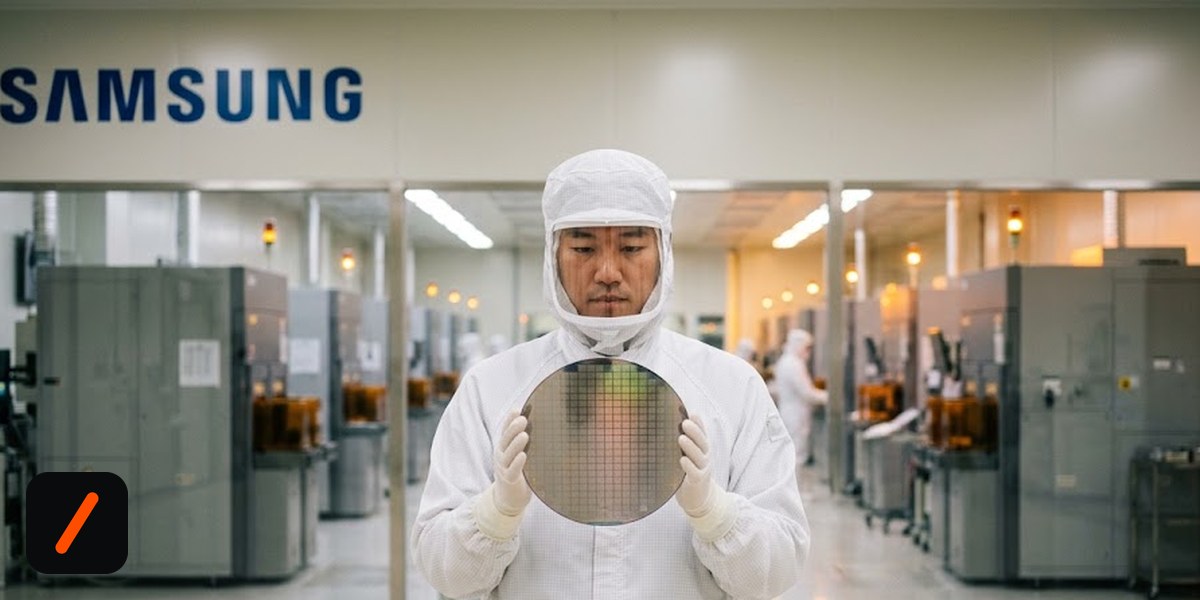
Samsung's foundry unit raised prices on its most important nodes by as much as 15 percent in July 2026, in the same quarter its share of the global contract chipmaking market fell to 7.3 percent, down from 11.5 percent a year earlier. Normally a company losing a third of its business cuts prices to win it back. Samsung did the opposite, and the reason is that this increase isn't really about Samsung's own competitiveness.
- Samsung raised prices on its 4nm (SF4), 5nm (SF5) and 8nm nodes in July 2026, with increases of roughly 10 to 15 percent depending on node and customer region.
- Chinese and US customers on 4nm absorb the steepest hikes, up to 15 percent, while Taiwanese customers on the same node see smaller increases of 5 to 10 percent.
- Samsung's foundry share dropped from 11.5 percent in Q2 2025 to 7.3 percent in Q2 2026, while TSMC's share climbed to 70.2 percent.
- Samsung's foundry division could turn profitable as early as 2027 if the higher prices stick, according to reporting tied to the increases.
Why raise prices while losing a third of your market?
Because the hike isn't Samsung flexing its own strength. It's Samsung renting out scarcity it didn't create. AI accelerator demand has soaked up so much of TSMC's leading-edge capacity that fabless customers who'd normally go straight to TSMC's 3nm or 5nm lines can't get enough slots. Some overflow lands on Samsung, whose 4nm line at Pyeongtaek now runs at full capacity. When the whole industry is capacity-constrained, the marginal customer has nowhere better to go, so even a distant second-place supplier gets to charge more. That's pricing power borrowed from a rival's shortage, not earned, though Samsung's 4nm yield has genuinely improved, roughly doubling since 2022 to about 70 percent.
RelatedTSMC Hikes Wafer Prices as Its Foundry Grip Tightens
| Axis | Samsung Foundry | TSMC | Intel Foundry |
|---|---|---|---|
| Q2 2026 foundry share | 7.3%, down from 11.5% | 70.2%, up year over year | No public share figure; minority player rebuilding customers |
| Capacity position | 4nm at Pyeongtaek at full capacity | Leading-edge capacity largely booked by AI demand | Has open advanced-node capacity while courting outside customers |
| Pricing direction, mid-2026 | 4nm, 5nm and 8nm up 10-15% in July | No comparable public hike reported | No confirmed pricing move this cycle |
| Node focus of the hike | Mature-advanced: 8nm, 5nm, 4nm, not bleeding edge | 3nm and below is the scarce resource driving this dynamic | 18A still ramping, foundry unit pre-profitability |
What the July increases look like, node by node
This wasn't a blanket surcharge. Samsung raised 4nm (SF4) prices 10 to 15 percent for customers in China and the US, and a smaller 5 to 10 percent for customers in Taiwan. The 5nm (SF5) node saw the same 10 to 15 percent range. The older 8nm node, still widely used for power management and RF parts, rose nearly 10 percent. None of these are Samsung's bleeding edge. They're the workhorse nodes carrying most of its external foundry revenue.
Why is China paying the most and Taiwan the least?
The geographic split is the most honest signal here. A hike applied evenly everywhere would just be Samsung testing how much the market will bear. A hike that varies by location is Samsung pricing off each customer's actual alternatives. Taiwanese fabless companies sit closest to TSMC, with existing capacity commitments there, so Samsung can only push them 5 to 10 percent. Chinese customers, boxed out of TSMC's most advanced nodes, and US customers competing for the same scarce slots as every other accelerator maker, have fewer places to go, so they absorb the full 10 to 15 percent. The price a customer pays is a readout of how many doors are open to them.
What does 15 percent do to a bill of materials? Where wafer cost is a large share of unit cost, a mid-teens fab increase flows almost straight through to gross margin unless it's passed along. Companies with pricing power of their own can pass it on. Companies competing on price in commodity segments, where 8nm parts for power management and RF live, absorb it or go looking for a second source that mostly doesn't exist.
Does this window close once TSMC's new capacity lands?
This is the real risk in Samsung's bet. The pricing power here isn't structural, it's cyclical. It exists because AI demand has temporarily outrun leading-edge supply, and TSMC is racing to add capacity precisely because that gap is so lucrative to close. Every fab TSMC brings online chips away at the scarcity letting Samsung charge more without winning any share. If TSMC's buildout catches up before Samsung converts these prices into a durable customer base, Samsung ends up back where it started, competing on price for share it still doesn't have, facing customers who remember exactly which quarter it charged them most. The improved 4nm yield, roughly 70 percent versus about 35 percent in 2022, is the one piece that isn't cyclical, and the better reason customers stay once the shortage premium fades.
RelatedApplied Materials lifts chip-gear outlook past 30%
What it means for the market
Samsung Electronics (005930.KS) is the direct beneficiary if the hikes hold. A foundry unit turning profitable as soon as next year, after years of dragging on Samsung's chip earnings, would shift the story investors tell about a business mostly centered on memory. TSMC (TSM) benefits differently: its own capacity constraint is what's generating Samsung's pricing power, and a 70.2 percent share suggests the AI buildout keeps consolidating toward the leader. Intel has an opening too, if it can convert open capacity into signed customers while both incumbents are tight or hiking. Every fabless company with 4nm, 5nm or 8nm parts has a cost line that moved in July. The signal for investors is that foundry pricing power currently tracks industry-wide AI capacity scarcity more than any one company's standing, which makes TSMC's buildout worth watching more than Samsung's roadmap.
Our take
The interesting part isn't the 15 percent number. It's that a company can lose a third of its market and raise prices at the same time, and have that be the rational move. That only happens when the real constraint sits above any single company, here an industry that can't make advanced logic chips fast enough for how much AI hardware everyone wants to build. Samsung's foundry business has spent years trying to win customers from TSMC on execution and mostly failing, which is what the share numbers show. What it's doing now is different: charging more not because it got better, but because everyone got busier. That's a real profit opportunity for the next several quarters, not evidence Samsung closed the gap with TSMC.
- Samsung foundry earnings. A 2027 profit would show the prices held; a miss suggests customers pushed back.
- TSMC capacity additions. New leading-edge capacity is the biggest threat to Samsung's leverage here.
- Intel Foundry customer wins. A signed external customer changes the three-way dynamic entirely.
- Chinese customer behavior. Whether they keep absorbing the steepest hikes signals how constrained they really are.
- ReferenceSamsung raises advanced foundry prices by up to 15 percent node-by-node breakdown
- ReferenceSamsung foundry price hike tied to AI demand coverage of the move
- AnalysisSamsung raises foundry prices while losing share the share-loss tension
- OfficialSamsung Foundry official overview
- FundingGenZTech funding tracker chip and AI funding tracker
Original analysis by GenZTech, drawing on reporting from Tom's Hardware and Techi.