
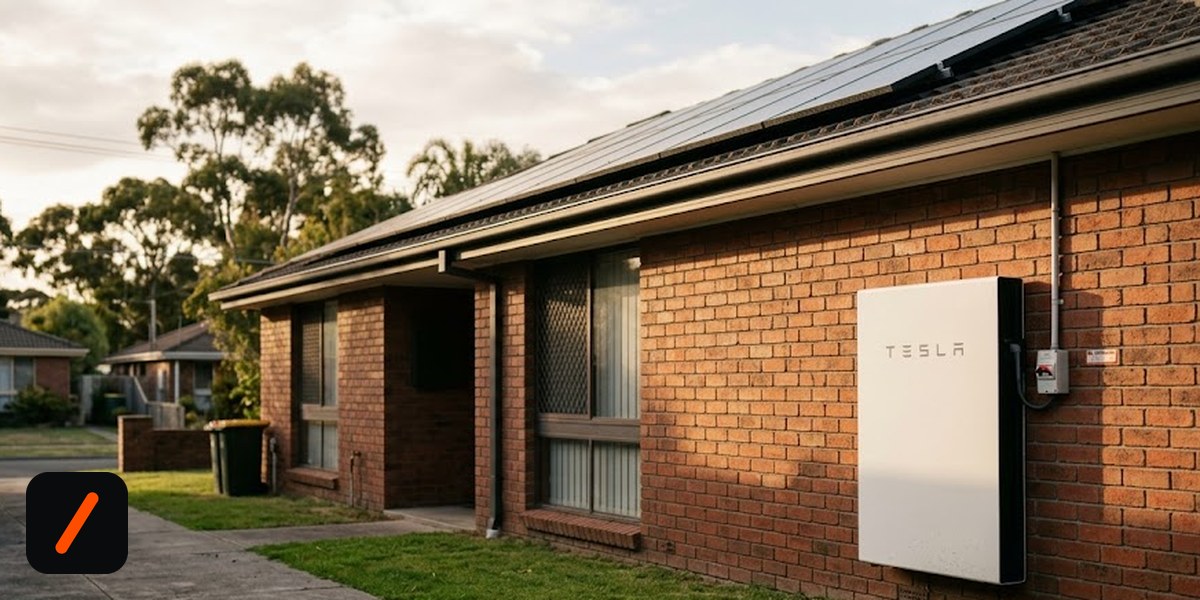
Australia crossed 500,000 subsidised home batteries this morning, and the government's pitch reached past the milestone itself. Energy Minister Chris Bowen told a press conference the rebate scheme had been the major factor in wholesale energy prices falling 47 percent over the last twelve months. The 47 percent is not spin. It comes straight out of the market operator's own quarterly numbers. The single-cause framing is the part that does not survive contact with those numbers, because AEMO credits three separate things, and household batteries are the third one on the list.
- More than 500,000 batteries have been installed under the Cheaper Home Batteries Program since it opened on 1 July 2025, running at roughly 2,000 systems a day.
- AEMO recorded a NEM-wide average spot price of $74/MWh in Q2 2026, down from $140/MWh a year earlier. That is the 47 percent, and it is the second lowest Q2 average since 2016.
- AEMO names three drivers: renewables hitting 42.1 percent of supply, grid-scale battery discharge up 194 percent, and lower evening demand as home batteries carry households after sunset.
- The sharpest single line in the data is the cap return component collapsing 92 percent, from $37/MWh to $3/MWh. That is a story about extreme price spikes going away.
What was actually announced today?
The Prime Minister and the energy minister confirmed the 500,000th installation under a program that has been running for about thirteen months. The government funds roughly a 30 percent discount on eligible small-scale battery systems, but only when they are paired with new or existing rooftop solar. Its budget was expanded last December from an estimated $2.3 billion to about $7.2 billion over four years, which tells you the take-up ran well ahead of what Treasury modelled.
RelatedSamsung Hiked Foundry Prices After Losing a Third of Share
Two details in the release matter more than the headline number. First, more than three quarters of the installs went to outer suburban and regional communities, not inner-city early adopters, which is the demographic pattern a subsidy needs if it is going to survive an election. Second, the country now has 8,846 accredited battery installers, double the count at launch. That second figure is the one that persists after the rebate tapers. Australia has effectively spent a year building a trained installer base, and installer capacity is usually the real bottleneck on residential energy hardware, not demand.
For scale: Australia now has more home batteries than the United States, a country with roughly twelve times the population. That is less surprising than it sounds. About one in three Australian households already has rooftop solar, so the addressable market for a solar-attached battery was enormous before a single dollar of rebate was paid.
Why does a battery in someone's garage move a wholesale price?
Spot electricity is priced by the last generator needed to meet demand. For most of the day in the National Electricity Market that is coal, wind or solar, and the price is unremarkable. Between roughly 6pm and 8pm, solar output falls off while households come home and switch everything on at once, and the market reaches for gas peakers and hydro. Those units set the price for everyone, which is why a handful of evening hours drag the whole quarterly average upward.
A home battery does not participate in that market at all. It simply removes a household from the evening demand curve, and half a million of them remove a meaningful slice of it. Shift enough demand out of the peak and the market stops needing the most expensive unit in the stack, so the clearing price drops for every buyer, including households that never bought a battery. That spillover is the genuinely interesting economics here, and it is the argument for subsidising the things in the first place.
The effect shows up elsewhere in the same dataset. South Australia set a record minimum operational demand of 57MW on 18 April, a number that would have read as a typo a decade ago. Grid demand as the market sees it is being hollowed out from both ends of the day.
Did home batteries really cause the 47 percent drop?
This is where the announcement and the evidence part ways. AEMO's Q2 2026 report lists three contributors, in its own order: higher renewable generation, rising battery discharge during evening peaks, and reduced evening demand from home storage. Only the third is the rebate program. The second is dominated by grid-scale batteries, which had a spectacular quarter, averaging 476MW of discharge against 162MW a year earlier, a 194 percent jump, with a peak discharge record of 3,759MW on 26 June. Those are utility projects with their own financing, not anything a household rebate paid for.
Meanwhile rooftop solar output itself rose only 6.9 percent year on year, from 2,355MW to 2,520MW, and renewables hit 42.1 percent of NEM generation, a record for a second quarter. Then there is the line that moves the average most violently: the cap return component fell from $37/MWh to $3/MWh, down 92 percent. Cap return is essentially the cost of extreme price events. When it nearly vanishes, the quarterly average falls hard regardless of what any individual technology did, and a quiet quarter for outages and weather contributes to that as surely as storage does.
There is also a timing problem with crediting today's fleet. The 47 percent figure describes April through June. Using Bowen's own stated rate of about 2,000 installs a day, roughly 90,000 of the batteries being celebrated today were installed after that quarter had already ended. The fleet that produced the measured result was materially smaller than the one in the headline.
None of this makes the program a failure. The mechanism is real, AEMO explicitly credits it, and the direction is right. It means the accurate sentence is that home batteries were one of three forces pushing prices down in a quarter that also happened to be unusually free of price spikes, not that they were the major factor.
RelatedHuawei, Cambricon Hike AI Chip Prices as HBM Squeeze Bites
| NEM region | Q2 2026 average | Change vs Q2 2025 |
|---|---|---|
| Victoria | $56/MWh | down 60% |
| Queensland | $67/MWh | down 44% |
| New South Wales | $75/MWh | down 53% |
| South Australia | $86/MWh | down 38% |
| NEM-wide | $74/MWh | down 47% |
Can other countries copy this?
Partly, and the part that does not travel is the important one. The rebate works because it sits on top of a rooftop solar base that took fifteen years and several earlier subsidy schemes to build. A third of Australian homes already generate more electricity than they can use in the middle of the day, so a battery has something to store and an obvious payback. Drop the same 30 percent discount into a country with single-digit rooftop penetration and you are subsidising a device with nothing to fill it, at which point the household is arbitraging retail tariffs rather than soaking up surplus generation.
The design detail worth stealing is the taper. The discount steps down each year and halves by 2030, tracking expected cell cost declines. That is the opposite of the flat, open-ended incentive that turned solar feed-in tariffs into a fiscal problem in several markets, Australia included. It also creates a deadline that pulls purchases forward, which is a large part of why installs are running at 2,000 a day and why the budget tripled.
For hardware vendors the read is straightforward. Australia has become the highest-volume residential storage market on earth relative to its size, with a trained installer channel and a known subsidy glide path through 2030. That is a rare thing to be able to plan around, and it is why Tesla, BYD, Sungrow and the rest treat the market as strategically oversized for a country of 27 million.
- 1 Jul 2025Cheaper Home Batteries opens roughly 30% off eligible systems, solar required
- 13 Dec 2025Budget expanded from an estimated $2.3bn to about $7.2bn over four years
- 30 Jul 2026AEMO publishes Q2 2026 data $74/MWh NEM-wide, renewables at 42.1% of supply
- 14 Aug 2026500,000th battery installed 8,846 accredited installers, double the launch count
- 2030Rebate halves annual step-downs tracking expected cell cost declines
- The Q3 print is the real test. Q2 benefited from an unusually quiet quarter for price spikes. If Q3 holds near $74/MWh with a normal cap return, the storage effect is structural rather than weather.
- Evening spreads, not averages. The number that isolates home batteries is the gap between the midday and 6pm to 8pm price. Watch that compress, since the quarterly average blends in too much unrelated noise.
- Whether the fleet gets orchestrated. Half a million batteries acting individually shave a peak. The same fleet under virtual power plant control could bid as a dispatchable asset, which is a far bigger market event than the rebate itself.
- The taper's first real bite. Each annual step-down tests whether demand is genuinely economic or purely subsidy-driven. The 2027 install rate will answer that.
Our take
The milestone deserves the attention. Half a million distributed batteries in thirteen months is a genuinely fast deployment of physical infrastructure, and the installer base it created is a durable asset that outlives the subsidy. The mechanism by which it lowers prices for everyone, including non-participants, is real and well understood.
The claim attached to it is doing more work than the evidence supports. AEMO put home storage third in a list of three, behind record renewable generation and a tripling of grid-scale battery discharge, in a quarter whose average was flattered by a 92 percent collapse in the cost of price spikes. A minister compressing three causes into one is ordinary politics. Repeating it as a finding is how a good policy ends up with a credibility problem the first quarter the number goes the other way. The program is defensible on its own numbers. It does not need the 47 percent.
- OfficialHalf a million cheaper home batteries Prime Minister of Australia, 14 August 2026
- OfficialCheaper Home Batteries Program DCCEEW, program rules and discount taper
- DataQuarterly Energy Dynamics Q2 2026 AEMO, the source of the $74/MWh and 47 percent figures
- DataRenewables, batteries continue to reshape energy markets AEMO media release naming the three price drivers
Original analysis by GenZTech. Reporting trigger: Yale Environment 360, 14 August 2026.