
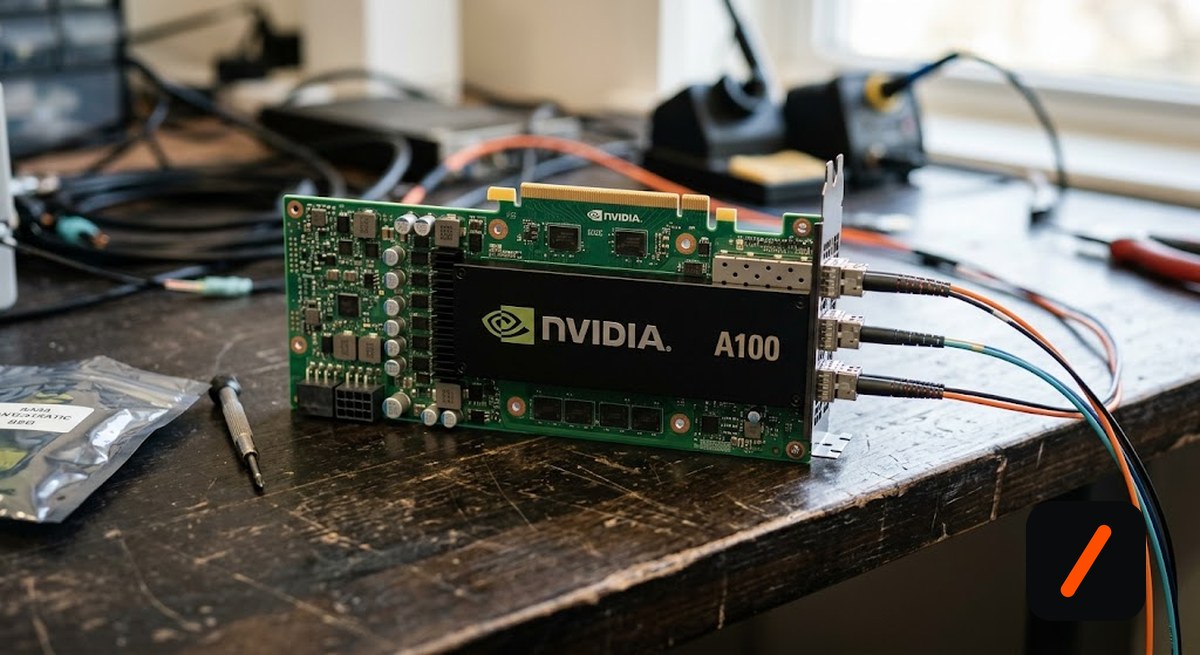
Nvidia's roadmap now runs through light. On its multi-year data center plan, the Feynman generation that follows Vera Rubin will be the first Nvidia platform to adopt NVLink switches with co-packaged optics, moving the optical engines that carry data between chips out of pluggable modules and directly beside the switch silicon. The reason is unglamorous but decisive: AI racks are hitting a wall where copper can no longer move enough bits per watt, and the fix is to stop converting signals to electricity for every hop. Feynman is Nvidia betting that the next bottleneck in AI is not the GPU, it is the wire.
- Feynman, Nvidia's post-Rubin architecture, is slated to be the first to use NVLink switches with co-packaged optics (CPO), integrating photonics next to the switch ASIC.
- Vera Rubin, comprising Vera CPUs and Rubin GPUs, ships in the second half of 2026; Feynman is the generation after, with die stacking and custom high-bandwidth memory.
- The driver is a power-and-reach wall: as per-port bandwidth climbs, electrical signaling over copper burns too much energy and cannot reach far enough across a rack.
- CPO cuts the energy spent per bit and shortens the electrical path, but it makes the switch harder to service and raises the stakes on optical reliability.
Why is copper running out of road?
Every time a switch sends data to a pluggable transceiver on the front panel, the signal travels centimeters of copper trace at very high frequency. At today's speeds that is fine. As Nvidia pushes NVLink bandwidth into the next tier, those same traces demand more power to keep the signal clean, and the usable reach shrinks. You end up spending a growing share of the rack's energy budget just shuttling bits between chips rather than computing on them. That is the wall: bandwidth keeps rising, but the physics of driving electrons down a wire does not scale with it.
RelatedSK hynix and Samsung Race to Ship 12-Layer HBM4E
What does co-packaged optics change?
CPO relocates the electrical-to-optical conversion from a front-panel module to tiny optical engines mounted on the same package as the switch ASIC. The electrical path drops from centimeters to millimeters, so the energy per bit falls sharply and the reach problem largely goes away because light in fiber travels far without the same penalty. For a rack full of GPUs that must act like one enormous accelerator, that lower interconnect tax translates directly into more compute per megawatt. This is why Nvidia frames Feynman around optics: at trillion-parameter scale, the network is a first-class part of the machine, not plumbing.
| Interconnect | Reach | Energy per bit | Serviceability |
|---|---|---|---|
| Copper DAC cables | Very short | Lowest | Easy |
| Pluggable optics | Long | High | Easy, field-swap |
| Co-packaged optics | Long | Low | Hard, tied to switch |
What is the catch?
Servicing. A pluggable module that fails gets swapped in seconds by a technician. When the optics are soldered next to a multi-thousand-dollar switch ASIC, a single failed laser can implicate the whole package, and lasers are the least reliable part of any optical system. CPO also concentrates thermal and manufacturing risk: you are now co-packaging photonics, which hate heat, right beside the hottest silicon in the rack. The industry has known CPO was coming for years precisely because these problems are hard. Nvidia scheduling it for Feynman rather than Rubin is an admission that the ecosystem needs more time to make optics dependable at this integration level.
What does it mean for the market?
The signal for investors is a reshuffling of the optical supply chain. Pluggable-transceiver volume has been a growth story for module makers; a shift toward CPO moves value toward whoever supplies the optical engines, lasers, and photonic integration, and toward foundries that can co-package them. Broadcom has pushed its own CPO switch line, so this is a genuine two-horse race in AI networking silicon, not a Nvidia monopoly. Watch the laser and photonics specialists, the companies that supply external laser sources and optical subassemblies, because a Feynman-era transition would concentrate demand on a short list of them. The read is that AI's next capex wave partly flows into photonics, an area the GPU headlines usually ignore.
RelatedHBM4 Enters Production for NVIDIA's Vera Rubin
- Rubin first. Vera Rubin ships in H2 2026 on conventional optics; it is the proving ground before Feynman goes optical-native.
- Reliability data. Real-world laser failure rates on CPO switches will decide whether the transition sticks or slips.
- Broadcom's counter. Competing CPO switch platforms will pressure pricing and set the pace for the whole sector.
Our take
Feynman is the clearest sign yet that AI performance is now an interconnect problem as much as a compute problem. Nvidia can keep making GPUs faster, but if the network to lash thousands of them together burns an ever-larger slice of the power bill, the gains stall. Co-packaged optics is the unglamorous, physics-driven answer, and putting it on Feynman rather than rushing it into Rubin is the right call: optics reliability is not yet where copper is, and getting it wrong at rack scale is expensive. The broader lesson for anyone tracking hardware is to stop watching only the GPU die. The most important change in the next Nvidia generation might be where the light starts.
- ReportNvidia data center roadmap, Feynman and CPO DCD
- AnalysisGTC 2026: LPX, CPO and Rubin TSPA Semiconductor
- ReferenceUpcoming hardware roadmap tracker TechPowerUp
Original analysis by GenZTech. Reporting via DataCenterDynamics.