
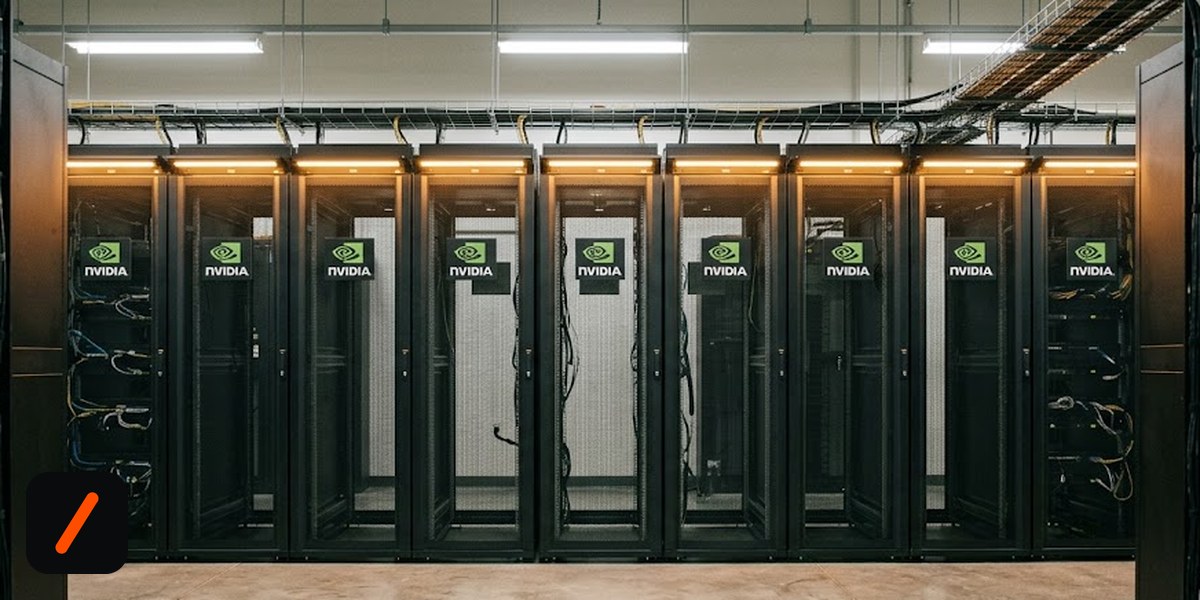
The company that built your iPhone now makes most of its money building AI servers. Foxconn's cloud and networking segment reached 51% of revenue in Q2 2026, up from 48% in Q1, crossing half of the business for the first time in the company's history. Smart consumer electronics, the division that assembles iPhones, came in at 29%.
That flip has been coming for about six quarters, and it finally landed alongside a set of numbers that are worth reading closely: consolidated revenue of NT$2.53 trillion, up 41% year on year, and operating profit of NT$94.8 billion, up 68%.
RelatedSamsung's phone arm posts its first ever operating loss
Why did operating profit grow faster than revenue?
Because AI racks are a better business than phone assembly, and this is the first quarter where the mix is heavy enough to show it in the margin line.
Revenue grew 41%. Operating profit grew 68%. Net profit attributable to owners grew 35%, to NT$60 billion, with earnings per share of NT$4.27 against NT$3.19 a year earlier. The gap between the 41% and the 68% is operating leverage: Foxconn is selling a more valuable box without a proportional increase in what it costs to run the factory.
Keep the absolute margins in view, though, because they are still contract-manufacturer margins. Gross margin came in at 6.12%, operating margin at 3.75%, net margin at 2.37%. Foxconn assembles what Nvidia designs. A rack full of Blackwell silicon is worth a great deal, and almost all of that value accrues to the company that made the silicon. Foxconn's improvement is real and it is measured in tens of basis points, not in a re-rating to software margins.
What it means for the market
Foxconn (2317.TW, also traded as HNHPF) has spent its entire public life valued as an Apple derivative. Analysts modeled iPhone units, applied an assembly margin, and moved on. That model now describes 29% of the company.
The signal for investors is a re-rating question rather than a growth question. Growth is not in doubt; management guided cloud and networking to high double-digit increases both sequentially and year on year in Q3, and expects full-year AI rack shipments to more than double. The open question is what multiple a business deserves when its largest segment is structurally tied to hyperscaler capex instead of a consumer refresh cycle. Those are different risk profiles. Consumer hardware is seasonal and predictable. AI capex is enormous, faster growing, and concentrated in a handful of buyers who could slow down together.
The read-through runs in several directions. Foxconn's rack volumes are one of the cleanest public proxies for whether Nvidia (NVDA) is actually shipping Blackwell-generation systems at the rate its own guidance implies, because Foxconn is Nvidia's largest server manufacturing partner and physically assembles the product. When Foxconn says rack shipments more than double, that is a supply-side confirmation of demand, reported by a company with no incentive to inflate Nvidia's story. Watch it as a check on the capex narrative, not as a stock call.
The other direction worth tracking is concentration risk. Half of Foxconn's revenue now depends on a small number of buyers spending at an unprecedented rate. Diversification away from Apple has, in practice, been diversification toward Nvidia and the hyperscalers. That is a better business today. It is not obviously a less concentrated one.
The ceiling nobody at Foxconn controls
Chairman Young Liu named the constraint on 2027 directly, and it is not anything Foxconn owns: CoWoS advanced packaging.
RelatedNvidia's $96.2B Quarter Meets Its First Real Challenger
CoWoS is the TSMC process that mounts GPU dies and high-bandwidth memory onto a single interposer. Every Blackwell-class accelerator needs it, and no amount of Foxconn assembly capacity changes how much of it exists. Foxconn can build racks as fast as its factories allow, and it will still ship exactly as many as TSMC's packaging lines permit.
This is the useful thing to take from an assembler's earnings call. Foxconn sits at the end of the chain and can see precisely where the queue stops moving. Liu pointing at CoWoS for 2027 is a supply forecast from someone with a clear view of the bottleneck, and it says the limiting factor on AI infrastructure next year is packaging throughput rather than demand.
- Q2 2025Consumer electronics still the anchor segment EPS NT$3.19
- Q1 2026Cloud and networking reaches 48% of revenue Approaching the crossover
- Q2 2026Cloud and networking hits 51%, consumer at 29% Revenue NT$2.53T, operating profit +68%, EPS NT$4.27
- Q3 2026Guided to high double-digit growth in cloud and networking Consumer also up sequentially on peak season
- 2027CoWoS packaging named as the ceiling on AI server output Constraint sits with TSMC, not Foxconn
- Whether 51% holds through peak season. Q3 and Q4 are iPhone quarters. If cloud and networking stays above half while consumer is at its seasonal maximum, the crossover is structural rather than a summer artifact.
- Operating margin, not revenue. Revenue growth is guided and largely known. Whether 3.75% keeps climbing is the question that decides if AI racks genuinely re-rate this company.
- CoWoS allocation news from TSMC. It now sets Foxconn's practical ceiling. Packaging capacity announcements are Foxconn guidance by proxy.
- Customer concentration disclosure. Half the business tied to hyperscaler capex is a different risk than half tied to one phone, and it deserves to be visible in the filings.
Our take
The headline is a milestone, and milestones are usually the least interesting part of an earnings release. The number we would keep is the 68% against the 41%.
Revenue mix tells you what a company sells. The spread between operating profit growth and revenue growth tells you whether the new thing is actually better than the old thing, and for Foxconn the answer this quarter is yes, by a clear margin. Assembling AI racks earns more per unit of factory effort than assembling phones does.
What it does not do is change what Foxconn is. This remains a business earning 2.37% net on enormous volume, with its 2027 ceiling set by a packaging process at another company. The AI boom made Foxconn's core competence considerably more valuable without making it a different competence.
- OfficialFoxconn Q2 2026 financial results revenue, operating profit, margins, EPS, Q3 outlook
- ReportingYoung Liu names CoWoS packaging as the 2027 AI server ceiling the constraint, stated by the chairman
- ReportingDigitimes: AI rack shipments to grow multiple-fold in 2026 shipment guidance and segment detail
- ReferenceGENZ TECH AI Coding Leaderboard what the models running on this hardware actually score
Original analysis by GenZTech, built from Foxconn's Q2 2026 results release and reporting on its earnings call.