
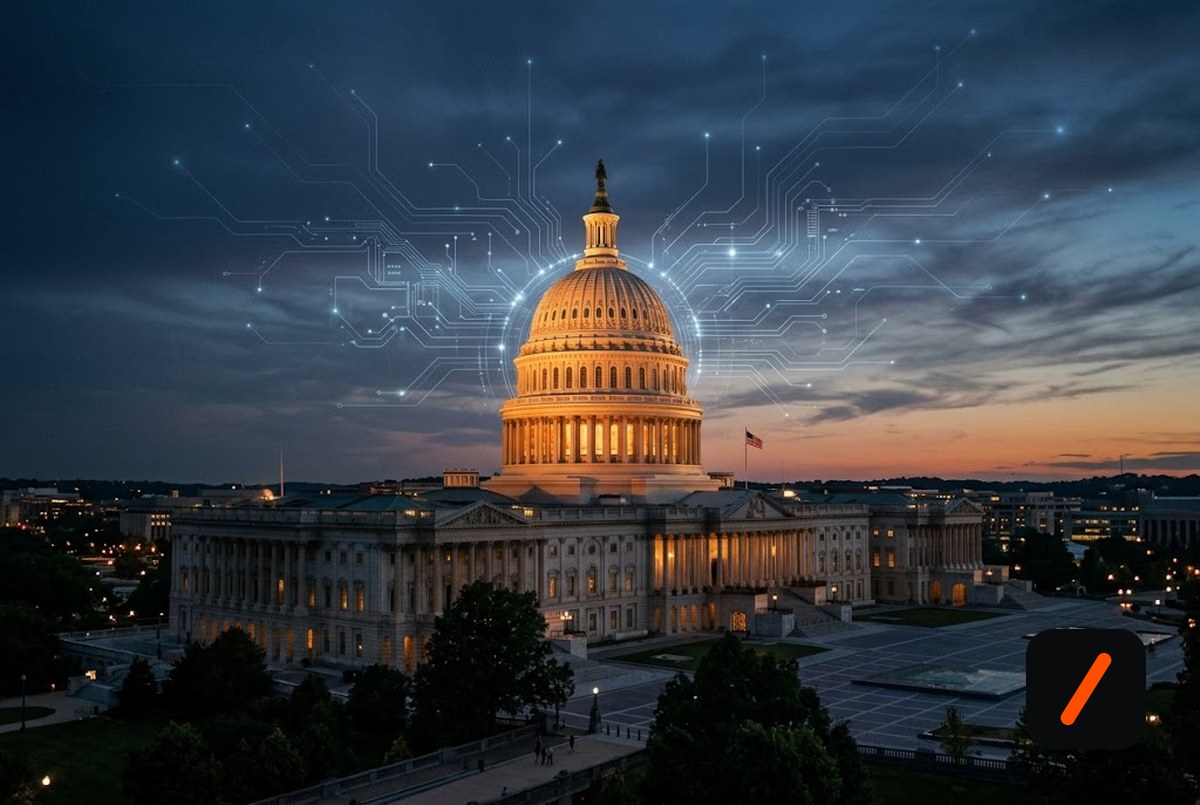
California just made the most aggressive government bet on frontier AI in the country, and it picked a vendor Washington is actively treating as a hazard. Governor Gavin Newsom signed a first-of-its-kind agreement giving every California state agency, plus cities and counties, access to Anthropic's Claude at a 50% discount, days after the federal government designated Anthropic a "supply-chain risk." The result is the clearest sign yet that US AI policy is splitting in two: states racing to deploy the same models the feds are moving to fence off.
- The deal covers all California state agencies, plus cities and counties, giving public-sector staff discounted access to Claude rather than a single pilot department.
- The 50% discount is the hook: it lowers the cost barrier that usually keeps government off frontier models and makes California the largest public-sector Claude footprint in the US.
- It lands while the federal government has labeled Anthropic a "supply-chain risk," the same month Washington briefly gated Anthropic's newest models under export controls.
- The subtext is a widening state-versus-federal split on who gets to use frontier AI, and under what conditions.
What did California actually sign?
The agreement makes Claude available to the entire California state government at a 50% discount, and extends that pricing to cities and counties that want in. This is not a single-agency proof of concept of the kind most governments run for a year before deciding anything. It is a statewide procurement vehicle: any qualifying public body can buy discounted access without negotiating its own contract from scratch. For the largest state economy in the US, that turns "should we try AI" into "which team uses it first," and it hands Anthropic the biggest public-sector deployment surface of any frontier lab. The discount matters more than it sounds, because the thing that usually keeps government off frontier models is not curiosity, it is per-seat and per-token cost against fixed public budgets. Halve that, and the math flips for a lot of departments.
RelatedJudge Strikes Down Pentagon's Anthropic Blacklist as Illegal
Why is the federal government pulling the other way?
At almost the same moment, Washington moved in the opposite direction. The federal government designated Anthropic a "supply-chain risk," a label that constrains how federal bodies can procure or rely on the company, and it did so in the same window that it briefly applied export controls to Anthropic's newest models. The tension is not really about whether Claude is a good model. It is about control: a frontier lab is simultaneously critical infrastructure and a national-security variable, and the federal posture treats concentration around any single AI vendor as something to manage, not encourage. California's calculus is the mirror image. A state government is measured on services delivered, not on strategic autonomy, so cheaper capable AI reads as an obvious win rather than a dependency to worry about.
How did Anthropic get here in one month?
The California deal did not happen in a vacuum. It caps a chaotic month for Anthropic and Washington that shows exactly how tangled frontier AI and government have become.
- Jun 12Export controls hit Anthropic's newest models. Washington restricts foreign-national access to Fable 5 and Mythos 5; Anthropic suspends both for everyone because nationality cannot be verified in real time.
- Jun 30Claude Sonnet 5 ships. Anthropic's most agentic Sonnet yet, with introductory pricing and a 1M-token context, becomes the default on Free and Pro.
- Jun 30Export controls lifted. The restriction is removed; Fable 5 returns globally on July 1.
- Early JulFederal "supply-chain risk" designation. Washington formally flags Anthropic as a procurement risk for federal use.
- Early JulCalifornia signs the statewide Claude deal. All state agencies, cities and counties get Claude at 50% off, contradicting the federal posture head-on.
What does this mean for the state-versus-federal AI split?
This is the story that outlives the news cycle. The US does not have one AI policy, it has at least two, and they are diverging fast. States are becoming the real deployment ground for frontier models, because they run the schools, DMVs, benefits systems and courts where AI can cut backlogs today, and because their incentives reward visible service improvements. The federal government, holding the national-security brief, is increasingly in the business of gating, vetting and restricting the same technology. California is not a minor player choosing a side. It is the fifth-largest economy on the planet setting a template every other state procurement office will study, and its bet is that broad, cheap access to a frontier model is worth more than the caution Washington is signaling.
RelatedAnthropic Ships Claude Opus 5 at Half of Fable 5’s Price
- Do other states copy the template? A statewide, discounted frontier-AI contract is a reusable model. Watch New York, Texas and Illinois procurement offices.
- Does the federal designation bite? "Supply-chain risk" is only as strong as the procurement rules behind it. The test is whether it actually blocks federal Claude usage.
- Vendor concentration backlash. Handing one lab an entire state government invites the same concentration worry Washington is citing. Expect calls for multi-vendor mandates.
- Real usage, not seats. Discounted access is easy to announce. The metric that matters is whether agencies ship anything with it.
Our take
California's deal is smart government and a genuine turning point, and it is also a preview of a fight the US has not had yet. Getting a frontier model into every agency at half price is exactly the kind of move that separates governments that will use AI to fix broken services from governments that will still be running pilots in 2030. The discount is the clever part, because cost, not capability, is what actually keeps public bodies off these tools. But the split with Washington is not noise to wave away. When one arm of the state treats a vendor as essential infrastructure and another treats it as a supply-chain risk, both cannot be fully right, and the contradiction will force a reckoning about whether concentrating public AI on a single lab is prudent or reckless. California has decided the upside is worth it. That is a defensible call, and it is also a bet the rest of the country is about to grade in public.
- OfficialAnthropic Newsroom company announcements on Claude and public-sector access
- GovernmentOffice of the Governor of California state procurement and technology announcements
- ReferenceClaude model family Sonnet 5, Fable 5 capabilities and pricing
- ContextGenZTech AI Coding Leaderboard where Claude stands against rivals on verified benchmarks
Original analysis by GenZTech. Based on public reporting of California's Anthropic agreement, current as of July 2026. Read more at Anthropic's newsroom.