
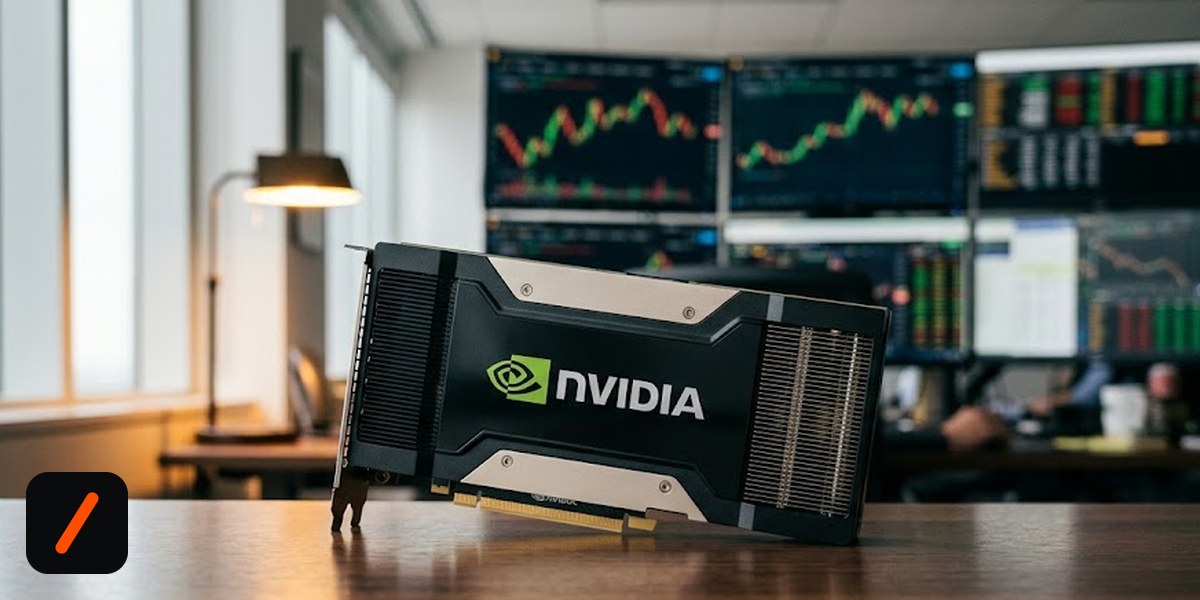
On August 10, Nvidia announced memorandums of understanding with six of the largest capital allocators on earth, Apollo, BlackRock, Blackstone, Brookfield, Goldman Sachs and KKR, to create independent compute-financing platforms aimed at mobilizing more than $500 billion of third-party capital. The money funds data centers, power and systems built on Nvidia hardware. It does not come from Nvidia, and it does not sit on Nvidia's balance sheet.
Jensen Huang told CNBC he approached exactly those six firms and none said no. That detail says more about the current market than the headline number does.
RelatedAI Datacenter Debt Isn't Subprime. It's Something Quieter.
What was actually signed?
An MOU is not a wire transfer, and the distinction matters more here than usual. The $500 billion figure describes capital the partnerships intend to mobilize over time, not a pool sitting in an account waiting to be drawn. Nvidia's own release frames it as establishing "dedicated pools of capital at significant scale" through platforms that are independent of Nvidia itself.
What is genuinely new is the structure. Nvidia is not lending money, not guaranteeing debt, and not taking equity in the platforms as described. It is doing something subtler: making the case to institutional investors that GPUs belong in the same mental category as toll roads and fiber. Huang's argument, in his words, is that Nvidia compute "is broadly adopted, flexible across models and workloads, fungible and transferable." Strip the marketing and that is an underwriting pitch. Fungible and transferable is what a lender needs to hear before accepting an asset as collateral.
Apollo president Jim Zelter said the quiet part directly, calling modern compute "a scarce, mission-critical asset class with compelling investment characteristics." Asset class is the operative phrase. That is the reclassification Nvidia is trying to make stick.
Why does Nvidia need this at all?
Nvidia has no shortage of cash. What it has is a customer-financing problem. The firms that want to buy GPUs at scale are increasingly not hyperscalers with $80 billion capex budgets. They are neoclouds, frontier labs and enterprises whose ambitions exceed their balance sheets. If those buyers cannot raise money, Nvidia's order book stops growing regardless of how good the silicon is.
Vendor financing is the classic answer, and it is also the one that gets companies in trouble. Lucent and Nortel both propped up demand by lending customers the money to buy their own equipment, and both discovered what happens when the loans and the revenue are the same dollars traveling in a circle. Nvidia has already drawn scrutiny for equity stakes in companies that buy its chips. This structure is a deliberate step away from that criticism: outside investors take the credit risk, and Nvidia books an ordinary hardware sale.
Whether that fully answers the circularity objection is a fair question. Nvidia is still the party convening the capital, defining the asset, and benefiting from the demand it creates. The risk transfer is real. The demand stimulation is also real.
How this compares to how AI infrastructure has been funded so far
| Model | Who takes the risk | Ceiling | Nvidia platform MOUs |
|---|---|---|---|
| Hyperscaler capex | Microsoft, Google, Amazon, Meta | Bounded by their own cash flow | Unbounded by any one balance sheet |
| Vendor financing | The vendor itself | Bounded, and accounting-risky | Risk sits with third-party investors |
| Neocloud venture debt | VCs and specialty lenders | Expensive, small scale | Institutional cost of capital |
| Project finance | Infrastructure funds | Needs an accepted asset class | Exactly what this creates |
Read down the right column and the strategy is clear. Nvidia is trying to move GPU buildouts out of the venture-risk bucket and into the infrastructure bucket, where the money is cheaper, more patient, and vastly deeper. Brookfield and Apollo do not write venture checks. They finance pipelines and grids over decades.
What it means for the market
The direct read for NVDA is that this is demand insurance rather than a revenue event. Nothing here adds to guidance next quarter. What it does is reduce the odds of the bear case where customers simply run out of funding capacity, which has been the most credible threat to the growth story. Watch for whether any platform actually closes a first vehicle with committed capital, because MOU-to-close is where these things live or die.
RelatedNvidia's $750B AI Deals Just Spooked Its Own Bondholders
For the six firms, APO, BLK, BX, BN, GS and KKR, the signal is fee-earning AUM in a category they have been trying to enter. Blackstone and Brookfield already own data center platforms; this formalizes GPUs as financeable rather than just the buildings around them.
The factor worth watching most closely is residual value. Infrastructure lenders underwrite against what an asset is worth if the borrower fails. A gas turbine holds value for thirty years. Nobody knows what an H-series GPU is worth in year six, and Nvidia's own upgrade cadence is the thing that makes that uncertain. If depreciation schedules on these platforms come in aggressive, the cost of capital rises and the $500 billion target stretches out. That is analysis, not investment advice, and the honest answer is that the residual-value question has not been tested through a downturn.
- First close, not first headline. An MOU converting into a funded vehicle with named LPs is the milestone that proves the thesis. Watch for one by mid-2027.
- Depreciation assumptions. The useful-life number these platforms publish will tell you more about GPU economics than any vendor slide.
- Who leases the compute. If the tenants are the same handful of frontier labs, concentration risk simply moved rather than diversified.
- Regulatory attention. A vendor convening $500 billion of financing for its own product category is the kind of arrangement antitrust reviewers eventually read closely.
Our take
This is the most consequential thing Nvidia has done this year, and it is not a chip. Selling GPUs is a business. Getting Apollo and Brookfield to treat GPUs as an infrastructure asset class is a market structure change, and market structure outlasts product cycles.
The risk is not that the plan fails loudly. It is that it works well enough to pull forward several years of buildout against residual-value assumptions nobody has stress-tested. Fiber in 1999 was also broadly adopted, fungible and transferable. It was still worth cents on the dollar when the demand curve bent. Compute is a better asset than dark fiber in most respects, particularly because it is scarce right now rather than overbuilt. The comparison is worth holding onto anyway, because the mechanism that hurt investors then was not bad technology. It was good technology financed on optimistic depreciation.
- OfficialNVIDIA Newsroom, August 10, 2026 The announcement, partner list and executive quotes
- OfficialNVIDIA Investor Relations release Filing-grade version of the same announcement
- ReportingAxios, Nvidia and Wall Street partner on $500B AI financing Independent read on the structure
- TrackerGenZTech funding tracker Our running record of AI capital formation
- BenchmarkBiggest AI funding rounds, ranked Scale context for the $500B target
Original analysis by GenZTech, based on NVIDIA's August 10, 2026 press release and independent reporting on the financing structure. Source: Axios.