
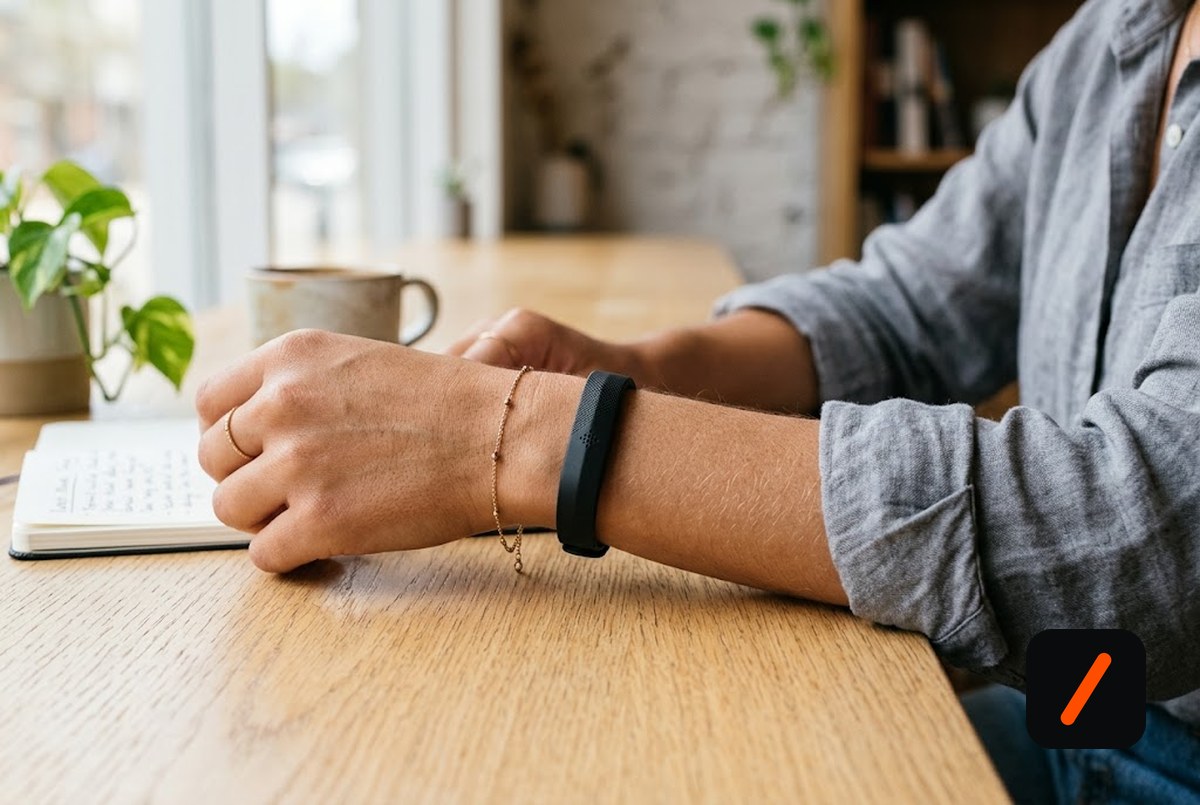
Fitbit Air is Google's screenless health tracker, and its sharpest feature is what it does not have: a subscription. Built in the mold of Whoop, the Air drops the display entirely and focuses on continuous health sensing, heart rate, an infrared SpO2 sensor, skin temperature, and an accelerometer and gyroscope, streaming it all to Google's new Health app. Google claims about a week of battery per charge and supports haptic alarms, and crucially it works without the recurring fee that defines its closest rival.
- Screenless by design: the Air is a pure sensor band, not a smartwatch, sending data to Google's Health app.
- Sensors cover heart rate, infrared SpO2, skin temperature, and motion, with haptic feedback for alarms.
- About a week of battery per charge, a direct answer to the always-charging pain of full smartwatches.
- The headline difference from Whoop: no subscription. You buy the band and you are done.
What is the Fitbit Air, and who is it for?
It is a wearable stripped down to sensing. There is no display, no notifications, no apps; the band sits on your wrist, records health metrics around the clock, and sends them to Google's Health app on your phone. The sensor set is serious for the form factor: continuous heart rate, an infrared SpO2 reader for blood-oxygen, skin temperature, and an accelerometer and gyroscope for movement and sleep. Haptics handle silent alarms. This is a device for people who want the data, athletes tracking recovery, anyone monitoring sleep and readiness, without wanting another glowing screen or the ritual of nightly charging.
RelatedThe Fitbit Air Drops the Screen, and That Is the Whole Point
Why does dropping the subscription matter so much?
Because it targets Whoop's business model directly. Whoop popularized the screenless recovery band, but it locks the experience behind a mandatory membership, so you never really stop paying. Fitbit Air's pitch is the opposite: buy the hardware, own it, no recurring fee to see your own data. That is a meaningful competitive wedge, because subscription fatigue is real and a one-time purchase is an easy story to tell. It also plays to Google's strengths. Google can afford to sell hardware and monetize through its broader ecosystem rather than nickel-and-diming health data, which is exactly the kind of pressure a subscription-first incumbent cannot easily match.
| Trait | Fitbit Air | Whoop-style band | Smartwatch |
|---|---|---|---|
| Screen | None | None | Yes |
| Subscription | No | Required | Usually no |
| Battery | ~1 week | Days | 1-2 days |
| Focus | Health sensing | Recovery sensing | Everything |
How does it fit the wider gadget trend?
It rides the biggest theme in wearables this year: devices that fade into the background. The industry is shifting toward discreet, screenless hardware, pendants, pins, bands, where AI and battery efficiency are the selling points rather than a bright display and a wall of notifications. The Fitbit Air is Google's clean expression of that idea for health. It also strengthens Google's health platform: every Air feeds the new Health app, deepening the data and the lock-in around Google's services rather than a standalone gadget. The trade-off is that a screenless band leans entirely on the phone app being good, so the software is now the product as much as the sensors.
The form factor also quietly changes who a tracker is for. A smartwatch is a public object, a screen you glance at and others see; a screenless band disappears under a sleeve and asks nothing of your attention during the day. For people who found smartwatches too demanding, buzzing, lighting up, begging to be checked, the Air is a deliberately calmer device. It gathers data in the background and hands it back on your terms, in an app, at a moment you choose. That restraint is a feature, and it is a big part of why the screenless category exists at all.
RelatedGarmin's Screen-Free CIRQA Takes Aim at Whoop
- Sensor accuracy. The spec sheet is strong; independent tests of heart-rate and SpO2 accuracy will decide if it is a serious health tool or a toy.
- The Health app. With no screen, the app is everything. Its insights and reliability make or break the experience.
- Whoop's response. A credible no-subscription rival pressures Whoop's core model. Watch for a pricing or hardware answer.
Our take
The Fitbit Air is a smart, focused product, and the no-subscription stance is the part that actually matters. Screenless recovery bands are a proven category, but the mandatory membership has always been the sticking point, and Google removing it is the kind of move only a company with other ways to make money can make. The sensor loadout is genuinely capable, the week-long battery answers a real annoyance, and feeding a unified Health app is a sensible way to turn one small device into a bigger platform play. The risks are the familiar ones for anything screenless: accuracy has to be real, and the app has to carry the whole experience. If Google nails both, the Air is not just a Whoop alternative, it is a pointed argument that you should not have to rent access to your own health data.
- OfficialGoogle Store · wearables Fitbit hardware lineup
- ProductFitbit trackers device and sensor details
Original analysis by GenZTech. Figures current as of July 2026. Source: BGR.